Program Overview
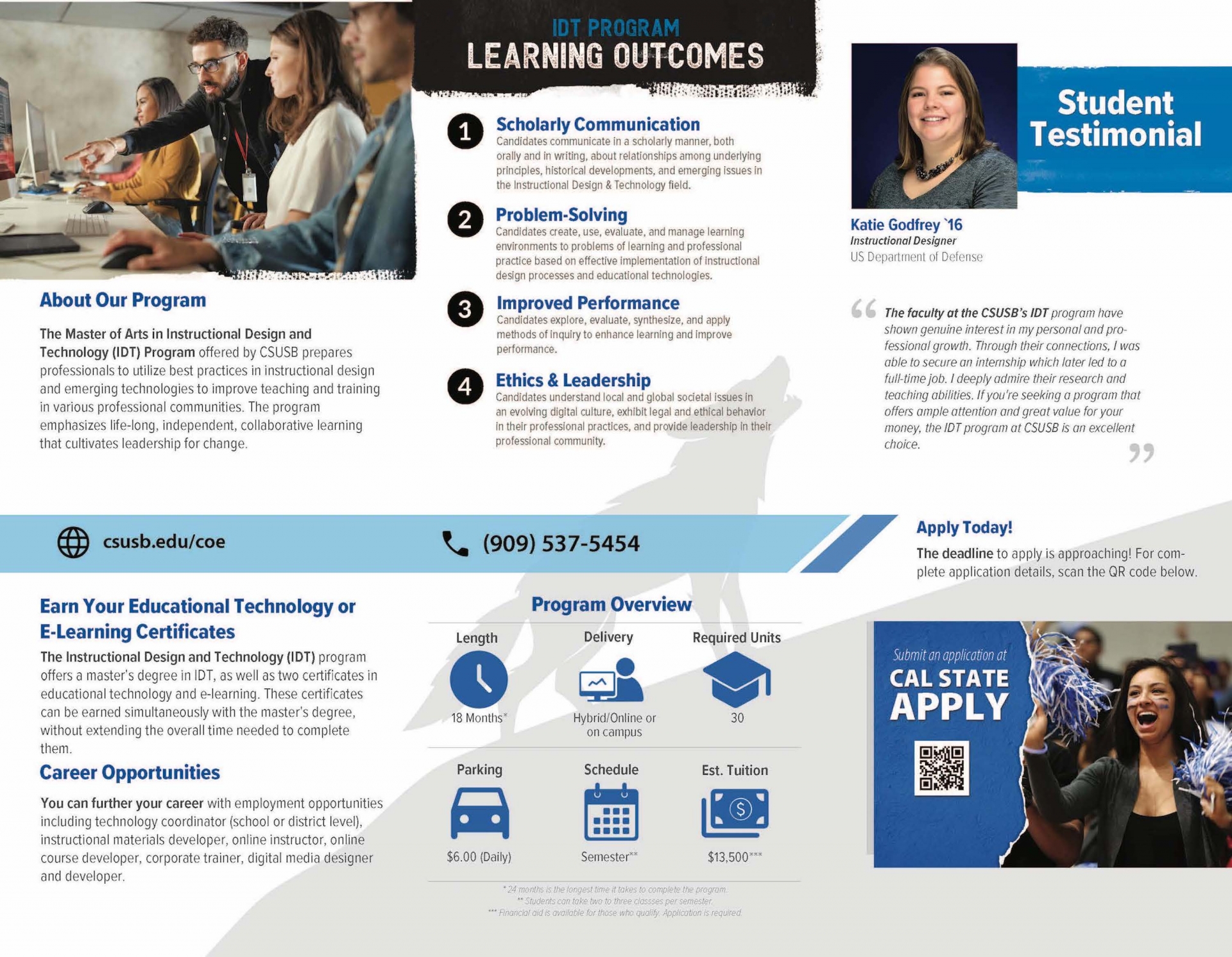
The Master of Arts in Instructional Design and Technology program at CSUSB prepares students to be instructional designers, improve use of instructional technology and support the use of technology.
Instructional Design and Technology (IDT) is the field of designing learning and training so people can learn more effectively—at school, online, or at work. It combines how people learn with practical tools (e.g., online platforms, multimedia, and emerging technologies) to create clear, engaging, and useful learning experiences.
Students do not have to have extensive technology experience prior to entering the ETEC program, however successful students bring with them to the program a love of learning technology and an ability to explore new technologies independently as well as in the classroom and/or corporate settings.
Careers in Instructional Design and Technology
Instructional Design and Technology (IDT) is sometimes mistaken as a new, “tech-only” career path. In reality, the field has a long history rooted in helping people learn effectively—first in large-scale training efforts and later through education, corporate learning, healthcare training, and online learning environments. As teaching, work, and professional development continue to evolve, the demand for well-designed learning experiences has grown across many sectors.
Just as importantly, IDT is a field that welcomes professionals from a wide range of backgrounds. Many instructional designers and learning technologists enter the profession after building experience in areas such as teaching, training, communications, multimedia, administration, or subject-matter roles. In today’s EdTech world, many instructional designers are in their early 40s, and a significant number enter the field as a second career—making IDT especially attractive for working adults and career changers who want to apply their expertise to new contexts.
What instructional designers and learning technologists do
Professionals in IDT help organizations solve learning and performance challenges by designing instruction that is clear, engaging, accessible, and outcomes-focused. Depending on the role, this work may include:
- Analyzing training needs and defining measurable learning outcomes
- Designing course structures, assessments, and learning activities
- Developing e-learning modules, multimedia lessons, and job aids
- Supporting faculty or trainers in course design and improvement
- Evaluating learning effectiveness and making data-informed revisions
- Integrating emerging tools responsibly (including AI, AR/VR, and learning analytics)
Because the field combines learning theory with practical design and technology skills, it offers both career flexibility and the ability to move across industries without starting over.
Where IDT professionals work
One of the strongest advantages of IDT is the range of settings where your skills apply. Graduates commonly work in:
Educational institutions
Instructional designers in K–12, community colleges, and universities support curriculum design, online and hybrid course development, student engagement, accessibility, and faculty development. They may work within academic units, centers for teaching and learning, or distance education teams.
Healthcare and public health
Hospitals and healthcare systems rely on training for compliance, patient safety, onboarding, clinical procedures, and continuing education. IDT professionals help create efficient, accurate, and scalable learning solutions for diverse staff roles.
Corporate learning and talent development
Many organizations employ instructional designers to support employee onboarding, leadership development, operational training, compliance training, and performance support. Roles may sit within HR, Learning & Development, or specialized training departments.
Government, military, and public agencies
Public-sector organizations often require consistent training across large, distributed workforces. Instructional designers contribute to workforce development, policy training, safety training, and certification programs.
eLearning and EdTech organizations
E-learning providers, publishers, and educational technology companies hire IDT professionals to design courses, build digital learning experiences, develop content, and collaborate with product teams.
Emerging areas, including AI-enabled learning
As AI tools expand across education and industry, organizations increasingly need professionals who understand learning design, ethical considerations, and how to integrate new tools responsibly. IDT professionals may contribute to AI-supported training workflows, faculty support resources, evaluation, and implementation planning.
Independent consulting and freelance work
Some instructional designers build independent practices, supporting schools, nonprofits, and businesses with course design, curriculum development, training systems, and content production.
Why IDT offers strong career flexibility
IDT skills transfer well because the core work—analyzing learning needs, designing solutions, and evaluating impact—remains consistent even when the subject matter changes. For example, a professional might begin in a university supporting online courses and later transition into corporate training, healthcare education, or a government agency role while continuing to use the same design competencies.
Preparing for these careers through the ETEC Program
The ETEC program is designed to help working professionals build both foundational knowledge and practical skills needed to contribute immediately in real-world settings. Students typically develop competencies in areas such as:
- Instructional design models and learning theory applied to practice
- Online and hybrid course design and facilitation strategies
- Learning technologies and content development approaches
- Assessment, evaluation, and improvement cycles
- Professional communication and project-based design work
- Ethical and responsible technology use in learning environments
Students do not have to have extensive technology experience prior to entering the ETEC program. However, successful students bring a genuine interest in learning technologies and the willingness to explore new tools independently, as well as through applied work in classroom and/or corporate settings.
Next steps
If you are exploring a career in instructional design, learning technology, or training and development, attending a program information session is a practical first step. It gives you a chance to learn about curriculum, formats, admissions requirements, and common career pathways for graduates.
Interested in learning more?
- Review program details and course descriptions on our program website.
- Attend an upcoming information session.
- Reach out with questions about your goals and the best pathway (master’s degree, certificate options, or professional upskilling). Contact: Dr. Eun-Ok Baek at ebaek@csusb.edu, 909-537-5454