Areas of Research
Our department's research spans experimental and observational physics and astronomy, from laboratory optics to planetary atmospheres to the earliest galaxies in the universe.
Quantum Optics
Research in this area uses precision optical and photonic techniques to explore new sensing, computing, and information technologies, spanning nanotechnology, semiconductors, spectroscopy, and quantum information science. Recent work has produced highly sensitive quantum field sensors built with nitrogen-vacancy centers in diamond, research recognized by a FedTech entrepreneurial incubator, in collaboration with the Naval Surface Warfare Center Corona Division. This work is supported by funding from the National Science Foundation (NSF) and the Department of Defense (DoD). Faculty working in this area: Dr. Martin Kim, Dr. Jonathan Daniel.
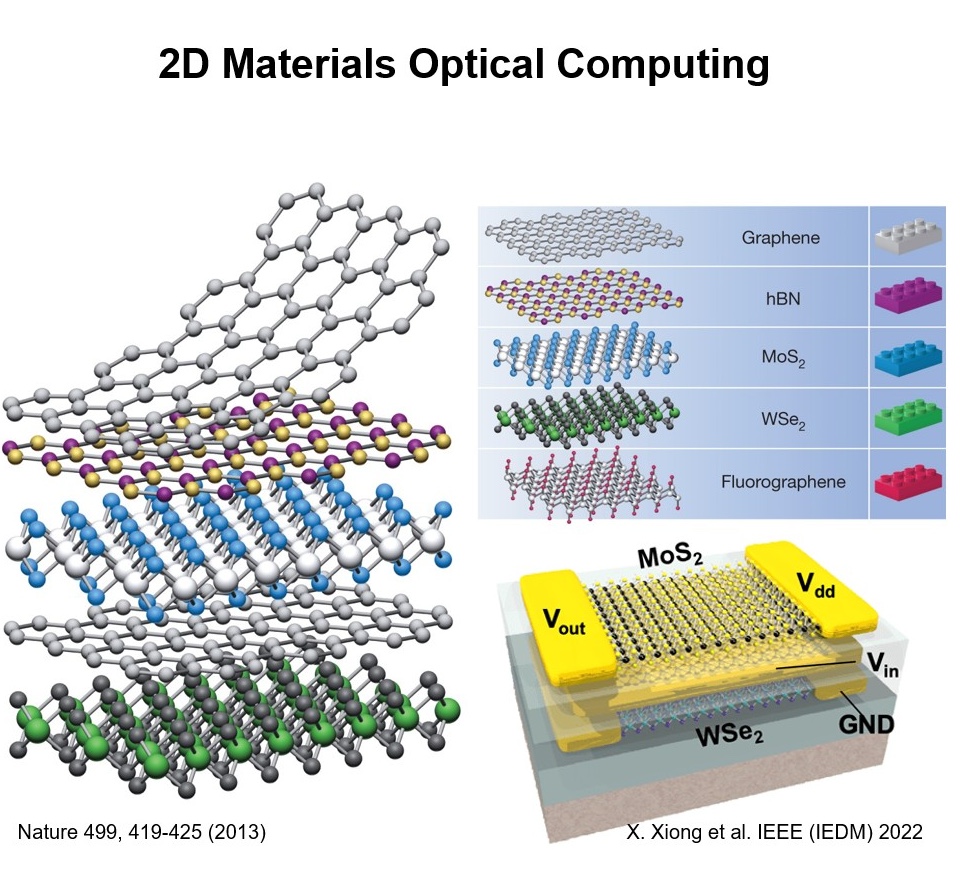
Caption: A schematic of 2D materials optical computing research, exploring how semiconductor heterostructures and topological insulators could enable next-generation photonic information processing.
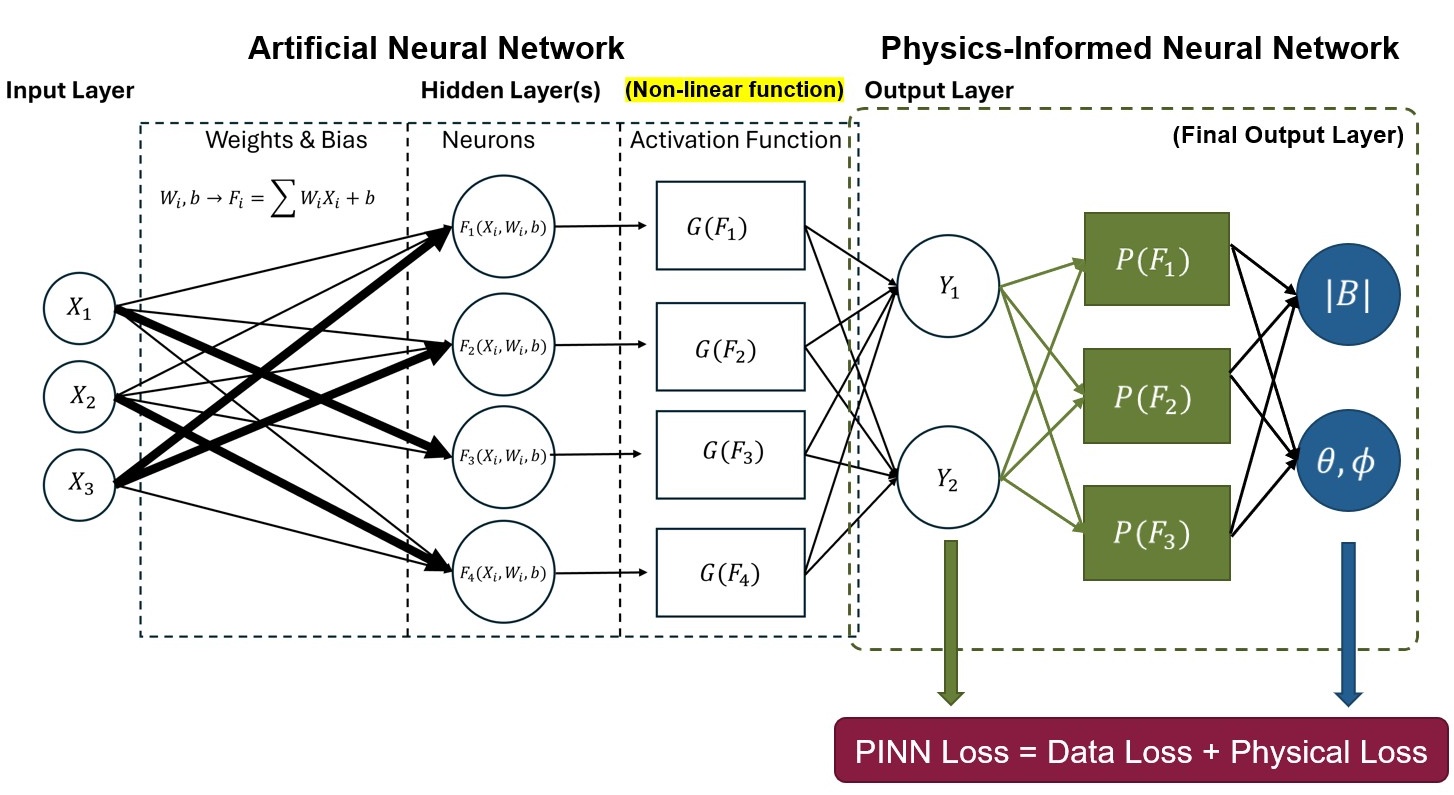
Caption: A Physics-Informed Neural Network (PINN) architecture diagram, showing how machine learning models can incorporate physical laws directly into training to solve problems like quantum sensing and nonlinear optics.
Applied Machine Learning
Research in this area applies modern computational techniques, including neural networks, to problems in quantum sensing and nonlinear optics. Recent work trains neural network models to infer magnetic and electric fields directly from optically detected magnetic resonance (ODMR) spectra collected from nitrogen-vacancy diamond sensors, combining real experimental data with physics-based simulations to improve accuracy and reduce the need for manual calibration. Faculty working in this area: Dr. Martin Kim, Dr. Jonathan Daniel.
Small Icy Solar System Objects
Research in this area studies comets and other small icy bodies throughout the solar system, using ground-based optical observations to track their composition and activity. Because these bodies have changed relatively little since the solar system's earliest days, they act as time capsules, preserving clues about the conditions present when the planets first formed. Current work focuses on Centaurs, small icy objects orbiting between Jupiter and Neptune that surprisingly outburst gas and dust despite being far too cold for water ice to sublimate. Faculty working in this area: Dr. Laura Woodney.
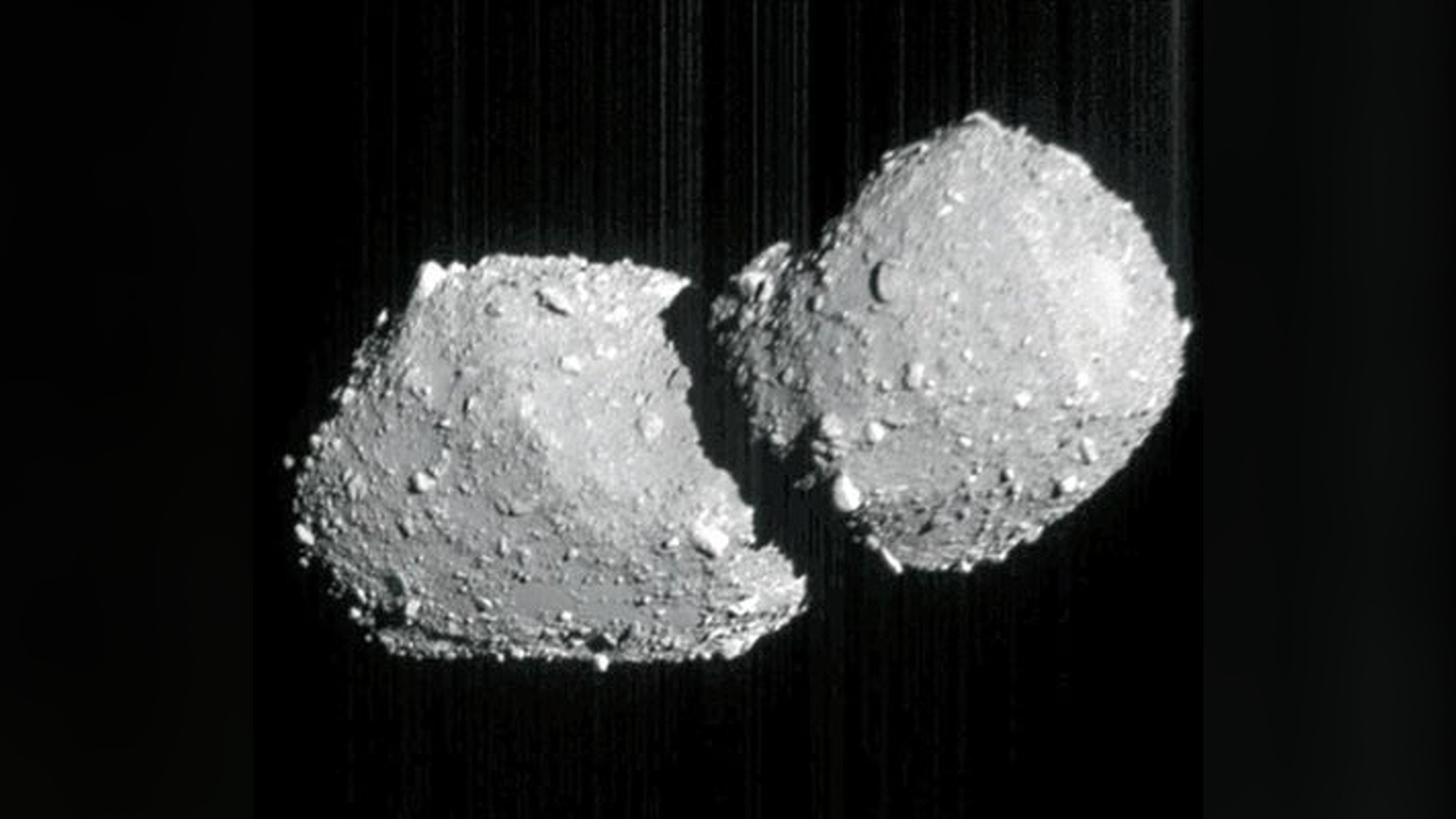
Caption: The Asteroid Torifune, as seen by the Hayabusa2 probe's Optical navigation camera (telephoto) during a close flyby on July 5, 2026. Courtesy Japan Aerospace Exploration Agency (JAXA)
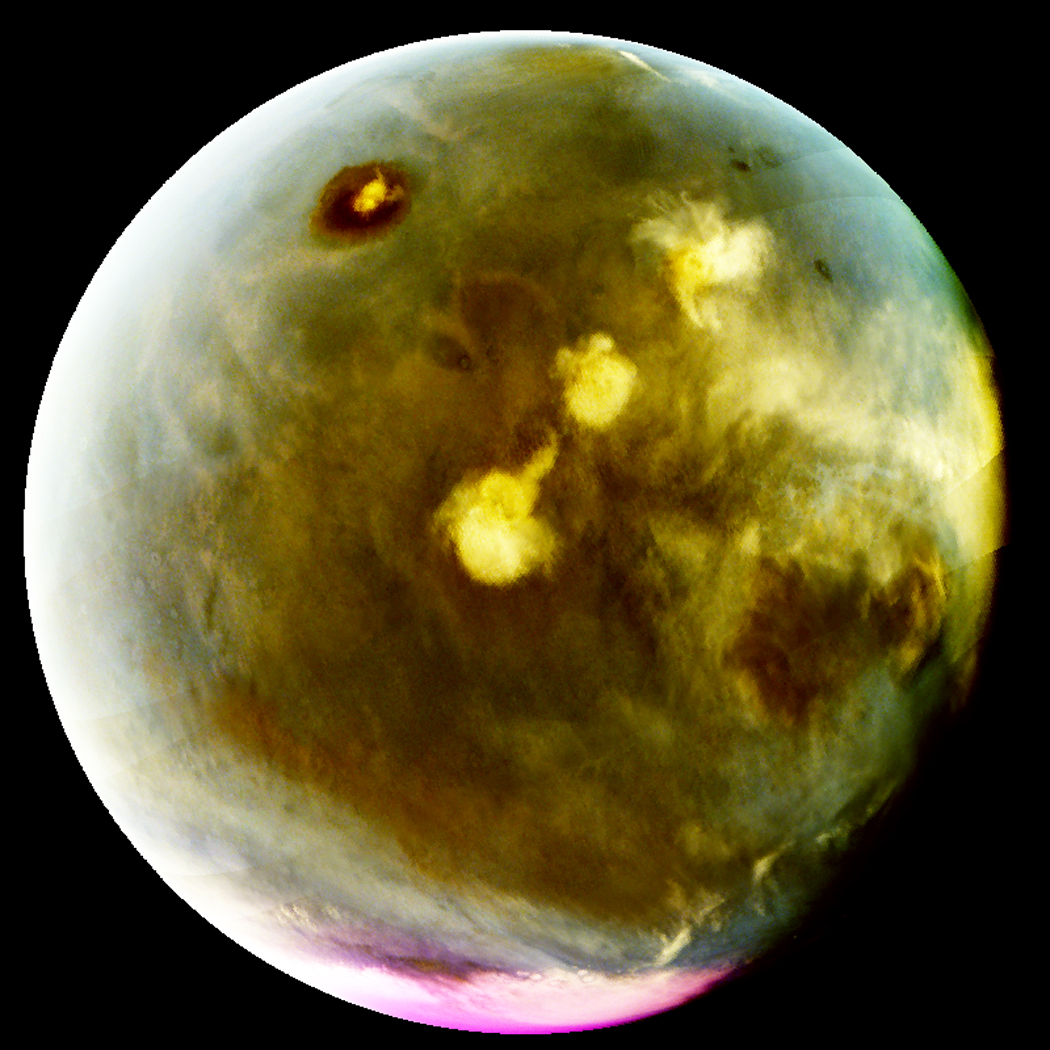
Caption: Ultraviolet images from MAVEN's Imaging UltraViolet Spectrograph capture rapid cloud formation over Mars's volcanoes on July 9-10, 2016, with afternoon clouds building over peaks like Olympus Mons in a process similar to mountain cloud formation on Earth. Courtesy NASA/MAVEN/University of Colorado-LASP.
Mars Atmosphere
Research in this area investigates the Martian atmosphere, including cloud formation and meteor ablation, drawing on data from NASA missions and international collaborations with the European Space Agency (ESA) and the Japan Aerospace Exploration Agency (JAXA), including the Martian Moons eXplorer mission returning samples from Phobos. Understanding how Mars's atmosphere behaves today, and how it has changed over billions of years, is a key piece of the puzzle in figuring out whether the planet could once have supported liquid water and life. This work is closely tied to the department's own Murillo Family Observatory, which gives students hands-on observing experience and a direct role in planetary science research. Faculty working in this area: Dr. Matteo Crismani.
Near-Field Cosmology
Research in this area uses ultra-faint dwarf galaxies and RR Lyrae variable stars as tracers of the early universe, combining optical telescope observations with cosmological simulations. These faint, ancient galaxies are among the least disturbed relics of the early universe, offering a uniquely clean window into how the first galaxies formed and how dark matter shaped their growth. Current work includes a large-scale RR Lyrae research program built on SDSS-V and Gaia survey data, along with photometric monitoring conducted at CSUSB's own Murillo Family Observatory. Faculty working in this area: Dr. Katy Rodriguez Wimberly.
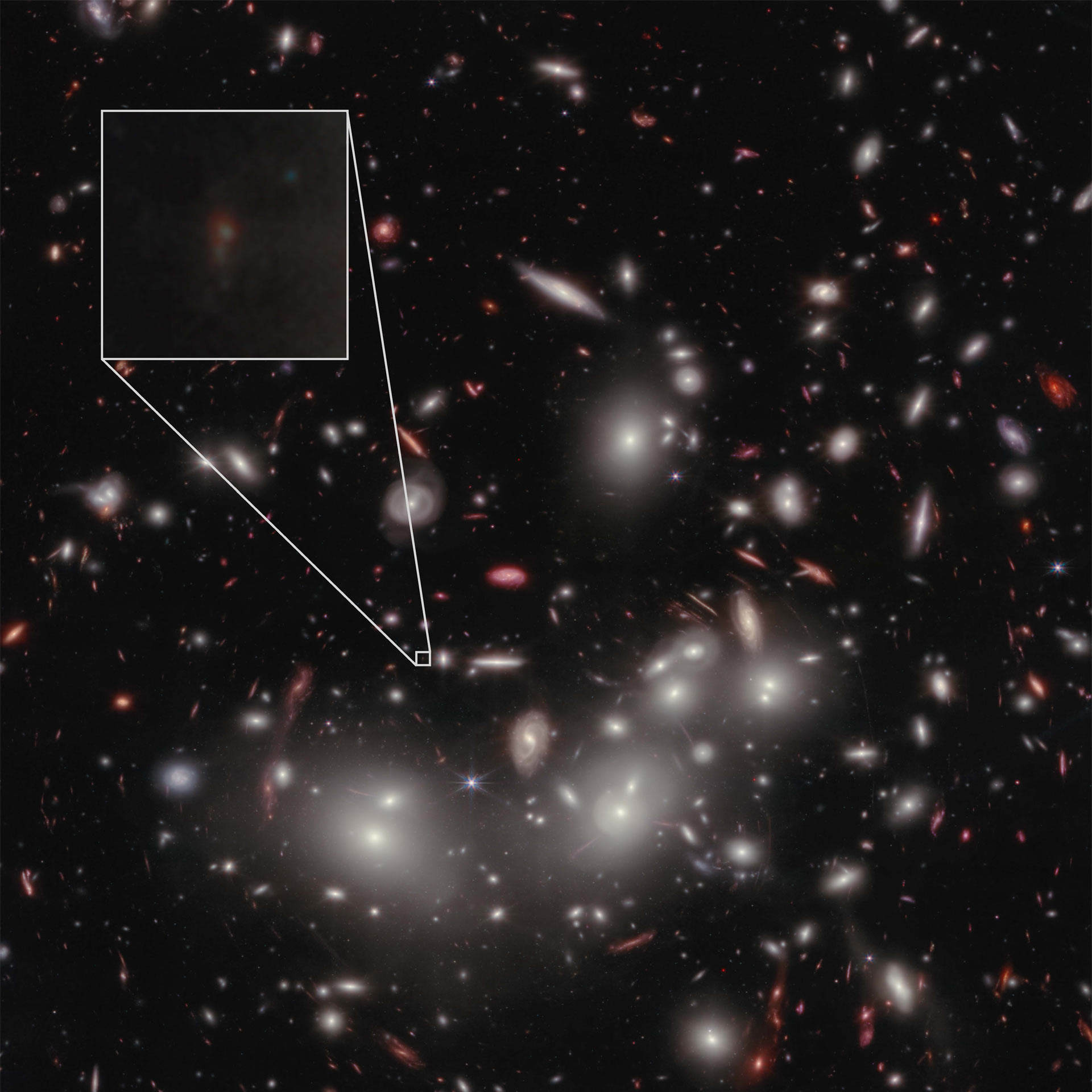
Caption: A projected image of the galaxy JD1 (inset), which is located behind the galaxy cluster Abell 2744. Courtesy Guido Roberts-Borsani, UCLA / NASA / ESA / CSA / Swinburne University of Technology / University of Pittsburgh / STScI.
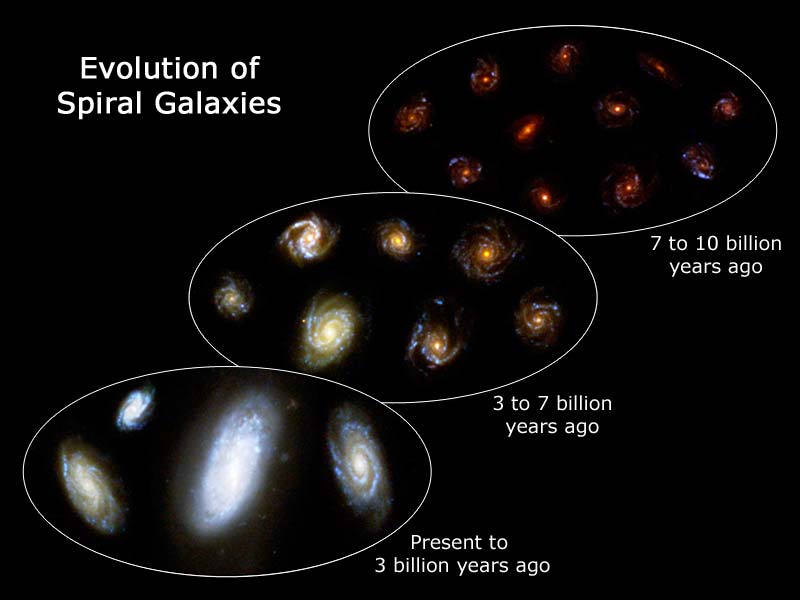
Caption: This image shows the evolution of spiral galaxies, from fully formed structures to disheveled collections of stars just beginning to form. Courtesy NASA
Galactic Evolution
Related work in this area traces the formation and assembly of the earliest galaxies, including the Milky Way itself, helping researchers understand how galaxies grow over billions of years and piece together the history of our own galactic home. This work connects to national leadership roles with the Astronomical Society of the Pacific and the Cal-Bridge Program, and to peer mentorship programs established at UC Irvine, UC Riverside, and within Cal-Bridge. Faculty working in this area: Dr. Katy Rodriguez Wimberly.
Want to get involved in research yourself? See our Faculty Researchers page to learn more about each faculty member's work, or reach out to our Administrative Support Coordinator, Maureen Murphy (mmurphy@csusb.edu).