Internships
Research experience, whether on campus or off, is one of the best ways to prepare for life after your physics degree. Here's how to find it.
Finding a Research Position at CSUSB
Most of our majors do research with a faculty member before graduating. Our approach is that if you want to do research, we'll find an opportunity that fits. The simplest way in is to just ask: talk to a faculty member whose work interests you, or bring it up at your required semester advising appointment (see Resources & Advising), where research and internship opportunities are a standing topic of discussion. Paid research positions are also posted periodically on our Job Postings page as they become available.
External Summer Research Programs (REUs and Beyond)
The NSF Research Experiences for Undergraduates (REU) program funds paid summer research placements at host institutions across the country. Individual REU sites run their own applications, not a single central one, so search current opportunities directly through the NSF REU program page. Our department also participates in the Cal-Bridge Program, which provides mentorship and financial support, including paid summer research, for students from underrepresented backgrounds pursuing physics and astronomy PhDs.
Student Research Highlights
A running showcase of research projects our students have completed with faculty mentors. New entries are added periodically.
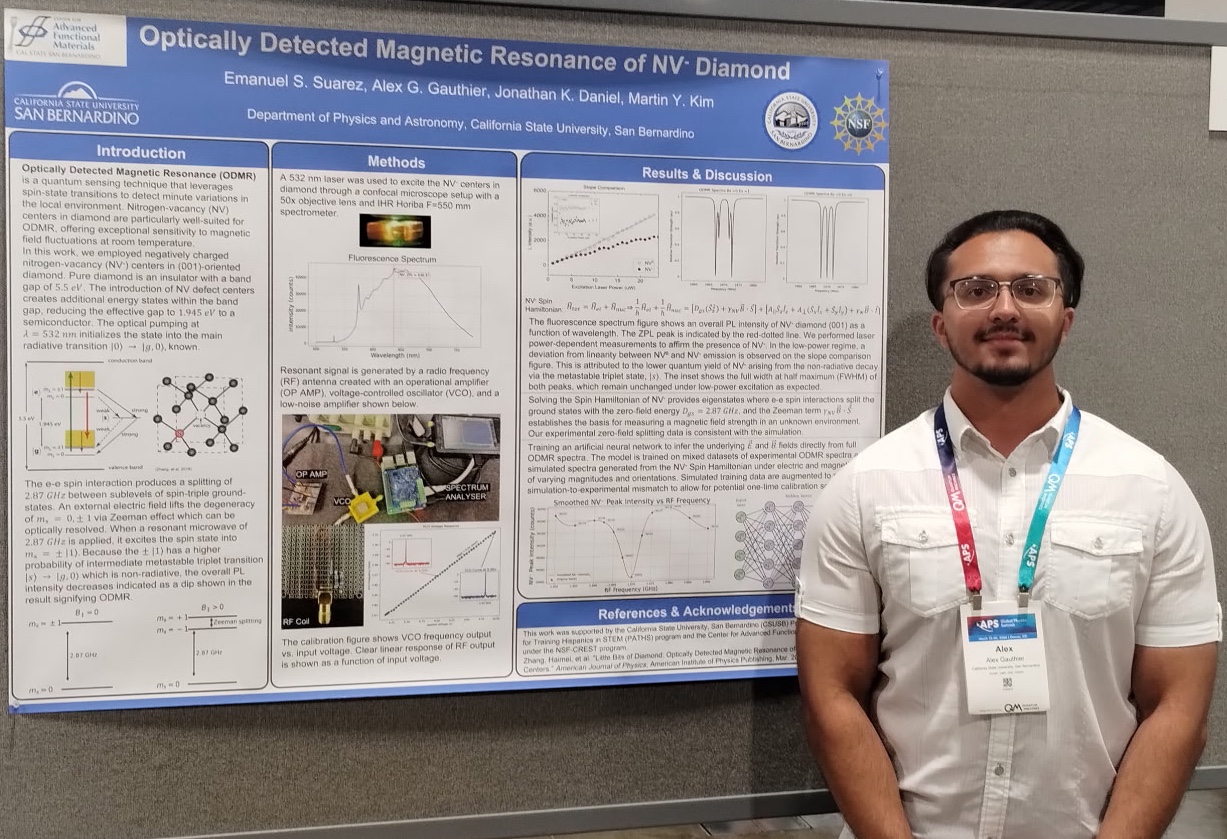
Summer 2025 - Current: Optically Detected Magnetic Resonance of NV⁻ Diamond
Alex Gauthier
This summer, Alex worked on kickstarting the experimental side of developing an optical neural network, preparing a steady-state pump-probe spectroscopy system to investigate the nonlinear optical response of stacked 2D materials. His work included characterizing the 532 nm pump and 1064 nm probe lasers, developing white LED collimation for sample localization and microscopy of hBN-encapsulated MoSe₂, and establishing simultaneous probe laser alignment with sample localization. The long-term goal is to evaluate MoSe₂ as a nonlinear optical element that could serve as an activation function in an optical neural network. Over his time in Dr. Kim's lab, he has presented related work at the APS Global Physics Summit 2026 in Denver, APS Far West 2025 at UC Santa Cruz, SCCUR 2025, two USRP Mini Conferences, OctoberTech 2025, the CSUSB Student Research Competition 2026, and NSF CREST 2025.
Summer 2026 - Current: Saturated Absorption Spectroscopy of Rubidium
Sabastian Gutierrez
Working with Dr. Jonathan Daniel, Sabastian built and ran a saturated absorption spectroscopy setup to study Doppler-free hyperfine transitions in rubidium vapor, characterizing the D2-line spectra of both ⁸⁵Rb and ⁸⁷Rb, locating transitions useful as frequency references for atomic clocks, and evaluating the system's stability and accuracy. The project is continuing in Dr. Daniel's lab, and Sabastian has presented this work at the USRP Mini Conference, APS Far West 2026, and the 2027 APS Global Physics Summit, with SCCUR and the Cal-Bridge Conference also planned. He recently joined Cal-Bridge as part of Cohort 13.
Summer 2026 - Current: Building a Taxonomy of Martian Clouds
Saul Ramos and Diego Andalon
Working with Dr. Matteo Crismani this summer, Saul and Diego are connecting the Cloudspotting on Mars: Shapes citizen-science project on Zooniverse with the MAVEN spacecraft's IUVS cloud dataset. The goal is to build a taxonomy of Martian clouds as a first step toward understanding the conditions that form them.
Spring 2026: Characterizing the Murillo Family Observatory's Telescopes
Dante Garcia, Lucia Bernal, and David Aguilar
Supported by the campus PATHS program, this team of three students worked with Dr. Matteo Crismani to characterize the performance of the Murillo Family Observatory's 17-inch and 24-inch telescopes and their CCD detectors, a key step toward registering the observatory for an official code with the national and international networks that track transient events and solar system objects. The team collaborated with Jerry Hilburn, Director of the Great Basin National Park Observatory, and by the end of the semester had characterized the telescopes well enough to hand the project off to Dr. Katy Rodriguez Wimberly, who is continuing the work with her own students this summer. They presented this work at Meetings of the Minds, the PATHS mini-conference, and AAAS in Pasadena.