Alan Llavore | Office of Marketing and Communications | (909) 537-5007 | allavore@csusb.edu
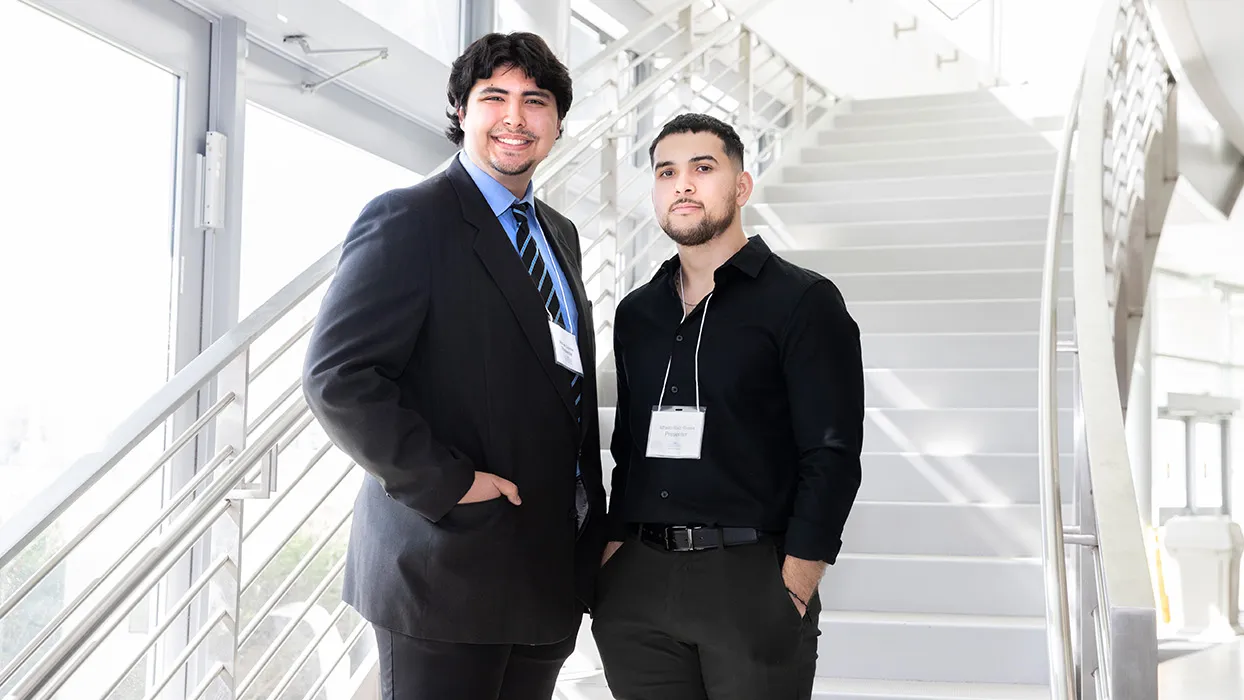
When Michael Zepeda began attending Cal State San Bernardino as a biology major, he had his sights set on becoming a doctor — a path he believed was the most direct way to help others. “It seemed like the perfect career to help people directly, by fixing their bodies,” he said.
But during the spring semester of his junior year, after taking a genetics class with Professor of Biology Nicole Bournias-Vardiabasis and working in her lab as a summer research intern, he changed course.
After being introduced to research methodology and toxicology studies that summer, he realized he could reach more people through research than he could as a physician. “I never thought about how researchers were contributing discoveries that directly impact individuals’ lives,” he said.
The experience also introduced him to the critical role of communication in science. “One of the earliest lessons I learned was the importance of scientific communication,” Zepeda said. “There is value in investigating something meaningful, but the true value lies in communicating your discoveries to others.”
After that experience, he began to define his next steps as a researcher. He earned a bachelor’s degree in biology in 2024 and was awarded a California Institute of Regenerative Medicine (CIRM) Bridges scholarship in August 2025.
CSUSB’s CIRM Bridges Program, launched in 2009 by Bournias-Vardiabasis, provides students with hands-on research experience and a pathway into advanced study, helping prepare the next generation of scientists. Bournias-Vardiabasis has remained the program director since its launch.
Zepeda completed his master’s degree in biology this past summer, and this fall will begin a doctoral program at the University of California, Irvine, in the Department of Environmental and Occupational Health in the lab of CSUSB alumna Nicole Sparks, Ph.D., M.S., biology ’12. He has worked as a CIRM Bridges intern and graduate student researcher since last summer.
Through these experiences, Zepeda has refined a broader goal — connecting research to the communities it is meant to serve. Today, he focuses on toxicology research with real-world implications, particularly the effects of nicotine and products such as e-cigarettes.
His commitment to this work is rooted in his upbringing in San Bernardino. “My mom is a special education teacher for people with severe disabilities, and she’s someone who always stood for advocacy and how important it is to stand up and fight and take stances for people who can’t do that for themselves,” he said. “And, growing up in a city where people largely have to advocate for themselves to continue to better their lives — it’s been instilled in me.”
At CSUSB, he has carried that commitment into his work as a researcher and mentor. “In my 15 years of running the CIRM Bridges training program and my 38 years of teaching and training future scientists at CSUSB, Michael ranks in the top 1 percent of the more than 300 students that have carried out research projects in my lab,” said Bournias-Vardiabasis.
Zepeda’s impact extends beyond his own research to support others. As a student researcher in the Bournias-Vardiabasis lab, he has mentored undergraduate students, community college students and a high school student, while contributing to a number of student projects. “This experience was incredibly enriching to me, because I got a small taste of the impact principal investigators have not only on research but on students’ professional development,” he said.
He has been a teaching associate in the Department of Biology since summer 2023 and served as lab and project manager in Bournias-Vardiabasis’ lab from 2023 to 2025. He was also a student mentor in the Office of Academic Success and Undergraduate Advising from 2021 to 2024. He currently serves as president of the Student Society for Stem Cell Research and was president of the Society for the Advancement of Chicanos and Native Americans in Science.
His focus on research and advocacy has also taken him beyond campus. As a graduate student, he has participated in two research internships. The first, in 2024, was through the Smoke and Tobacco Outreach and Prevention Scholars Program (STOPs) at Charles Drew University, where he continued working on nicotine toxicity on specific organs such as the heart and liver. He said although the research was meaningful, the advocacy experiences required by the program were the most memorable.
“I had the opportunity to work as a Tobacco and Smoke Prevention Advocate for the San Bernardino County Schools. As a San Bernardino local, I got to help my community directly with my research experiences,” he said. “I talked at high schools in my neighborhood about the dangers of e-cigarette consumption. For the first time, I was not just contributing to the scientific community, but I was contributing directly to my community.”
The experience also clarified and further reinforced the purpose behind his work. “My goal to pursue a doctorate is not just for research. I want to contribute to something greater than myself,” he said. “Having a career where I can contribute to the body of work in the scientific community, advocate for those who do not realize they need it, and work with those who will be the future of science is my passion.”