Sustainable Food Systems Main Page
Minigrants
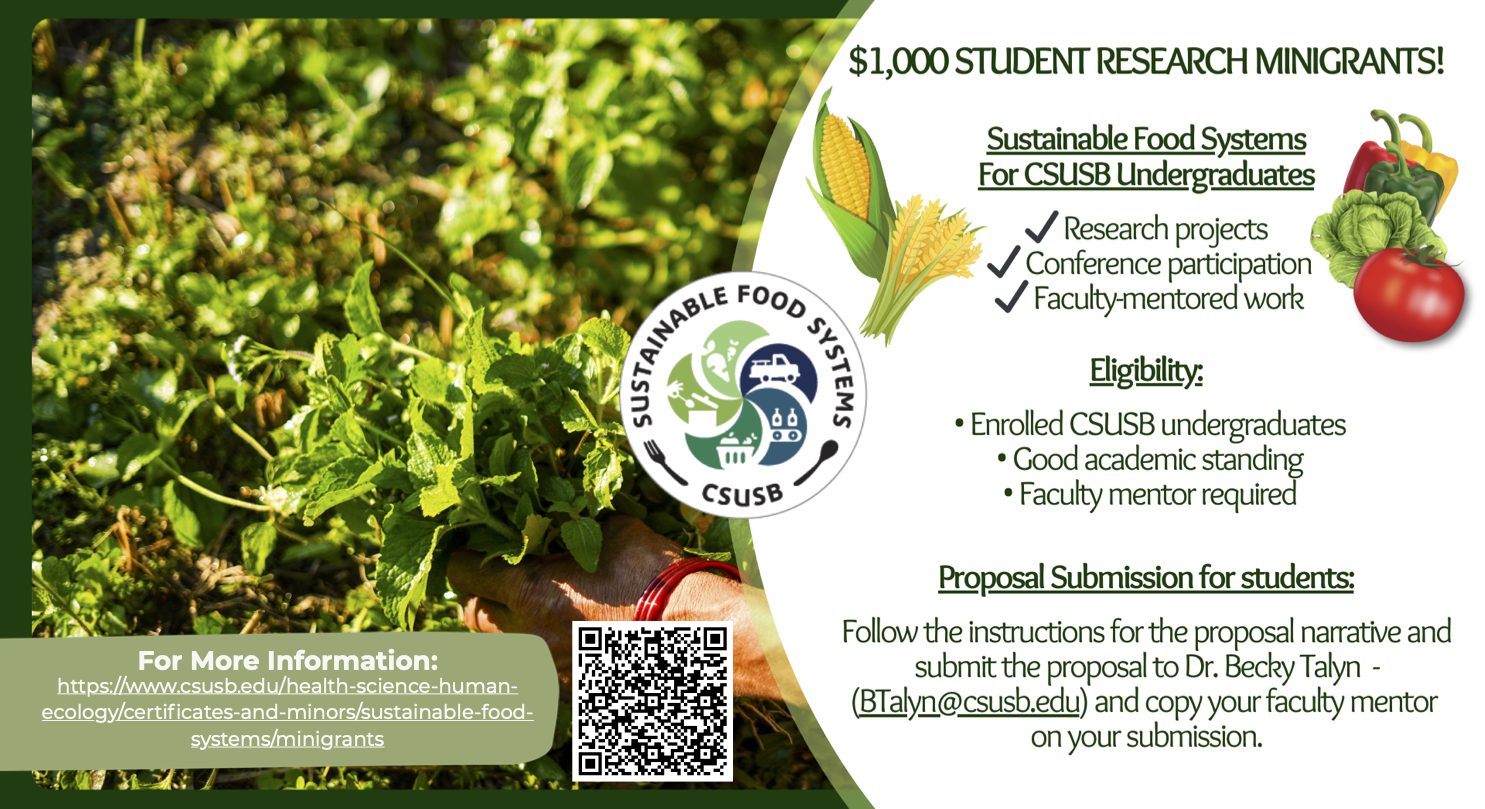
Students and Faculty Minigrants are now open
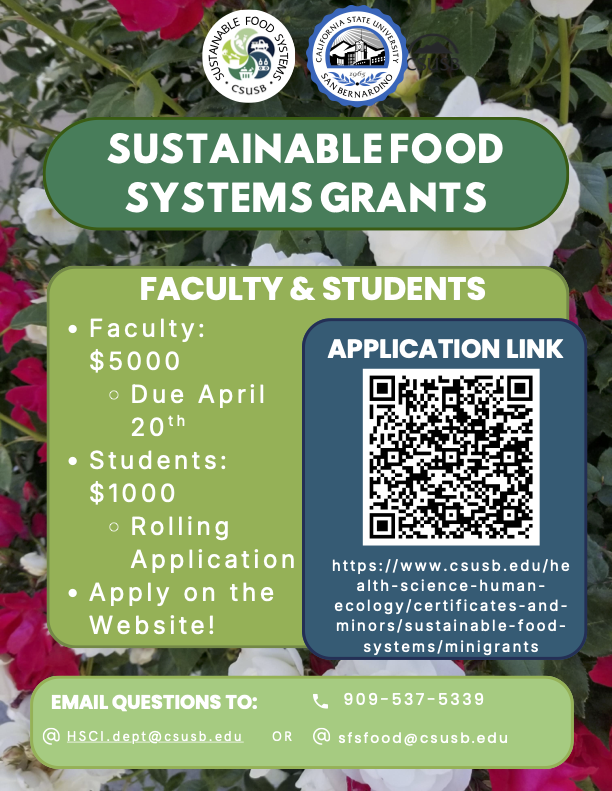
Click on Faculty and Student Application Guidelines tabs to learn more!
Sustainability in Food Systems by Achieving Optimal Drinking Water Quality
*Dr. Swat Kethireddy, Department of Health Science and Human Ecology swat.kethireddy@csusb.edu
 This project examined nitrate contamination in drinking water across Southern California, with a focus on San Bernardino, Riverside, and Orange Counties. Using laboratory-generated water quality data alongside secondary data from the State Water Resources Control Board’s Compliance, Monitoring, and Enforcement Drinking Water Information System (CLIP) Portal, the study identified elevated nitrate concentrations exceeding California and California and United States Environmental Protection Agency (U.S. EPA) Maximum Contamination Levels in inland regions. The work analyzed public and private drinking water systems and explored potential public health implications, including risks associated with methemoglobinemia. This research contributed to improve the understanding of agricultural impacts on sustainable water management practices.
Mapping Community Gardens in the Inland Empire
* Mike Kohout and Bo Xu, Dept. of Geography and Environmental Studies, College of Social and Behavioral Sciences (SBS) mkohout@csusb.edu bxu@csusb.edu

We are creating an interactive web map of community gardens in the Inland Empire. Using web tools, we will identify community gardens in the region and link them to data about their history, purpose, plant composition, and organizations that grow them and use them. We will train community organizations in maintaining the map, keeping it current and useful to them. We hope that in developing this one-stop information sharing resource, we will encourage organizations who grow community gardens to network, potentially increasing knowledge and resource sharing, as well as building a regional community.
Impact of Organic and Biodynamic Farming Practices on Carbon Sequestration
* Dr. Erik Melchiorre emelch@csusb.edu
The proposed work will quantify the impact of sustainable farming practices on soil carbon sequestration. This work specifically examines aspects of soil health; the base of the sustainable food system pyramid. Soil organic carbon and other geochemical measurements will be made, to generate a data set for use in student classroom and laboratory activities for Sustainable Food Systems courses. Students will utilize the carbon data and maps to calculate the total carbon sequestered by organic, regenerative, and biodynamic (sustainable) farming practices as compared to native soil. The field site is an organic farm in Reche Canyon, CA, which has been used as a “living laboratory” for CSUSB students for 20 years. This activity will also set baseline carbon values that inform future student-faculty research.
Developing a Community Partnership to Address Food Insecurity in the Coachella Valley
* Dr. Emily Loveland emily.loveland@csusb.edu

This project will build a community partnership with a local non-profit food distribution organization, Food Now Desert Hot Springs (DHS), and use community-based participatory research (CBPR) approach to examine and address food insecurity in the Coachella Valley through sustainable food systems initiatives. Together with Food Now DHS, we will explore opportunities for actionable change toward sustainable food systems development by enhancing food access, promoting local food production, and reducing food waste while emphasizing the long-term sustainability of food systems. This project will apply a community needs assessment that identifies trends in local food insecurity, federal food assistance use, and client satisfaction with local food pantry use. Food Now DHS and researchers will analyze outcomes of the community needs assessment to collectively identify a community action plan that aims to address service gaps in the Coachella Valley which are aligned with sustainable food system initiatives.
Investigating Social Justice Implications of Glyphosate Residues in Human Urine: Proof of Concept and Seed Data
* Dr. Becky Talyn BTalyn@csusb.edu

Glyphosate, the listed active ingredient in professional-grade Roundup, is the most extensively utilized herbicide globally. A growing wave of concerns has surfaced regarding its health implications, particularly because of contamination within our food supplies. Recent research indicates the troubling detection of glyphosate in human blood and urine, revealing frequent human exposure. This proposal outlines an in-depth study aimed at meticulously quantifying levels of glyphosate residue in urine samples of the diverse population of CSUSB students and relating them to social justice factors, including city of residence, socioeconomic status, and both occupational and dietary exposure risk factors. This will allow us to better understand the distribution of glyphosate exposure, and which risk factors contribute most to exposure risk.
From Garden to Gazette: Investigating Food Sustainability at CSUSB
* Gregory Gondwe gregory.gondwe@csusb.edu

This summer, The Coyote Chronicle student journalists will embark on a research-based reporting project investigating sustainable food systems at California State University, San Bernardino. With mentorship from Dr. Gregory Gondwe, the team will explore issues such as campus gardening, food insecurity, composting, and institutional sustainability practices.
Students will produce original investigative and feature stories for the bi-weekly newspaper and its digital platform, drawing on interviews, data, and fieldwork. This project supports the USDA-funded Sustainable Food Systems initiative by deepening student engagement, amplifying diverse voices, and fostering dialogue around food justice on campus and in the wider Inland Empire community. Stories and updates will be available at: https://coyotechronicle.net/