Stay Up-to-Date with Multimedia & Immersive Technologies
Welcome to the News & Events page of CSUSB’s Multimedia & Immersive Technologies Department. Here, you’ll find the latest updates on our innovative projects, upcoming events, and important announcements. Stay informed about how we are transforming education through technology and creativity.
Innovative Projects: Discover the cutting-edge projects our team is working on, from virtual reality applications to multimedia production advancements. Learn how these projects are enhancing the educational experience for students and faculty.
Technology Updates: Get the latest information on new technologies being integrated into our services, including updates on equipment, software, and best practices for utilizing these tools in educational settings.
Success Stories: Read about the success stories of our collaborations with faculty, students, and external partners. See how our services have positively impacted teaching and learning outcomes.
Workshops and Training Sessions: Join our hands-on workshops and training sessions designed to help you master new technologies and multimedia production techniques. Our events cover a range of topics, from Zoom best practices to advanced 3D printing and design.
Webinars and Online Seminars: Participate in our online webinars and seminars to stay current with the latest trends in multimedia and immersive technologies. These virtual events provide valuable insights and practical tips from industry experts.
Special Events: Don’t miss our special events, including guest lectures, technology showcases, and collaborative projects with other departments and organizations. These events are opportunities to network, learn, and engage with the latest innovations.
Event Recaps: Catch up on what you missed with detailed recaps of our recent events. Read summaries, view photos, and watch videos to get a comprehensive overview of the highlights.
Photo Galleries and Videos: Explore our multimedia galleries to see our technology and projects in action. Our photo galleries and videos offer a glimpse into the dynamic world of multimedia and immersive technologies at CSUSB.
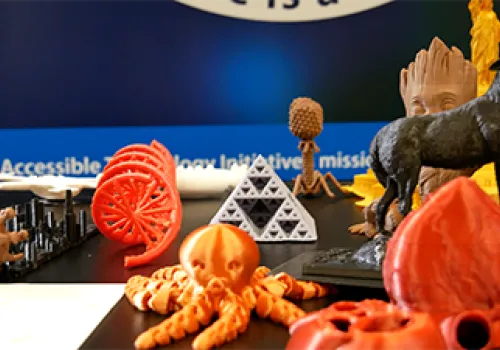
An interview on the benefits of 3D printing for accessibility, discussing 3D printed tactile learning models.

The virtual festival is highlighting the amazingly innovative work...
The TEDxCSUSB event, “Defining the Future,” that was held virtually on June 7 can now be viewed in its entirety on YouTube.

This contemporary adaptation based on Homer’s classic poem “The Odyssey” will drop on the Department of Theatre Arts’ Vimeo channel for four...

CSUSB’s Opera Theatre has released the full-length theatrical motion picture “Song from the Uproar,” by Grammy-nominated Missy Mazzoli,
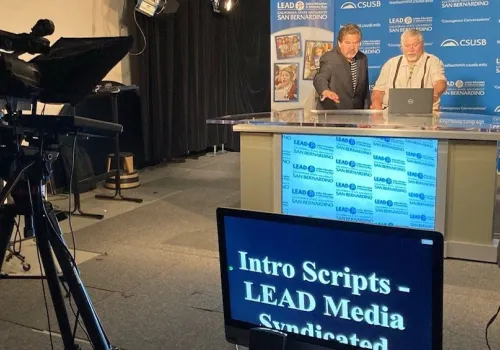
The Latino Education and Advocacy Days (LEAD) project at CSUSB launches a digital platform this summer with original programming off its...
Students discover motion capture at CSUSB — and new career paths
Students at Cal State San Bernardino are gaining hands-on experience with motion capture technology, discovering new ways to tell stories and expanding their career possibilities in fields ranging from entertainment to emerging media.
Students enroll and even transfer to Cal State San Bernardino for a variety of reasons — but in recent years, many are discovering something unexpected once they get there: motion capture technology.
At CSUSB, hands-on access to motion capture technology, rarely available at the undergraduate level, is reshaping how students think about performance, storytelling and their future careers.
CSUSB is the only university in the Inland Empire offering students access to a dedicated Motion Capture Studio (MoCap Studio), led by Kristi Papailler, associate professor of theatre arts, and developed through a collaboration between CSUSB’s xREAL Lab and Multimedia and Immersive Technologies (MIT) Department.
And, Papailler said, being the only university around with this type of program is important to students. “We have created a space, a hub here in the Inland Empire for people to come and engage with our university, to come and engage with our Motion Capture Studio, while we're also allowing our students to become leaders in the field.”
Motion capture technology records human movement and translates it into digital animation used in film, television, video games and immersive media.
The program began in 2021, when Papailler, working as a fellow with the xREAL Lab during the pandemic, explored new ways to teach performance remotely. “The folks in the xREAL Lab said, ‘There's this thing called motion capture that could work.’”
Papailler credits the xREAL Lab and MIT department as the collaborative foundation of the program; since its inception, between 75 and 100 students have participated. The program has since expanded to include courses such as “Acting for Motion Capture” and collaborative productions that integrate live performance with digital environments.
For some students, the decision to come to CSUSB started with a specific interest — and quickly became something more. Scarlet Rodriguez transferred from Victor Valley College and is now pursuing a bachelor’s degree in theatre arts. She initially chose the university for the theatre program but said motion capture shaped her career direction.
“My interest in motion capture was the main catalyst that ultimately convinced me to pursue a career in theatre arts,” she said. “Learning about the motion capture lab and getting to work in it has felt like a full-circle moment.”
For others, the discovery happened almost as soon as they arrived on campus.
Senior Anthony Tallent previously attended Riverside City College (RCC) and Cal State Fullerton before transferring to CSUSB this semester. His plan was to complete both a degree in theatre arts and a teaching credential while pursuing his passion, creating video games, on the side.
Learning about the Motion Capture Studio “was actually a lucky accident,” he said. “I was paired with Professor Papailler as my advisor and when she found out I was working on video games, she told me about the studio. I was like, ‘Excuse me’? They didn’t have anything like this at RCC or CSU Fullerton.”
Inside the Motion Capture Studio, students quickly learn that the work requires precision and awareness.
“In my time working in the studio, I’ve learned how small gestures and movements can affect a performance,” said Rodriguez. “An actor’s movement is perceived differently through the lens of a motion capture camera. I’ve had the opportunity to perform within the motion capture space and have learned to move with the cameras in mind while still maintaining a believable performance.”
That technical complexity is part of what makes the experience so different.
“You need to make sure that each take you're capturing includes everything you want to capture because it's not just one camera that you perform in front of,” Tallent noted. “There are 10 or 11 cameras, and there's also a face rig with a camera in front of the actor’s face.”
For some students, the experience deepens their understanding of how stories can be told. “It changed the way I think about storytelling through movement,” said Maddox Martinez, a senior majoring in theatre arts. “I find it fascinating that you can tell a story purely through someone's movement.”
It can also push students outside their comfort zones.
“I'm not an acting major, so performing was a bit scary for me,” Martinez said. “But this class helped me break through that and become more comfortable in my own skin when it comes to acting.”
As students gain experience, many begin to see new career possibilities.
“I didn't realize how much it was going to open up my options,” Tallent said. “When I came to CSUSB, I thought, ‘I'm going to get my degree and get the teaching credential. I'm going to teach, and I'm going to build games on the side.’ But so many other areas that I didn't really think about use this technology that there's a lot more I can do.”
Martinez agreed. “This class helped me realize that there are opportunities in this field creatively. I can still work in theater and the entertainment industry, but working in motion capture is something I should seriously consider pursuing as a career,” he said.
Papailler said opportunities are varied and include career paths in theater, the performing arts, television, film, kinesiology and sports medicine. “On their resumes, our students can include training in motion capture technology and motion capture performance, graphics for motion capture and 3D design.”
For students, access and affordability both played a role in their interest to pursue motion capture at CSUSB.
“You can't beat the price point for this technology,” Tallent said. “It's the best bang for your buck, and in this economy, you have to think about ‘What am I paying, and what am I getting?’ I've been working in the motion capture lab for less than two months, and there's so much more I can do now.”
“My previous institution had nothing like the MoCap Studio at CSUSB,” said Rodriguez. “Having this studio close to home has opened up more opportunities and creative outlets in the physical and digital space.”
To Papailler, the success of the Motion Capture Studio “says to me that we're on the right track. It says to me that we are on time, that we are preparing our students for short- and long-term success in a way that will be able to give them a very good and solid foundation in theater, theater performance and design technology.”
For students, the experience is ultimately about possibilities. “I’m going to have a very robust portfolio by the time I graduate, and I'm excited about that,” Tallent said.
“If someone were considering transferring to CSUSB for this program, now would be a great time,” Martinez said. “They would have access to a brand-new motion capture lab that's ready to use, as well as a state-of-the-art performing arts facility that was recently opened, both of which would support their academic and professional goals.
“What excites me most right now is working on my capstone project and seeing the final result of an idea that came from my own mind being brought to life through motion capture,” he said. “I never thought I’d do something like this, but here I am.”