Alan Llavore | Office of Marketing and Communications | (909) 537-5007 | allavore@csusb.edu
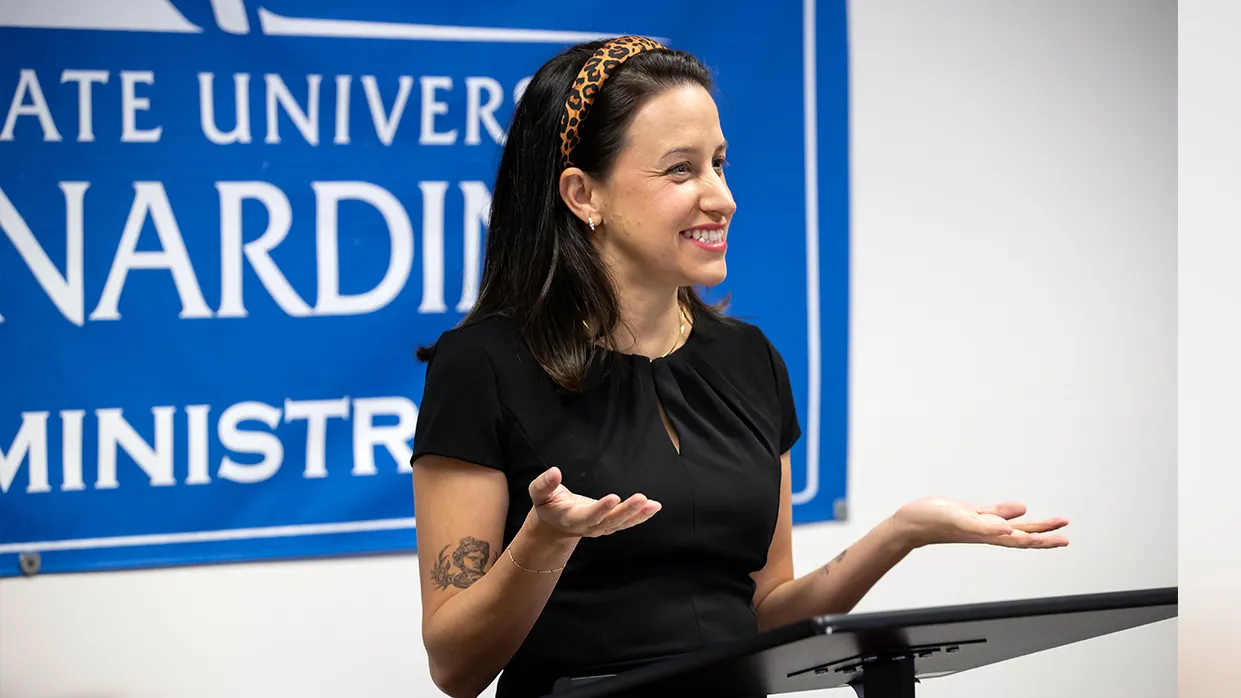
The students may not always be “alright,” but Cal State San Bernardino’s Pamela Medina and her fellow researchers are helping educators better understand how to support them.
Medina, associate professor of public administration in CSUSB’s Jack H. Brown College of Business and Public Administration, has been selected alongside co-authors Lauren Azevedo and Lindsey Evans to receive the 2026 Journal of Public Affairs Education (JPAE) Spotlight Paper Award for their article, “Are the Students Alright? Faculty Adoption of Trauma-Informed Pedagogy in Public Affairs Education.”
The JPAE Spotlight Paper Awards recognize outstanding contributions to the scholarship of teaching and learning in public affairs education. The selection process considers emerging or pre-tenure scholarship, representation of groups historically underrepresented in academia, meaningful contributions to teaching and learning, and research that advances social justice.
For Medina, the recognition underscores an issue that has become increasingly important in higher education: how educators can help students continue learning and engaging with difficult issues while navigating stress, uncertainty and crisis.
“I feel honored that our work is being highlighted for its contribution toward student engagement and well-being,” Medina said. “In the past few years, students and faculty have been managing global crisis after crisis, and this has certainly had an impact on how we experience higher education.”
Medina and her co-authors examined how public affairs educators are responding to student distress through trauma-informed pedagogy, an approach that recognizes how stress, crisis and trauma can affect students’ ability to learn, participate and feel secure in the classroom.
“More than ever, proactive discourse around governance and democratic norms is needed to address the volatile and divisive political situation in which we find ourselves,” Medina said.
Their research found that many faculty members have observed political exhaustion, anxiety and declining perceptions of institutional legitimacy among students studying public affairs. At the same time, educators are finding ways to adapt their teaching and help students engage with complicated and sometimes emotionally charged issues, often while working within limited resources and institutional constraints.
That innovation can take relatively simple but intentional forms. Trauma-informed practices might include alerting students before introducing emotionally activating subjects, actively facilitating difficult conversations and creating classroom environments where students feel psychologically safe enough to participate.
The goal is not to avoid challenging topics. Rather, Medina said, these approaches can create conditions that allow students to engage with them more meaningfully.
“Trauma-informed practices … ensure that students are psychologically safe while still engaging in the critical thinking required to tackle today’s global challenges,” she said.
That balance can be particularly important in public affairs education, where students routinely examine complex questions involving government, democracy, social justice and public trust.
By examining what faculty are already doing and identifying opportunities for stronger institutional support, Medina and her co-authors’ research offers insight into how universities can sustain inclusive learning environments while supporting both student well-being and rigorous academic engagement.
The award also highlights the student-centered scholarship taking place within CSUSB’s Jack H. Brown College of Business and Public Administration.
“Thanks to thoughtful educators and researchers like Dr. Medina, students are certainly in good hands,” said Tomas Gomez-Arias, dean of the college. “We are thrilled to see her work step into the national spotlight and spark an important conversation about creating classrooms where students feel supported, empowered and ready to tackle the world’s toughest challenges.”
Medina and her co-authors will be formally recognized during the NASPAA Awards Luncheon on Oct. 1, bringing their research — and the question at the heart of it — to a national audience of public affairs educators.