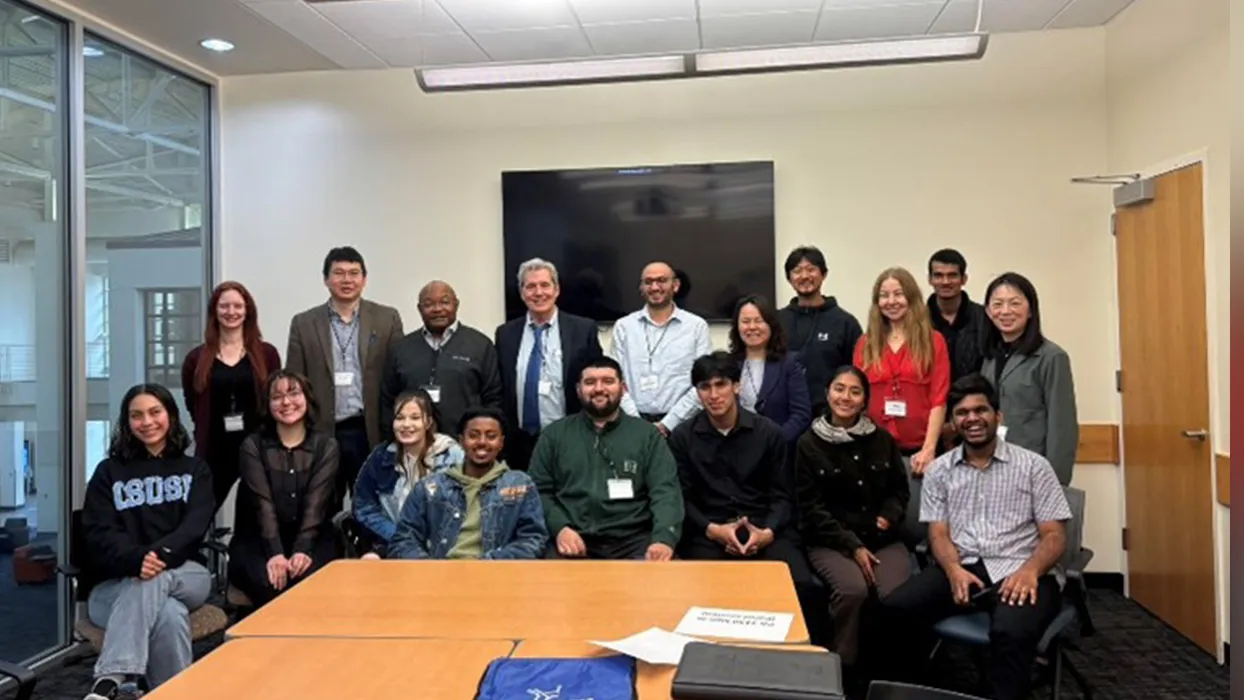
A National Science Foundation (NSF)-funded research project led by faculty at Cal State San Bernardino is helping colleges better understand how to teach science, technology, engineering, and math (STEM) courses online — especially at Hispanic-Serving Institutions (HSIs), where many students come from underrepresented backgrounds.
Funded by a $199,952 grant from the NSF, the three-year project studied what actually helps students succeed in online STEM classes and what does not. The research by an interdisciplinary team was led by Principal Investigator Anna Ni, with Co-Principal Investigators Yunfei Hou, Miranda M. McIntyre and Pamela Medina, representing CSUSB’s Jack H. Brown College of Business and Public Administration, the College of Social and Behavioral Sciences and the College of Natural Sciences.
The project, titled HSI Pilot Project: Improving Online STEM Education for Undergraduate Students at HSIs, ran from Oct. 1, 2022, to Sept. 30, 2025. Researchers collected information from more than 1,000 students through surveys, along with interviews with faculty, student focus groups, and analysis across multiple STEM subjects.
The study looked closely at how online STEM classes are designed and how students experience them. One major finding was that many common online teaching strategies do not always work well for STEM courses. For example, students said they preferred longer, well-organized lessons — about 90 minutes per week — rather than short video clips. While students appreciated interactive tools such as polls and practice questions, they were less interested in small-group breakout activities often used in online classes.
Students also said that practice and feedback were especially important. They learned more when they had required, graded practice assignments that helped them prepare for exams. While many students liked taking exams online because it was convenient, the study found that online testing systems still have limitations. For lab courses, students generally did well in hybrid classes that combined online learning with some in-person lab work. Fully online labs were most effective when used for specific learning goals.
In addition to improving teaching practices, the project highlighted that student success in online STEM courses depends more on how the course is designed than on students’ backgrounds. By focusing on Hispanic and other underrepresented students, the research showed that clear structure, meaningful practice and thoughtful assessments can make online STEM learning more effective and equitable.
“This project pushed faculty out of their comfort zones,” said Ni. “Working across disciplines took time and trust, but it also allowed us to learn from each other and see online teaching from new perspectives.”
The project also helped build research skills across campus. Seventeen faculty members took part in NSF-funded research, many working across departments for the first time. Several early-career faculty published their first NSF-supported research articles, and the team created a public website to share their findings and resources with educators.
Monty Van Wart, the project manager, said collaboration played a key role in the project’s success. “By bringing faculty together around shared ideas instead of departments, we were able to work more efficiently and make better use of everyone’s expertise,” he said.
Overall, the CSUSB-led project provides clear, practical guidance for colleges looking to improve online STEM education. Its findings offer a roadmap for creating online courses that are rigorous, inclusive, and designed to help students succeed at Hispanic-Serving Institutions and beyond.