Evidence-Based Practice
Peer Learning Programs within the Academic Centers for Excellence are guided by best practices grounded in both the scholarly literature on peer learning and ongoing analysis of CSUSB participation and outcomes data, ensuring that program design remains responsive, effective, and evidence-informed.
Accreditation and Associations
- In summer 2023, following a thorough review process, the CSUSB Supplemental Instruction (SI) Program became fully accredited with the International Center for Supplemental Instruction (UMKC). Reviewers recognized the CSUSB SI Program as exemplary, meeting or exceeding all criteria for international accreditation. Particular praise was extended for the program’s support structures including SI leader training, professional development, observation protocols, and collaborative paraprofessional advancement pathways.
- CSUSB Peer Learning Programs is an active partner with the West Coast Peer Learning Network (WC-PLN)
Supplemental Instruction
Foundational Research
Supplemental Instruction (SI) was developed at the University of Missouri, Kansas City in 1974 by Dr. Deanna Martin as a proactive, course-embedded peer learning model designed to support students in historically difficult courses. Rather than targeting individual students, SI integrates structured, collaborative study sessions led by trained peer facilitators who attend the course and model effective learning strategies.
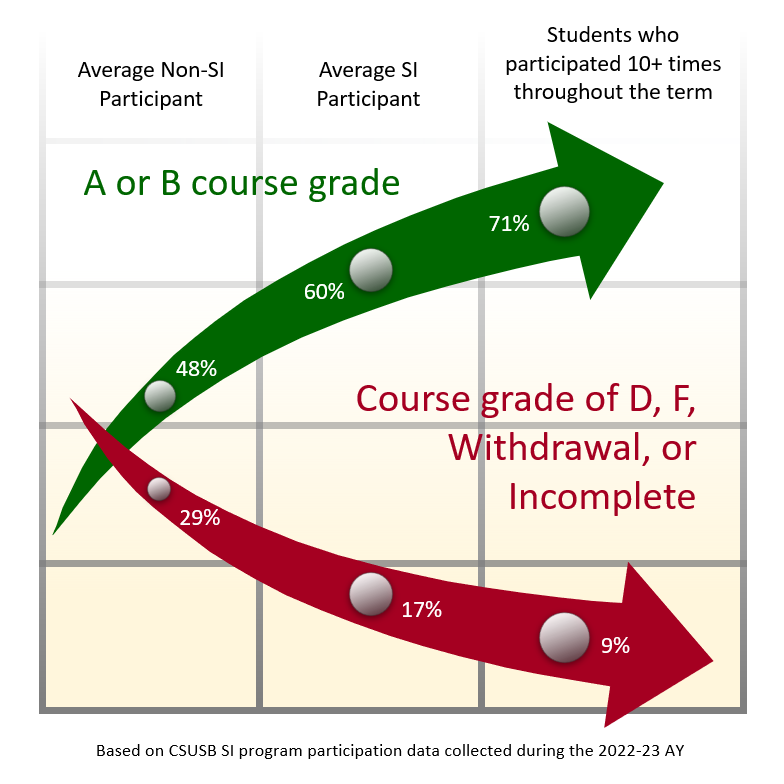
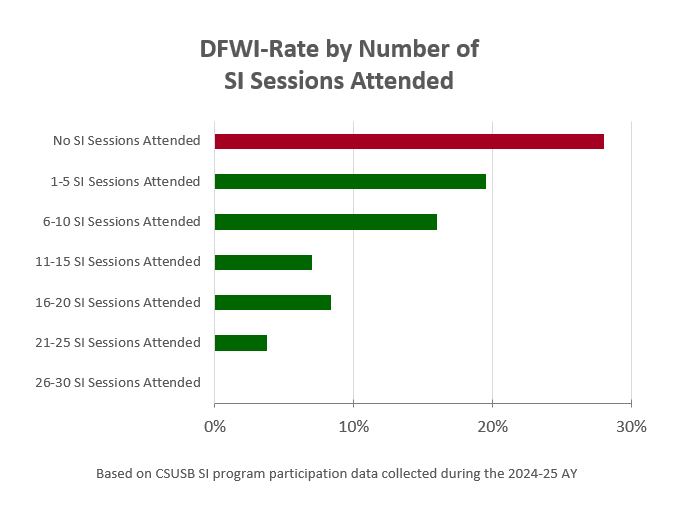
Across institutions and disciplines, research consistently associates SI participation with higher course grades, lower DFWI-rates, and increased student persistence (Blanc et al., 1983; Congos & Schoeps, 1998; Dawson et al., 2014). In addition to academic outcomes, SI has been linked to improved metacognitive learning strategies, stronger engagement with course material, and greater academic belonging within challenging gateway courses (Arendale, 2014; Dawson et al., 2014). Aggregated international outcome data collected by the International Center for Supplemental Instruction are available for review at: https://info.umkc.edu/si/data/.
At CSUSB
Each semester, both quantitative and qualitative data are collected locally to assess program effectiveness, including participation trends, academic performance outcomes, retention impact, and student experiences. Recent findings are reported below.
Student Success Outcomes*
- Average DFWI rate of 10% among SI participants, compared with 26% for non-participants in the same courses
- 71.3% of participants identify as URM students
Participation and Persistence Trends*
- Greater session attendance is associated with progressively lower course failure rates
- No student who attended 26 or more SI sessions failed the associated course
Institutional Research Analysis
- Matched-sample analyses conducted with the CSUSB Office of Institutional Research show statistically significant associations between SI participation and improved course outcomes
- Positive effects remain consistent across course, gender, ethnicity, student level, Pell status, prior GPA, enrollment status, and course repeat status
Interactive course-level data, including participation trends, grade distributions, and GPA comparisons, are available through the CSUSB Supplemental Instruction Dashboard maintained by the Office of Institutional Research.
* Based on CSUSB SI program data collected during the 2024-25 AY
Qualitative Findings from Student Feedback*
Open-ended responses from SI student feedback surveys at CSUSB provide insight into how students perceive the value of SI participation. When asked what they would say to students considering SI, responses were highly consistent across semesters and reflected several recurring themes.
- Conceptual Clarification and Deeper Understanding— Students frequently described SI as helping them better understand course material. Collaborative review and peer explanations helped clarify concepts introduced in lecture.
- Academic Success and Performance Gains— Students commonly linked SI participation to improved academic outcomes, including stronger exam preparation, higher grades, and increased confidence in challenging courses.
- Supportive Learning Environment— Participants emphasized that SI sessions provide a comfortable space to ask questions and work through difficult material without the pressure often associated with large lecture settings.
- Collaborative Peer Learning— Students highlighted the value of learning alongside peers enrolled in the same course, noting that discussion and shared problem-solving deepened their understanding of course content.
- Strong Student Advocacy for Participation— Many respondents directly encouraged other students to attend SI, often emphasizing that the sessions are “worth the time” and provide meaningful academic support.
Collectively, these findings suggest that students experience SI at CSUSB not simply as additional review time, but as a structured peer-learning environment that supports deeper understanding, engagement, and academic success.
* Based on CSUSB SI program data collected during from Fall 2020-Spring 2025
Student Perceptions of Academic Impact of SI Participation*
- 92% — SI improved understanding and performance in the course
- 91% — SI sessions were helpful
- 91% — SI sessions were enjoyable
- 87% — Skills learned in SI transfer to other courses
- 94% — Would recommend SI to a friend
- 93% — Would participate again in the future
Most Helpful Aspects of SI Sessions*
- 87% — Review of course content
- 72% — Exam preparation and test-taking strategies
- 66% — Learning and study strategies
- 66% — Small-group collaborative learning environment
- 57% — Study guides and learning resources provided by SI leaders
* Based on CSUSB SI program data collected during the Spring 2025 academic term
Embedded Peer-to-Peer Active Learning Support
Foundational Research
Embedded peer-to-peer active learning support models draw on a substantial body of research demonstrating that structured, collaborative learning improves student engagement and academic performance in higher education. Within these approaches, trained peer educators participate directly in the classroom, facilitating discussion, guiding collaborative problem solving, and modeling effective learning strategies alongside course instructors.
Decades of research on active learning and peer-facilitated instruction show that students in courses incorporating collaborative, interactive learning strategies demonstrate higher conceptual understanding, improved course performance, and greater persistence compared with traditional lecture-centered instruction (Freeman et al., 2014; Crouch & Mazur, 2001; Topping, 2005). Evidence from peer-assisted learning and embedded tutoring models further indicates that integrating trained peer educators into classroom instruction can strengthen engagement, normalize help-seeking behaviors, and support inclusive learning environments that benefit diverse student populations (Dawson et al., 2014; Topping, 2005).
At CSUSB
Peer Learning Programs Embedded Tutoring and Embedded Supplemental Instruction modalities apply these evidence-based principles by integrating trained peer facilitators directly into course environments where collaborative learning and active engagement are intentionally structured and supported.
Recent Peer Learning Programs Presentations and Colloquia
14th International Conference on Supplemental Instruction - June 2026 (Portland, OR)
- Turning Silos to Systems: Leadership Strategies for Higher Education Academic Support
Presenter: Dr. James Graham, Peer Learning Programs Coordinator, CSUSB - #nofilter: The Hidden Burnout Undermining Student Success
Presenter: Dr. James Graham, Peer Learning Programs Coordinator, CSUSB
Association of Colleges for Tutoring and Learning Assistance – ACTLA 51 Annual Conference – April 2024 (Online)
- #nofilter: The Hidden Burnout Undermining Student Success
Presenter: Dr. James Graham, Peer Learning Programs Coordinator, CSUSB
10th Annual West Coast SI Conference – November 2025 (Online)
- Bend, Don’t Break: Adaptability to Change in SI
Presenter: Amy Dong, Peer Learning Programs Senior Leader, CSUSB - Turning Silos to Systems: Leadership Strategies for Higher Education Academic Support
Presenter: Dr. James Graham, Peer Learning Programs Coordinator, CSUSB
3CSN Peer Educator Power Webinar Series - October 2025 (Online)
- Color Outside the Lines: Embracing Neurodiversity in Student Support
Presenter: Dr. James Graham, Peer Learning Programs Coordinator, CSUSB
9th Annual West Coast SI Conference – November 2024 (Online)
- Re-Imagining SI: A Multi-Instructor Approach
Presenters: Amy Wassing, CSUSB Communications Faculty & Vanessa Jimenez, SI Leader - Mandatory SI!
Presenter: Jacob Otero, SI Senior Leader, CSUSB - Exploring the Academic Multiverse: Championing Neurodiversity in Student Learning
Presenter: James Graham, Supplemental Instruction Coordinator, CSUSB - Defying Gravity: Through Wicked Challenges to Wonderful Outcomes
Presenter: James Graham, Supplemental Instruction Coordinator, CSUSB
13th International Conference on Supplemental Instruction – May 2024 (Baltimore, MD)
- I'm Here, Now What?: Transforming and Aligning an Inherited SI Program
Presenters: James Graham, Supplemental Instruction Coordinator (CSUSB) & Janice Levasseur, Assistant Director Center for Academic Achievement (ETSU)
8th Annual West Coast SI Conference – November 2023 (Online)
- Conference Keynote Presentations
Student Keynote Speakers: JohnPaul Solomon (SI Senior Leader) & James Leduc (SI Specialist/SAIL Academic Intervention Specialist), CSUSB - Weaving the Academic Web: Strengthening Connections for Enhanced Learning Environments
Presenter: Jeel Faldu, SI Leader, CSUSB - Q & A with Student Keynote Speakers
Presenters: JohnPaul Solomon (SI Senior Leader) & James Leduc (SI Specialist/SAIL Academic Intervention Specialist), CSUSB