Welcome
Thank you for your interest in the ACE Peer Learning Programs (PLP) at CSUSB. The following resources are designed to provide you with an overview of PLP and the many ways your students may benefit from the various peer-led, active learning support modalities. If you have any questions or would like more detailed information about PLP, please do not hesitate to contact us. We look forward to partnering with you for student success!
Partnership for Student Success
The ACE Peer Learning Programs provide peer-to-peer support for students enrolled in historically challenging courses at CSUSB. Peer Learning Facilitators (PLFs) are Instructional Student Assistants (ISAs) employed by CSUSB to provide peer-led academic support through Supplemental Instruction (SI), Embedded Tutoring, and Embedded SI. These paraprofessionals undergo specialized training in designing and facilitating active learning strategies (either in and/or outside of the classroom). While they are employed and supervised by Academic Success and Undergraduate Advising, ACE Peer Learning Programs PLFs work closely with course/department faculty throughout the academic term.
Peer Learning Program Academic Support Modalities
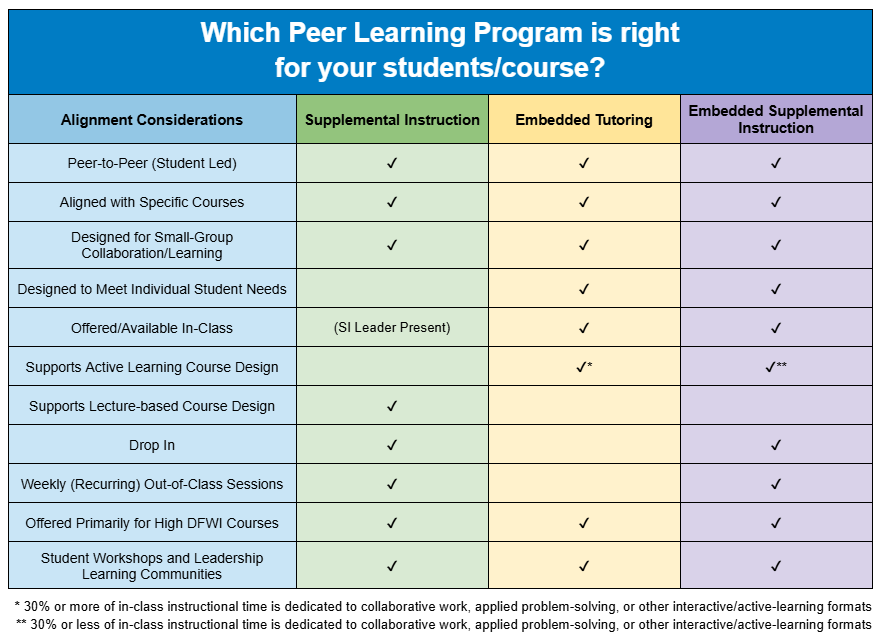
- Supplemental Instruction (SI)— The internationally accredited CSUSB Supplemental Instruction program offers peer-led academic support designed to improve student success in historically challenging courses. SI Leaders facilitate regularly scheduled, small-group study sessions outside of class, focusing on core course concepts, strategic learning techniques, and discipline-specific study skills. This model is especially effective in lecture-heavy courses with limited in-class active learning, offering students a collaborative environment in which to deepen their understanding and improve performance.
- Embedded Tutoring— Embedded Tutors are placed directly within selected courses to work alongside instructors, offering immediate, course-specific academic support. Unlike traditional tutoring, which occurs outside of class, this model integrates assistance into the learning environment to promote deeper engagement, clearer understanding of course material, and the development of effective academic strategies. Embedded tutoring is best suited for courses in which at least 30% of each class meeting involves active learning (collaborative work, applied problem-solving, or other interactive formats).
- Embedded Supplemental Instruction (SI)— Embedded SI integrates the evidence-based Supplemental Instruction model with in-class academic support. In this hybrid approach, SI Leaders assist with active learning activities in class and also host course-aligned, outside study sessions. Embedded SI is ideal for courses in which some portion of weekly instructional time is dedicated to active learning, supporting both real-time engagement and extended learning beyond the classroom. Embedded SI is not recommended for courses with 30% or more of class time dedicated to active learning as the SI sessions may be redundant.
The Peer Learning Facilitator (PLF) Role
Peer Learning Facilitators (PLFs) are undergraduate (sometimes graduate) students who have previously been successful in the corresponding content course or an equivalent course in the subject area.
PLFs are employed by the Office of Academic Support and Undergraduate Advising as Instructional Student Assistants and are selected through a screening process from a bank of applicants recommended by the faculty member or department for which they will provide support.
Prior to each semester, PLFs are trained in designing and facilitating active learning sessions, small group learning dynamics, general and discipline specific learning strategies, effective test taking skills, etc.
PLFs attend all corresponding content course lectures. Embedded Tutors help facilitate the active learning components designed by the course instructor for use within the course lecture session. SI Leaders design and facilitate 50 min. SI sessions twice a week, working closely with the course instructor throughout the semester.
PLFs help guide learning by answering questions, providing study tools, and taking the lead in collaborative learning around challenging course concepts, either in or out of class.
Depending on their specific role (SI Leaders, Embedded Tutors, and Embedded SI Leaders), PLFs assist students in:
• Reviewing lecture notes and text material
• Discussing and applying important concepts
• Preparing for an upcoming quiz or exam
• Asking and answering questions
• Learning effective study and test taking techniques
• Discovering strategies for doing well in the course
Note that all PLP-supported students participate in teaching, learning, and study, not just the Peer Learning Facilitator.

More Questions?
Email peerlearning@csusb.edu or call 909.537.7320 to learn more about Peer Learning Programs.