Alan Llavore | Office of Marketing and Communications | (909) 537-5007 | allavore@csusb.edu
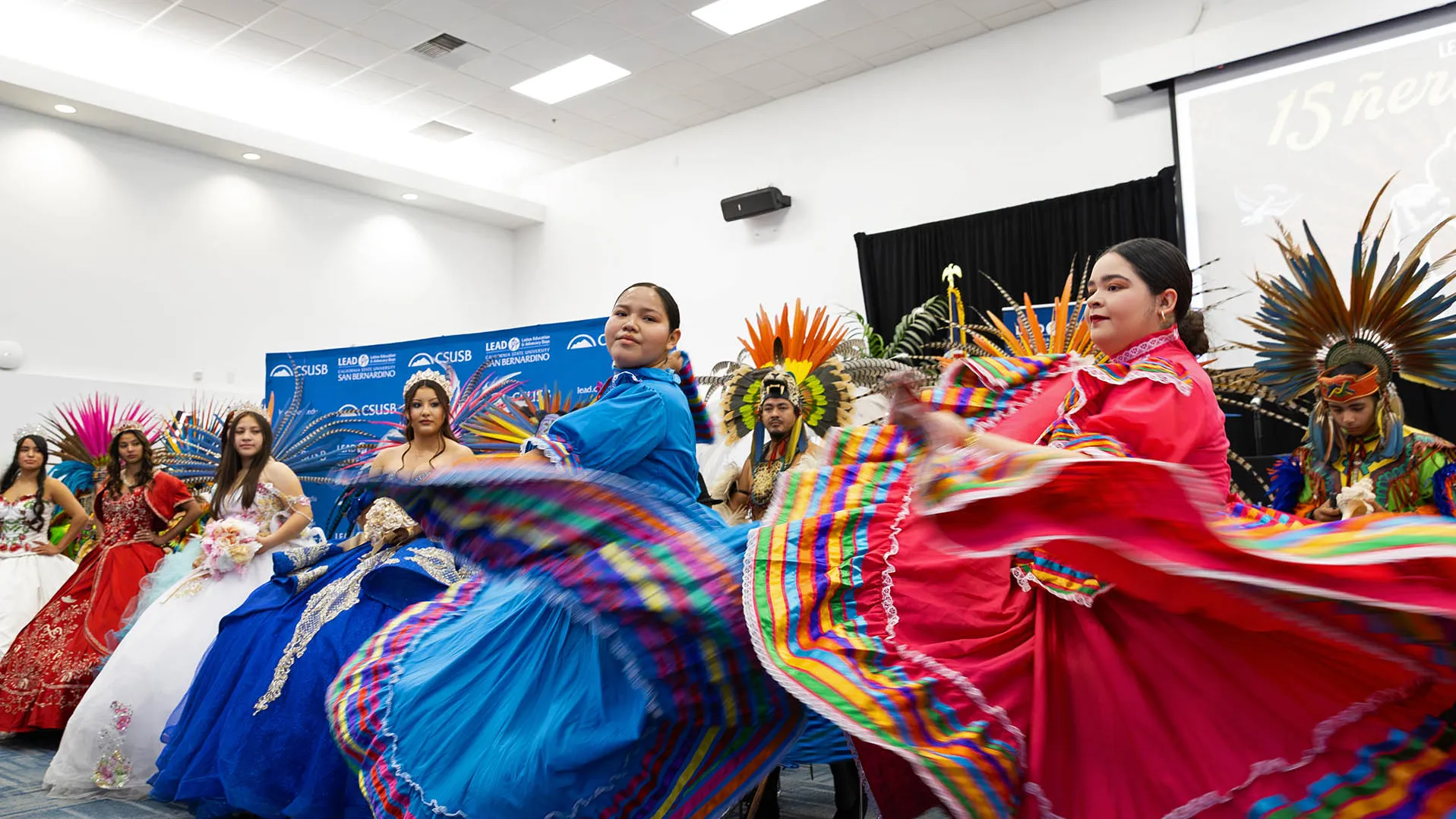

LEAD Summit XV brought youth, educators and advocates together to honor ancestral wisdom, confront educational inequities and build civic power through
The 15th annual Latino Education and Advocacy Days Summit at Cal State San Bernardino marked a milestone with a message that looked backward for strength and forward for action: Young people are not waiting for the future to lead change.
The Oct. 16 gathering, themed “15ñera for Justice: Divina Juventud: From Innocence to Resistance,” used the symbolism of a quinceañera and Día de los Muertos traditions to honor those who expanded educational opportunity while challenging a new generation to continue that work.
“What we're trying to do is invoke the sacred vitality of youth, la divina juventud, not as naive idealism but as revolutionary energy,” said Enrique Murillo Jr., executive director of LEAD and CSUSB professor of education. “Our quinceañera is not only a commemoration but a declaration. We have come of age. Innocence has given way to insight, and in the spirit of our ancestors, ni muertos ni vencidos. Ni muertos ni vencidos. We’re still here and we rise.”
The summit’s two keynote presentations connected that theme to the lived experiences of Latino, immigrant and working-class communities. Jerry Tello, an author and longtime practitioner of community healing, urged young people to draw strength from their families, cultural traditions and ancestral teachings. Luz Gallegos, executive director of the TODEC Legal Center, described how immigrant-rights organizing, civic participation and the sharing of community stories can build political power and advance justice.
Also signifying its coming of age, state Sen. Eloise Gómez-Reyes presented LEAD with a proclamation from the state recognizing what the organization has done for the community and California for the last 15 years. In her welcome remarks, the senator, who is the sister of university President Terri Gómez, said, “We're here to honor people who came before us and to the young people who will carry us forward. For my sister and for me, that connection between generations is deeply personal. We're here because of our family. We're here because of their hard work, their sacrifices, and the dreams they held for us.”
Added Gómez: “This year's gathering recognizes the coming of age of this powerful initiative by calling out both those who have served as the elders of the project and – as is the true marker of education – the young who continue to transform and deliver the future. We believe in you. . It serves to provide a living ofrenda for us by serving as an altar for these years of educación con conciencia and courageous dialogue.”
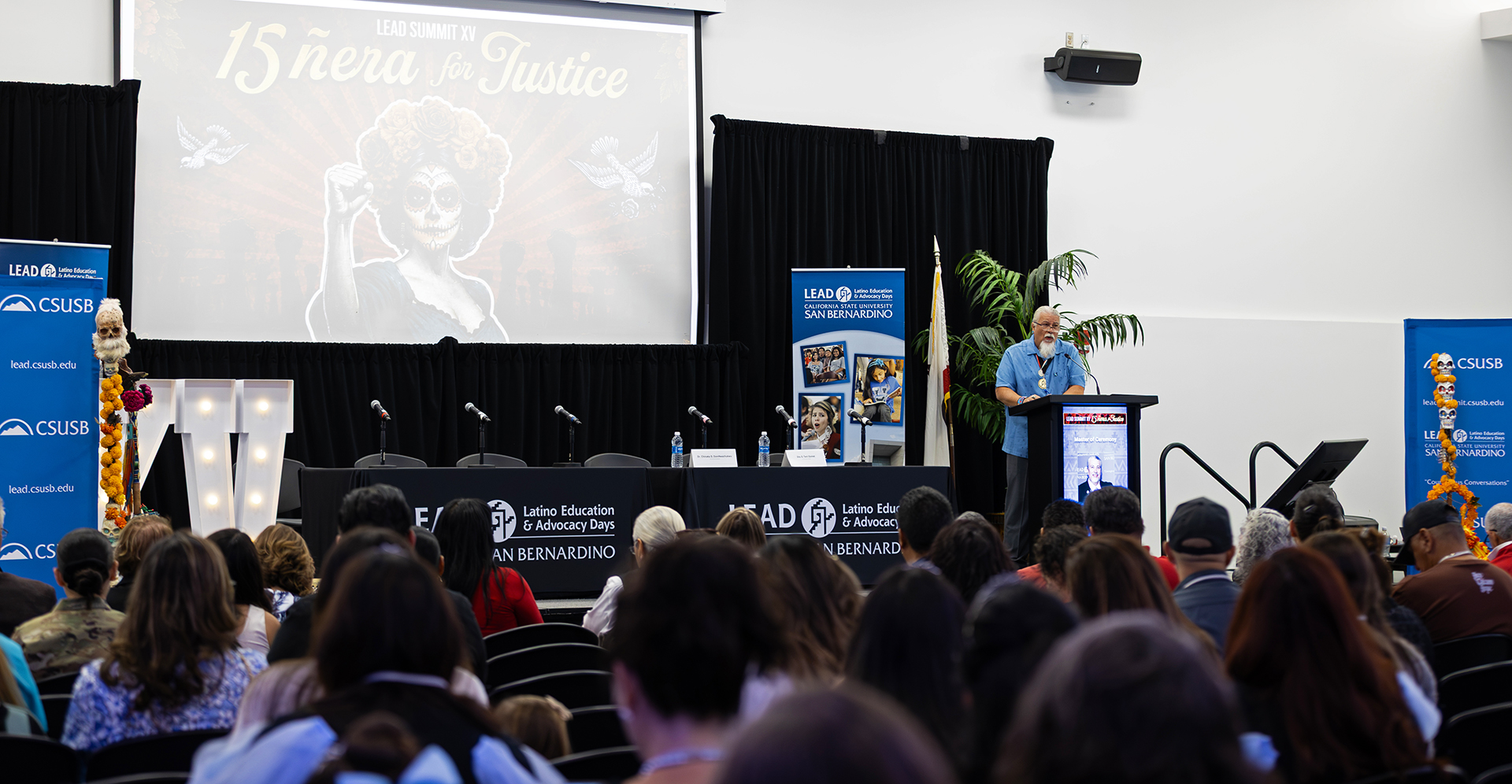
The daylong summit also featured panel presentations on “Educación como Resistencia: Teaching and Learning for Liberation in the Age of Disinformation;” the annual Dr. Tomás Rivera Featured Panel, “Ni Muertos Ni Vencidos: Memory, Language, and Cultural Survival;” and the capstone presentation, “In Tloque Nahuaque: The Interconnected Sacredness and our Intergenerational Movement for Justice and Healing.”
In his morning keynote presentation Tello drew on his childhood in Compton to describe how fear and hardship can follow children into the classroom. He recalled students whose anger or disengagement may reflect experiences educators cannot see, including immigration enforcement, policing, family instability or discrimination.
He told the story of a 4-year-old boy who had been removed from two preschools and labeled an “angry little boy.” Tello said adults needed to look beyond the child’s behavior and recognize the hurt beneath it.
“The journey to healing, the first step is acknowledgement,” Tello said. “That I see you. I see your sacredness behind all the wounds.”
Tello also spoke about his grandmother, who prayed for the family, blessed the children and passed down teachings that helped them understand their value. He distinguished formal schooling from what he called ancestral education – the knowledge, values and spiritual practices passed through generations.
“What I want every young person that I deal with to know is you come from a sacred people,” Tello said.
He urged students to remember their families and culture, surround themselves with people who share their values and use their own experiences to become authors, speakers and leaders.
In the afternoon keynote presentation, Gallegos connected LEAD’s theme to the continuing challenges facing immigrant families and farmworker communities in the Inland Empire and Coachella Valley. She described growing up in an immigrant family shaped by her parents’ work organizing farmworkers and confronting discrimination.
Her parents founded TODEC in the 1980s after witnessing injustices affecting farmworker communities in the region. Gallegos said their example taught her that organizing requires persistence and that community stories can help policymakers and the public understand the barriers vulnerable families face.
“In order for us to create social change, we need to build political power because those that are in power will not listen to people that are voiceless,” she said.
Gallegos said TODEC has helped more than 300,000 immigrants become U.S. citizens and engage in voting. She encouraged young people to remain connected to their roots, participate in civic life and continue advocating for families whose experiences are often overlooked.
“Where I find my strength is my faith,” Gallegos said. She also credited the young people and community members who continue working together to support others.
Since its founding in 2010, LEAD has evolved from a forum for dialogue into a platform for educational leadership, scholarship and advocacy. The 2026 summit explored how education can strengthen civic engagement, develop young leaders and advance social justice.
Opening remarks emphasized CSUSB’s connection to the region. University President Gómez said about 90% of students come from San Bernardino and Riverside counties, while 70% are Latino, 60% come from low-income backgrounds and 76% are the first in their families to attend college. Still, she said, barriers remain. For example, 46% of Latinx high school students graduate without completing the A-through-G course work that would make them eligible for admissions to a CSU or University of California campus. And Latinx student enrollment on UC campuses remains low enough that they are still listed as underrepresented.
“We have to do a better job of serving our students. There is clearly more work to be done. This is where LEAD’s voice and actions matter,” Gómez said. “Since its founding in 2010, LEAD has established a local, regional, national and even international reputation as a voice for Latinx communities in the field of education. Because education is a game changer – don't let anybody tell you differently – not only for individuals, but for families and communities. It takes the first one to do it, and then the rest of us will follow.”