Alan Llavore | Office of Marketing and Communications | (909) 537-5007 | allavore@csusb.edu
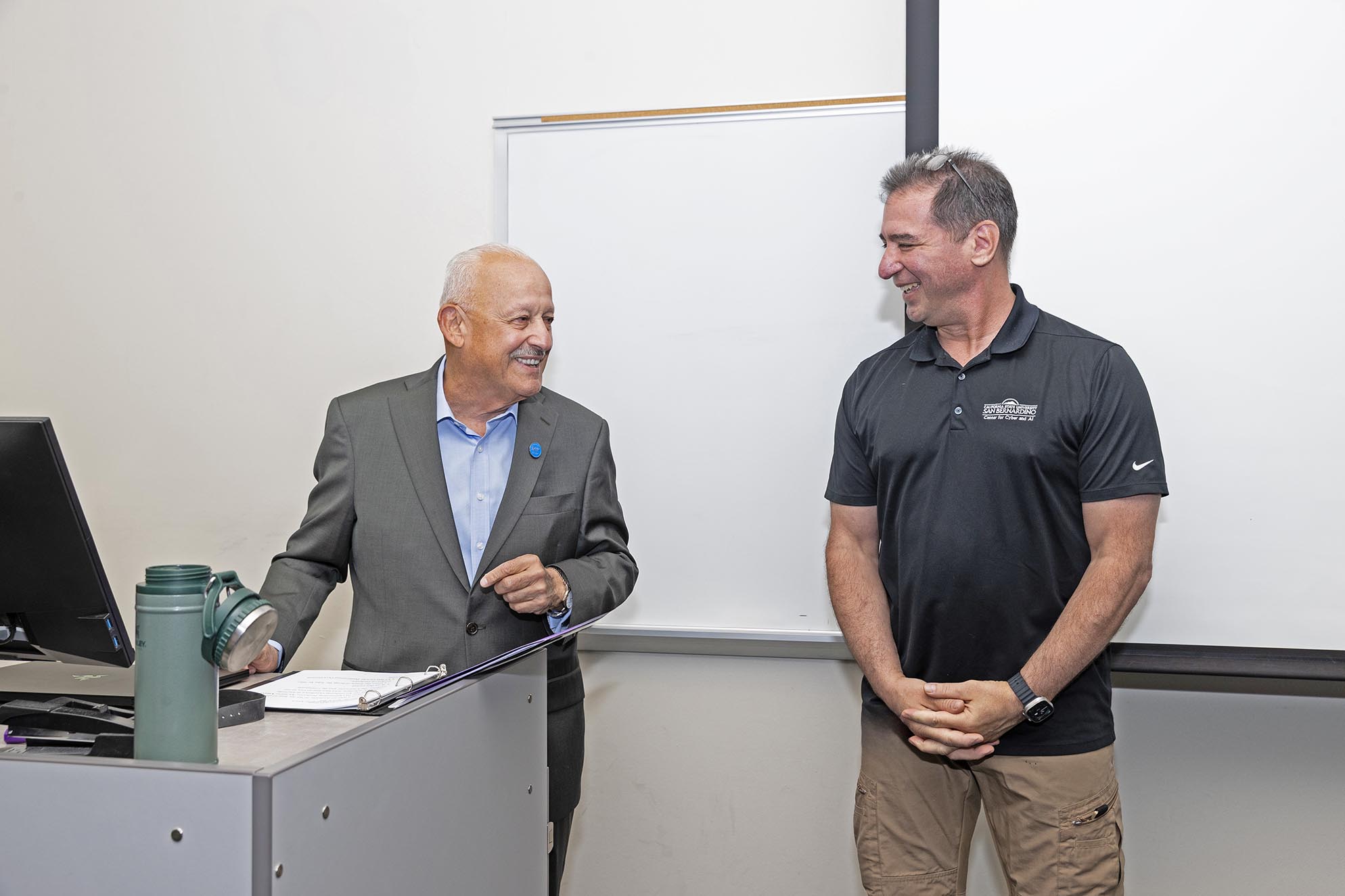
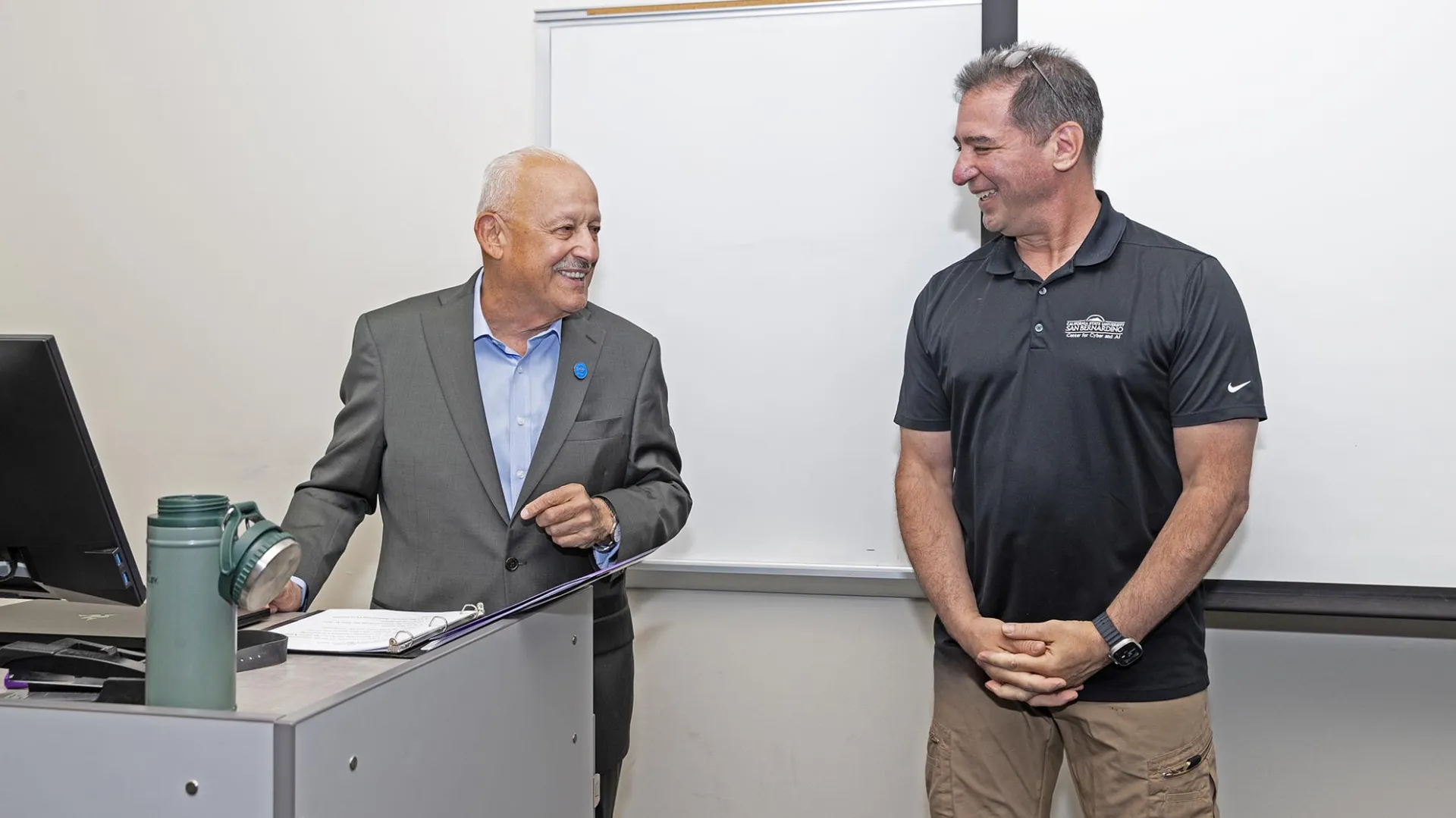
As a few dozen faculty, administrators and staff entered a classroom to join Vincent Nestler’s students the morning of April 9, he quipped, “Wow, I feel like this is an episode of ‘This Is Your Life,’” referring to the television program in which friends and family shared stories about the featured guest.
“It is,” replied Cal State San Bernardino President Tomás D. Morales.
As the room filled and cameras and phones began recording, Morales announced that Nestler, a professor in the School of Cyber and Decision Sciences, was selected as the recipient of the university’s 2026 Outstanding Professor Award.
“We are here to present the 2025-26 Outstanding – Outstanding – Professor Award to Vincent Nestler for his enduring excellence in teaching, research, scholarly activities, and service, most importantly, to our students,” Morales said to those gathered in the second-floor classroom in Jack H. Brown Hall.
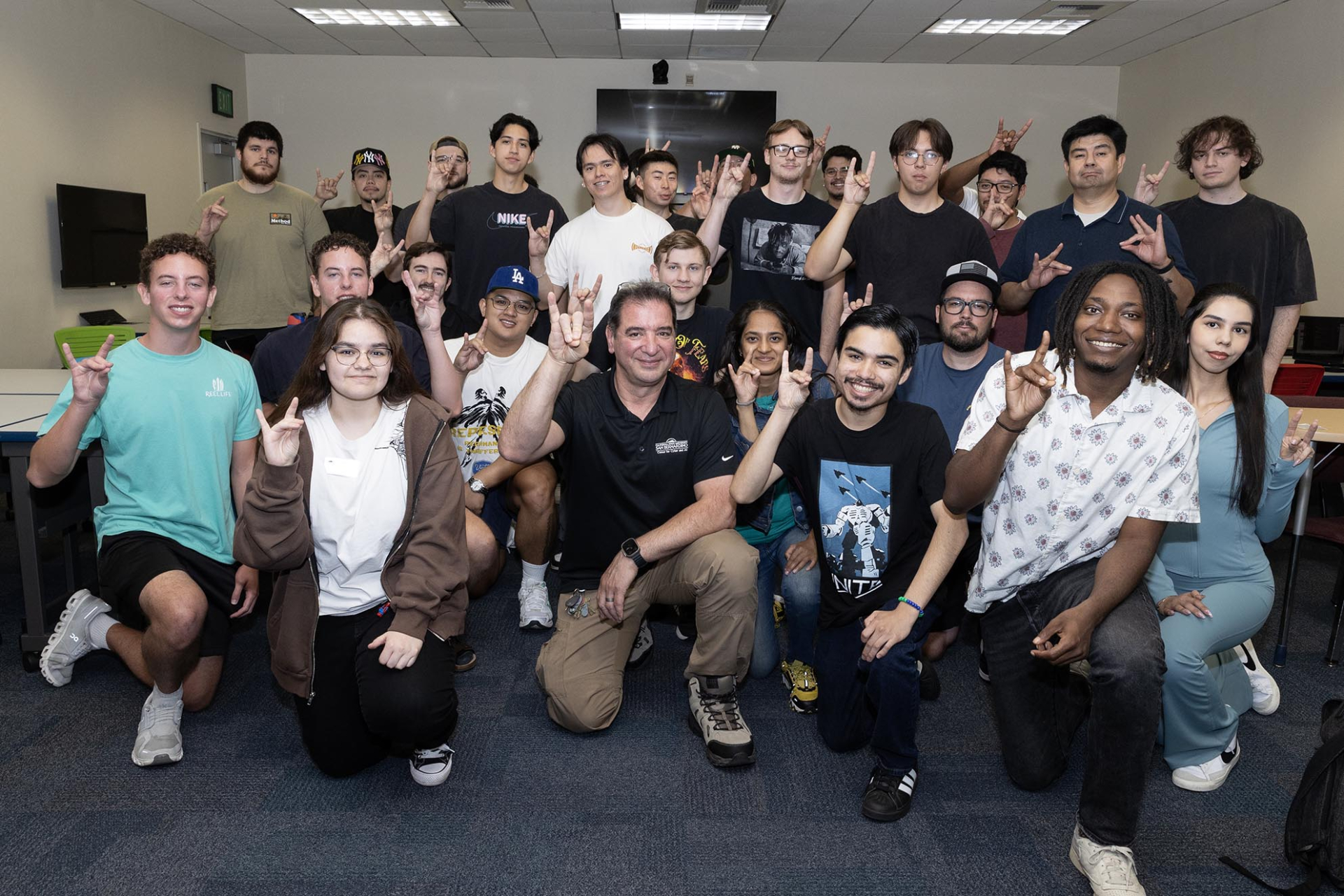
It has become a tradition at CSUSB to surprise recipients of the university’s top faculty awards by entering a class or lab while they are teaching, allowing students to share in the moment. In Nestler’s case, the announcement came as he was teaching a class on ethical computer hacking.
The award comes with the honor of being the John M. Pfau Endowed Professor; a $3,000 Faculty Professional Development Grant, the balance of the endowment in the form of a check; and recognition at the awardee’s spring college commencement ceremony.
Morales went through a comprehensive list of accomplishments and contributions Nestler has made as a faculty member at CSUSB, helping to lead, with Executive Director Tony Coulson, the university’s highly regarded and nationally acclaimed Center for Cyber and AI.
“Since 2016, he has involved over 1,000 local K-12 students and educators, many from backgrounds underrepresented in the field, in GenCyber summer camps and professional development workshops.” In addition, Morales said, “Dr. Nestler literally co-wrote the book that hundreds of institutions use as a standard reference for their curricula.”
Morales concluded, “Provost (Rafik) Mohamed and I join the University Awards Committee in saying that Professor Nestler is most deserving of this award for all the reasons I have listed.”
Mohamed wanted to ensure Nestler’s students understood the significance of the award: “It is a comprehensive appraisal of what a faculty member does. … What this award signifies is not just his excellence as a frontline instructor, but also his contributions to the discipline through scholarship and research. … And also his service to the campus and the larger community. It is the Outstanding Professor Award because it comprises all of the things that our tenure line faculty are, that every element of what our tenure line faculty are supposed to do.”
Tomás Gomez-Arias, dean of the Jack H. Brown College of Business and Public Administration, where the cybersecurity program is housed, said Nestler’s reputation in the field extends beyond the United States. He pointed to a recent trip to England, noting that “the national security establishment in the UK listens to this guy.”
He also described Nestler as forward thinking. “His mind is 5, 10 years ahead of us,” Gomez-Arias said. “He has been working on artificial intelligence before we were thinking about artificial intelligence. Always thinking about not only what's going on today, (but) what is going to happen in 5 years. What are the needs of society, of students, you know, 5, 10 years from today?”

And once the congratulatory speeches were made, Nestler described the surprise announcement event as a “full circle” moment. He recounted that, as a student in the Educational Opportunity Program at the State University of New York, New Paltz, Morales served as an EOP director who was a strong advocate for students. In 2012, just as Morales arrived at CSUSB to become its fourth president, Nestler was interviewing for a faculty position in what was then called the cybersecurity decision sciences department.
He said that he wanted to join CSUSB because of Morales’ leadership, which helped him at the start of his academic career. “And so I'm really happy that I've had the chance to use my academic energy as being part of your administration,” Nestler said to Morales. “So that's a wonderful kind of full circle thing.”
He gave credit to Coulson, saying the pair made a good team as they led the Center for Cyber and AI. “I think it's our teamwork and synergy that's made a lot of this stuff happen,” he said.
Nestler also expressed gratitude to university administrators. “A lot of the stuff we do does not happen without their support,” he said. “And that leadership is part of what also helps make us be as great as we are.”
And there was also mention of ganas. Morales quoted one of Nestler’s nominators, who said, “Dr. Nestler believes in a teaching philosophy he calls ‘ganas’ (‘desire’ or ‘drive’). He uses ganas to represent the desire to learn, the inner motivation that fuels growth, transformation, and self-discovery in his students.”
Addressing his students, Nestler said, “Find your desire, find your trajectory, do what you love doing, you'll never work a day in your life. I can't believe I get paid to be here and talk to you all, and share in this moment as you all ascend into becoming, you know, real human beings that pay taxes. So with that, find your ganas, find your direction, use it, and thank you for celebrating this moment with me.”
Nestler’s degrees include a B.A. in political science from the State University of New York at New Paltz; an M.A. in social studies secondary education at Columbia University; an M.S. in network security from Capitol College in Laurel, Maryland; and a Ph.D. in instructional design from Idaho State. He has also earned an online specialization from the University of California, Irvine in programming the internet of things.
Since joining CSUSB over a decade ago, Nestler’s innovative approach to teaching, the outsized impact of his research locally and with external collaborators, and his development of K-12 outreach pathways have helped make CSUSB a national leader for cyber security education and training.
Nestler designs his courses to provide students with innovative and hands-on experiences that will transform them into capable cybersecurity professionals. In particular, he builds complex, real-world-inspired projects that have students apply their skills and knowledge in challenging environments similar to those they will see across their careers.
His students are highly successful in their coursework and beyond. They compete at, and win, cybersecurity competitions, present at national conferences, and often transition directly to employment in government organizations and industry.
The NSF-funded NICE Challenge Project supported a model for cybersecurity education that has become a national model, serving over 700 institutions. Partnerships with the Pacific Northwest National Lab and the U.S. Space Systems Command provide scholarships and research opportunities for students while connecting them with industry and government internships.
Nestler has also been a key figure in building infrastructure to support student learning, with the CyberLab a signature accomplishment. The CyberLab is a virtual computing environment that students can access 24/7, giving them opportunities to work on projects remotely, “providing them with industry-level experience in managing and administering complex lab environments.”
This is not the first time Nestler has been recognized for his contributions at CSUSB. In 2019, he was awarded the Provost’s Research Award and he was given the Jack H. Brown College of Business and Public Administration Outstanding Service Award in 2019 and 2024.
The 2025-26 Committee is headed up by co-chairs Jennifer Alford (Department of Geography) and Stacey Fraser (Department of Music). Other members include Sara Callori (representing the College of Natural Sciences), Yawen Li (representing the College of Social and Behavioral Sciences) and Ying Cheng (representing the Jack H. Brown College of Business and Public Administration).