Alan Llavore | Office of Marketing and Communications | (909) 537-5007 | allavore@csusb.edu
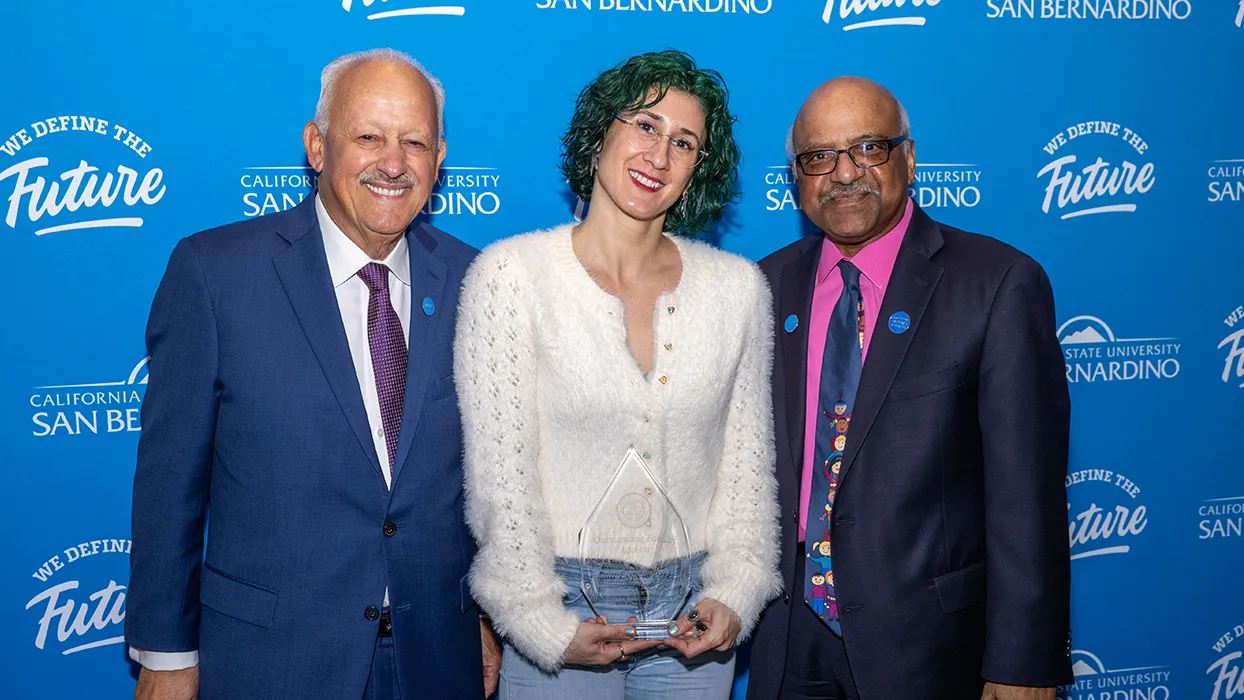
When Lúa López stepped into her new role as faculty director of CSUSB’s Office of Community Engaged Learning (OCEL) on January 2, she brought with her an academic background marked by mentorship, experiential learning and a deep commitment to students. An assistant professor in the Department of Biology, López has been widely recognized for her advising and mentorship.
As faculty director of OCEL, López will lead efforts to strengthen partnerships across the Inland Empire and Coachella Valley and expand opportunities for students to engage in high-impact, community-based learning experiences that promote student success and regional vitality. She will also collaborate with faculty, students and community partners to develop and assess service-learning, internships and other applied experiences that connect classroom learning to real-world impact. She recently discussed her teaching philosophy and vision as faculty director of OCEL.
Q: Before stepping into this new role, you built a strong record as a faculty member in the Department of Biology. Can you share a bit about your path to joining the faculty at CSUSB and what initially drew you to this campus?
My path into academia has been a bit unorthodox. As a first-generation student, going to college was important for my family, but I didn’t grow up imagining myself as a professor or researcher. I sort of stumbled into it.
During my senior year of undergrad, I joined a research lab studying marine ecosystems mainly because I wanted to go scuba diving. That experience sparked my curiosity and introduced me to research, even though it still felt like a world I didn’t quite belong to.
I graduated. Then I went on to earn a master’s degree in biology and another in pedagogy and then did doctoral and postdoctoral work in Germany, Penn State and Binghamton University.
During my interview at CSUSB, I knew this campus was home. I saw myself in our students, first-generation students, adult learners and individuals balancing school, work and family. Five years later, that feeling hasn’t changed. I’m here for the students, and that continues to drive everything I do.
Q: Since arriving at CSUSB, you’ve taken on multiple roles as a researcher, educator and mentor. What have you enjoyed most about your work as a professor here?
What I have enjoyed most is, without question, my interactions with students. One of the most rewarding parts of being a professor at CSUSB is witnessing students come into their own, seeing them gain confidence, recognize their potential and begin to believe in what they’re capable of.
In my courses and research lab, I often watch students discover new possibilities for their future. Many enter my course-based undergraduate research experience (CURE) class unsure of themselves or convinced that research isn’t for them – and then pursue independent projects they never imagined they could do.
Beyond the classroom, I serve as the mentorship facilitator for the COMPASS Program in my department, working with students as they build scientific and professional skills. What makes this work especially meaningful is that it doesn’t end at graduation. Hearing from alum ni who share their next steps is a constant reminder of why I do this work.
Q: You’ve been recognized for your advising and mentorship, including the Outstanding Faculty Advisor Award and the Upward Bound Champion Award. What do those recognitions reflect about the parts of your work you value most?
Those recognitions reflect my vision of education, one that goes beyond coursework or degrees. At the core of my work is the belief that universities can be transformative spaces where students discover their voice, confidence and power to shape their futures.
Advising and mentorship are not add-ons to my teaching. They are central to how I understand my role as an educator.
Q: Much of your teaching and research has centered on experiential and community-engaged learning. How has that focus prepared you to lead the Office of Community Engaged Learning?
My teaching and research have always been rooted in the idea that learning is most powerful when it is active, relevant and connected to real communities and real problems.
I’ve seen how experiential and community-engaged learning can transform students’ confidence, sense of purpose and career trajectories.
That long-standing focus has prepared me to think about this work not just at the classroom level, but as a coordinated, institution-wide effort. Leading the Office of Community Engaged Learning requires aligning faculty innovation, student learning and community partnerships in ways that advance the university’s mission and priorities.
Q: As faculty director, will you continue teaching or engaging directly with students? Why is that connection important?
Yes, maintaining a direct connection with students is essential to me. Teaching and mentoring keep me grounded in the realities of students’ experiences, their challenges, aspirations and strengths.
Q: When you look ahead a few years, what would success look like for OCEL from a student’s perspective?
From a student’s perspective, success would mean that community-engaged and experiential learning are fully integrated into their academic experience as intentional and accessible opportunities connected to their academic and career goals.
If students graduate with confidence, practical experience, strong community connections and a clear understanding of how their education prepares them to contribute meaningfully to their communities and the region, then OCEL will be fulfilling its role.