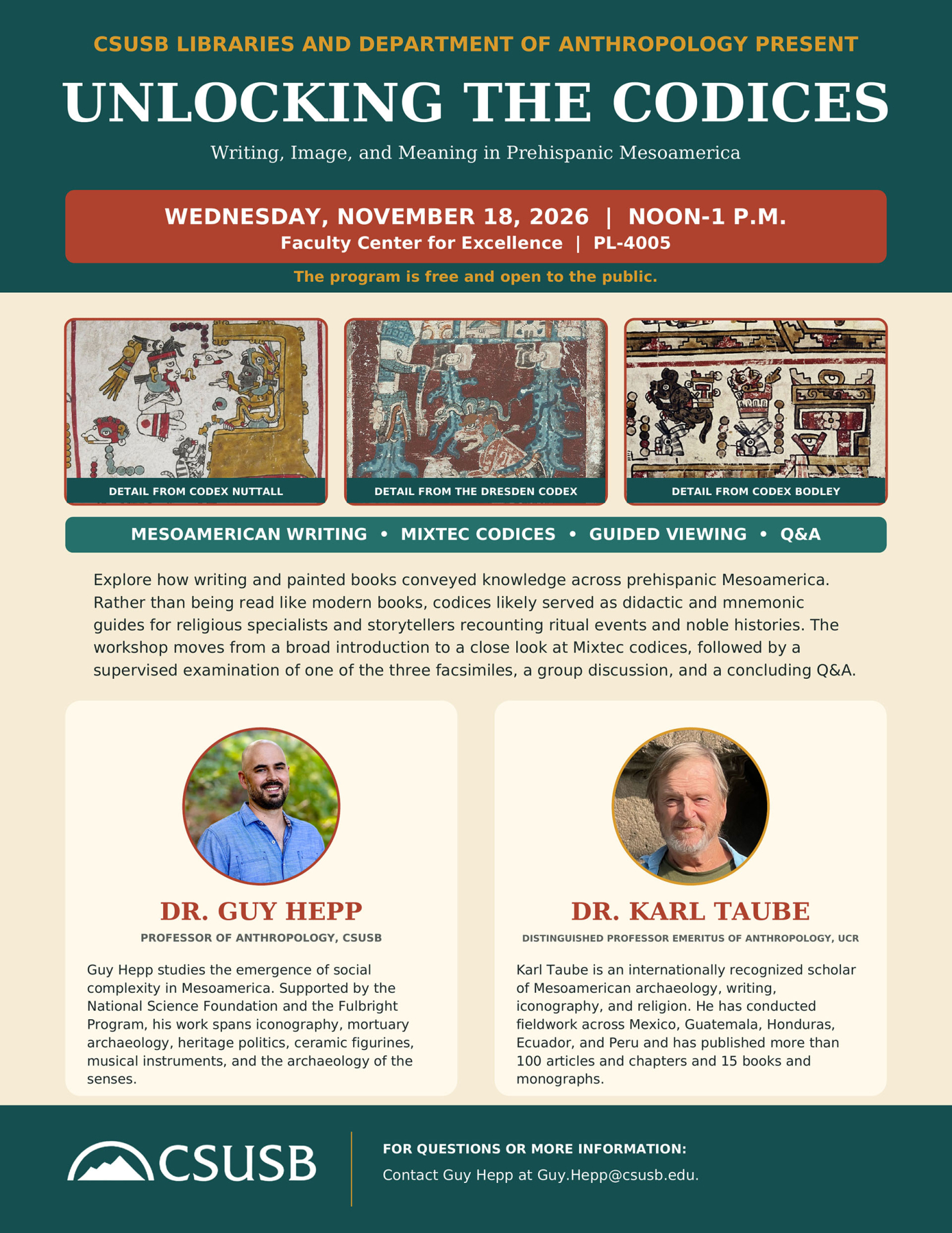
A free workshop at Cal State San Bernardino will explore how painted books conveyed knowledge across pre-Hispanic Mesoamerica through writing, images and ritual.
“Unlocking the Codices: Writing, Image, and Meaning in Prehispanic Mesoamerica” will take place from noon to 1 p.m. Nov. 18 in the Faculty Center for Excellence, PL-4005, on the fourth floor of the John M. Pfau Library.
CSUSB Libraries and the Department of Anthropology will present the program, which will feature facsimiles of the Codex Bodley, the Dresden Codex and the Codex Selden. The Codex Selden will be on loan for the event.
The three works represent two major Mesoamerican traditions. The Maya Dresden Codex contains ritual calendars and astronomical tables, while the Mixtec Codex Bodley and Codex Selden preserve dynastic and political histories.
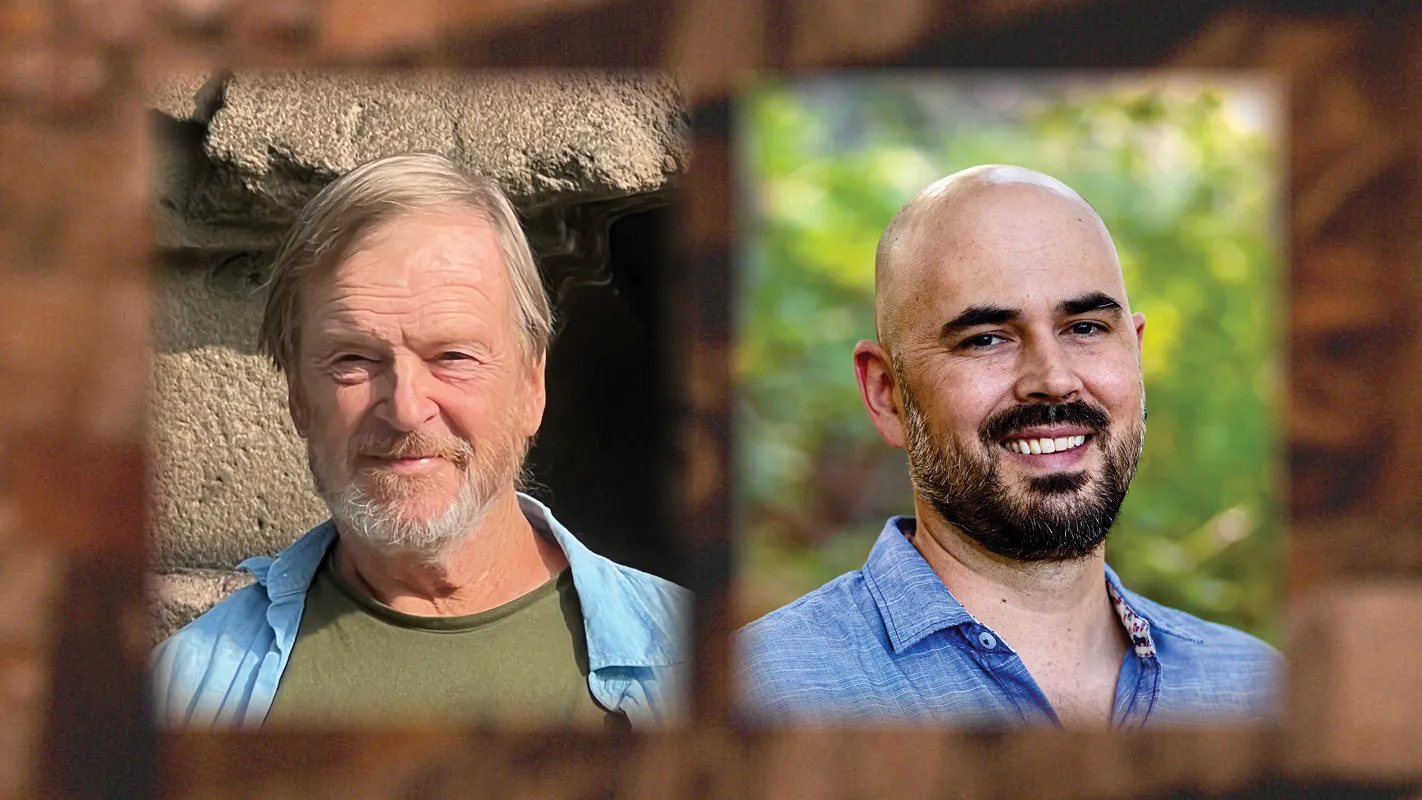
Guy Hepp, a CSUSB professor of anthropology, will open the workshop with an overview of Mesoamerican writing and codices. Karl Taube, distinguished professor emeritus of anthropology at the University of California, Riverside, will discuss the Mixtec codex tradition.
The program will conclude with a group discussion and audience question-and-answer session. Participants also will have an opportunity to examine a high-quality codex facsimile under supervision.
Unlike modern books, Mesoamerican codices likely functioned as didactic and mnemonic guides that helped religious specialists and storytellers recount ritual events, creation stories and noble histories, Hepp said.
“The Mesoamerican codices are incredibly rare books. Only a few produced before the Spanish arrived in the Americas survived the colonial era,” Hepp said. “Although their interpretation requires highly specialized knowledge, the codices offer an extraordinary window into the cosmology, dynastic histories, ritual practices and political life of Mesoamerican societies.”
The Mixtec codices provide important information about political and religious life, including births, marriage alliances, warfare, ritual practices and creation mythology, Taube said.
The Dresden Codex came by way of Cesar Caballero, dean emeritus of the library. “Cesar Caballero’s donation of the Dresden Codex facsimile has provided our students and faculty with an exceptional resource for exploring one of the most important surviving Maya manuscripts,” said Rebecca Lubas, dean of CSUSB Libraries. “We are grateful to Cesar, former dean of the Pfau Library and now dean emeritus, for a gift that allows members of our campus and surrounding community to encounter this remarkable work more closely.”
Hepp’s research examines the emergence of social complexity in Mesoamerica and includes iconography, mortuary archaeology, heritage politics, ceramic figurines, musical instruments and the archaeology of the senses. His work has been supported by the National Science Foundation and the Fulbright Program.
Taube’s scholarship focuses on Mesoamerican archaeology, writing, iconography and religion. He has conducted fieldwork in Mexico, Guatemala, Honduras, Ecuador and Peru and has published more than 100 articles and chapters and 15 books and monographs.
The workshop is free and open to the public. For more information, contact Hepp at Guy.Hepp@csusb.edu.