Alan Llavore | Office of Marketing and Communications | (909) 537-5007 | allavore@csusb.edu
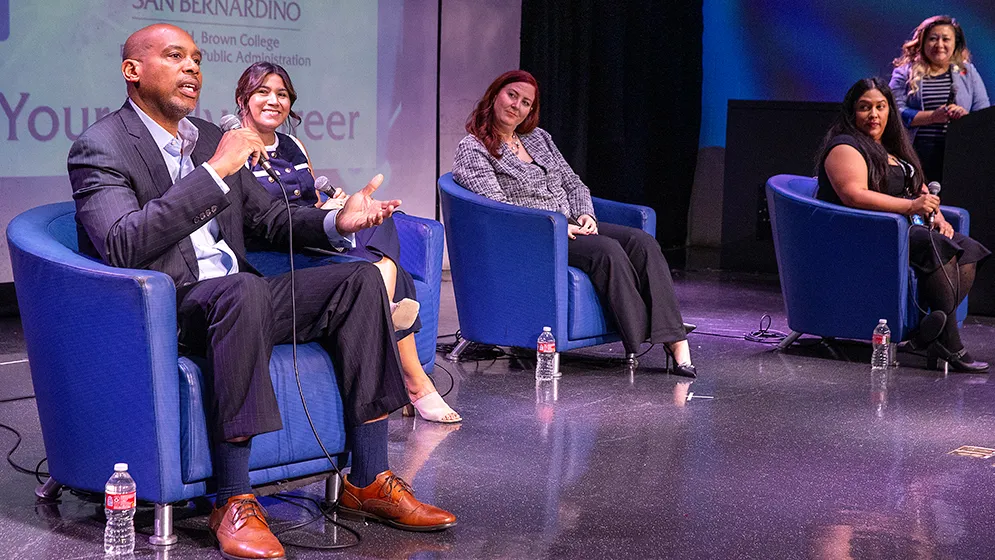
When four human resources professionals were asked what always makes them smile, Jerrold Coakley, senior vice president of human resources at Stater Bros. Markets, didn't hesitate.
“My wife,” he immediately replied, drawing a warm reaction from the audience.
It was one of several lighthearted moments during Cal State San Bernardino's 2026 HR Forum, where students heard candid career advice, personal stories and an encouraging message: You don't need to have your entire future figured out to build a successful career.
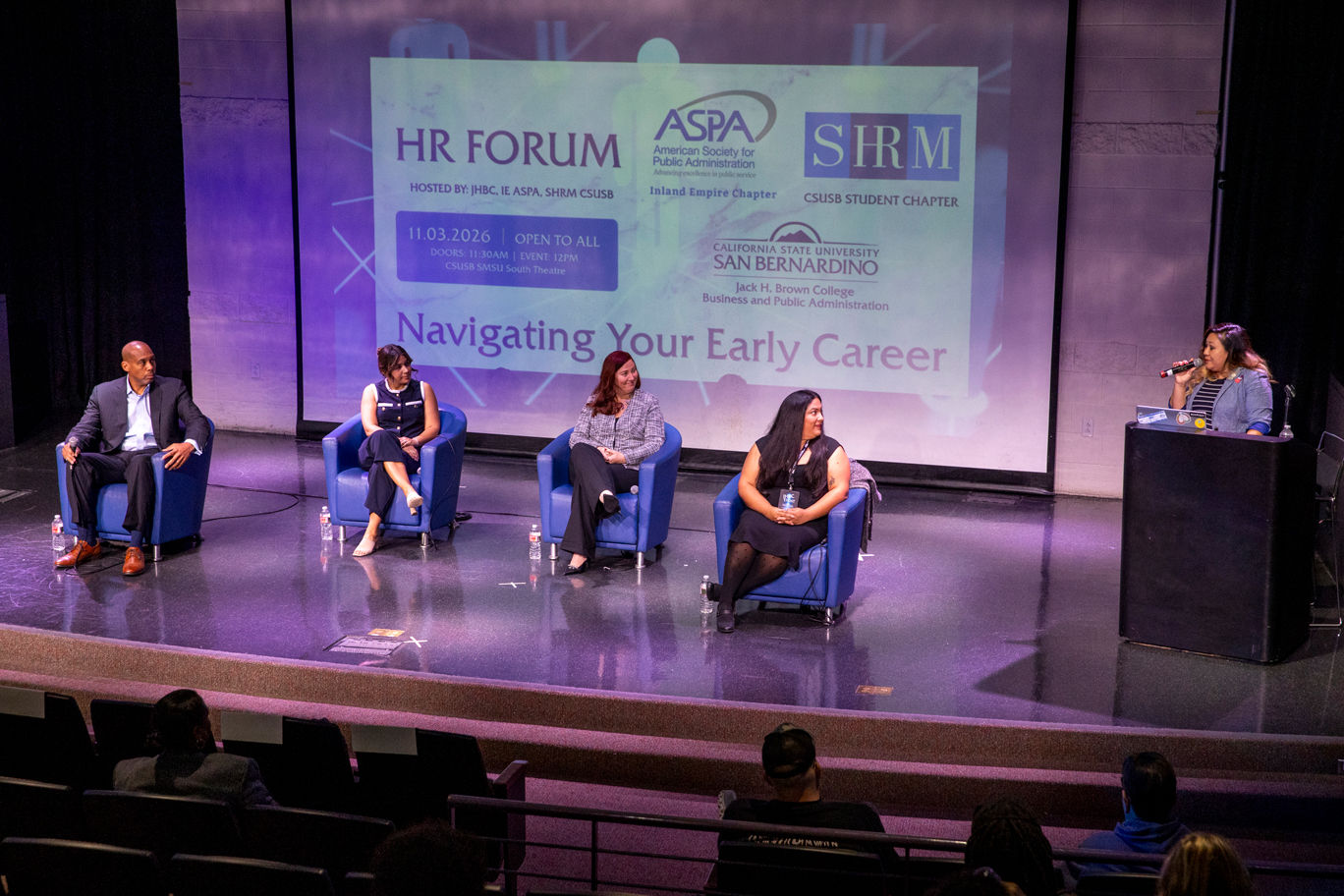
Held Nov. 3 at the Santos Manuel Student Union South Theater, the forum returned to an in-person format for the first time since the COVID-19 pandemic. The event was presented by CSUSB's Jack H. Brown College of Business and Public Administration (JHBC) in collaboration with the Inland Empire chapter of the American Society for Public Administration (ASPA) and the university's student chapter of the Society for Human Resource Management (SHRM).
Tomás Gomez-Arias, dean of JHBC, welcomed attendees, while Craig Seal, professor of management and faculty advisor for the SHRM student chapter, encouraged students to get involved in the organization to take advantage of professional development and networking opportunities.
The panel discussion, “Navigating Your Early Career,” featured four HR leaders representing the retail, hospitality and public sectors:
- Jerrold Coakley, senior vice president of human resources at Stater Bros. Markets
- Stacey Barnier, chief human resources officer at the San Bernardino County Employees' Retirement Association (SBCERA)
- Kayla Kruger, director of human resources at Thompson Palm Springs Resort
- Jenna Yorck, human resources manager for the City of Redlands
The discussion was moderated by Kandy Liu, CSUSB lecturer in public administration, executive director of CSUSB Audit & Advisory Services and president of the Inland Empire ASPA chapter.
Liu opened with a few icebreaker questions that revealed a more personal side of the panelists. When asked what hobby she would most like to master, Kruger admitted that solving a Rubik's Cube had long eluded her. Her motivation? Her son loves the puzzles, and she'd love to be able to challenge him.
When Liu asked whether anyone in the audience knew how to solve one, several hands went up.
“You've got some mentors here,” Liu told Kruger, a playful moment that introduced a topic that would take on a deeper meaning later in the discussion.
Your first job doesn't have to define your future
For students who may feel pressured to choose a career path before they've had a chance to explore their interests, the panelists offered a different perspective.
“Be very, very open-minded. Where you start is not where you're going to end,” Yorck said. “There's something that you can take from everything – good, bad or indifferent.”
Barnier's own career provided a memorable example. Before becoming an HR executive, she worked as a bartender, then a corporate trainer and in payroll before landing her first HR position.
And those bartending skills? They've proven surprisingly valuable.
“I will tell you that I still use my bartender skills in dealing with difficult people,” she said.
Barnier even keeps her restaurant experience on her resume, recognizing the skills she developed in those early jobs.
Coakley encouraged students to focus less on finding the perfect career and more on understanding themselves.
“You don't have to know what you want to be,” he said. “Take the time now to figure out who you are.”
Getting hired takes more than a polished resume
The panelists also shared what they look for in job candidates and how students can make themselves stand out in a competitive hiring process.
Barnier encouraged students to put genuine effort into their applications rather than relying on generic, AI-generated materials. She also stressed that professional communication skills can make a lasting impression, for better or worse.
“I want to know that people who are working for us aren't going to write ‘BRB’ in an email to a member,” she said.
Yorck emphasized the importance of critical thinking, while Kruger pointed out that hospitality employers need people who are adaptable, comfortable working with others and committed to service.
Another important consideration was how well applicants understand the organizations they hope to join. Liu reinforced that point with advice that students might find familiar.
“It sounds like homework,” she said. “You need to put in the effort to make sure that you really understand the organization that you're about to go in and serve.”
Networking, mentorship and finding the right person
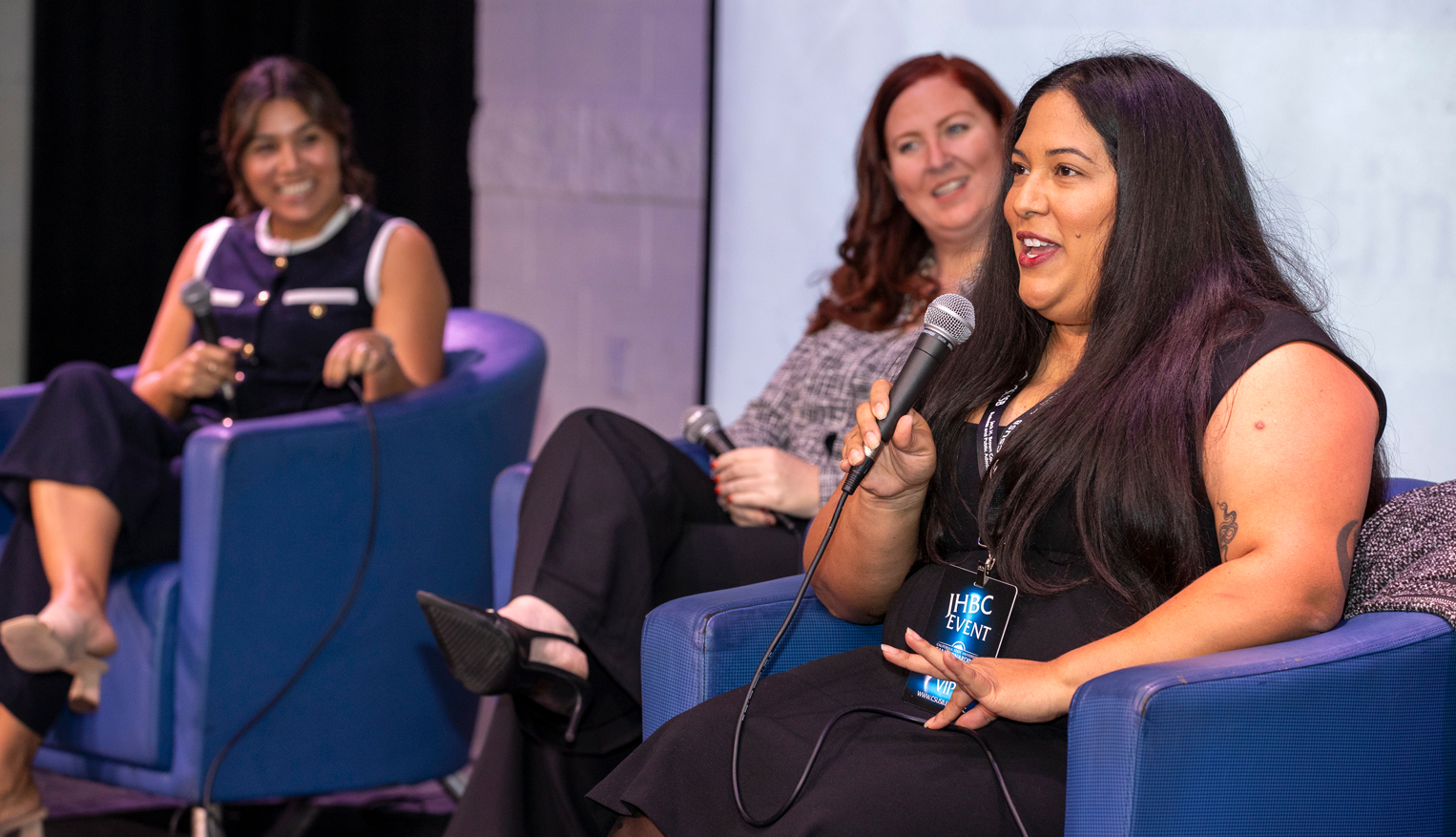
When the conversation turned to networking, several panelists acknowledged that making professional connections doesn't necessarily come naturally, even to people who have built successful careers. Barnier shared that she was painfully shy as a child, to the point that she couldn't order her own food at a restaurant. She eventually took a restaurant job to challenge herself.
For students who feel similarly uncomfortable approaching strangers, she suggested beginning with something manageable.
“Pick one person and make friends with them. Sit next to somebody and talk to them,” she said. “You never know who's going to have that job opening, who's going to want to mentor you.”
Kruger understood another challenge students face: finding time to network while balancing school and work. Having worked her way through college, she recalled how difficult it was to fit anything else into an already demanding schedule.
“I want you to remember that intentionality is attending things that are going to matter to you, that are going to put you on the right path,” she said.
But Coakley offered a more provocative perspective on mentorship, challenging students to think beyond simply finding someone willing to offer career advice.
“Mentorship is overrated,” he said.
His point wasn't that professional relationships lack value, but that students should seek out people who have the ability to actively support their career growth by providing training, opportunities and access to positions that help them advance.
“The most important word in business is development. You want to be developed,” Coakley said.
He emphasized that the right connection can be more valuable than a large professional network.
“You don't need to network with a lot of people,” he said. “You just need one right person.”
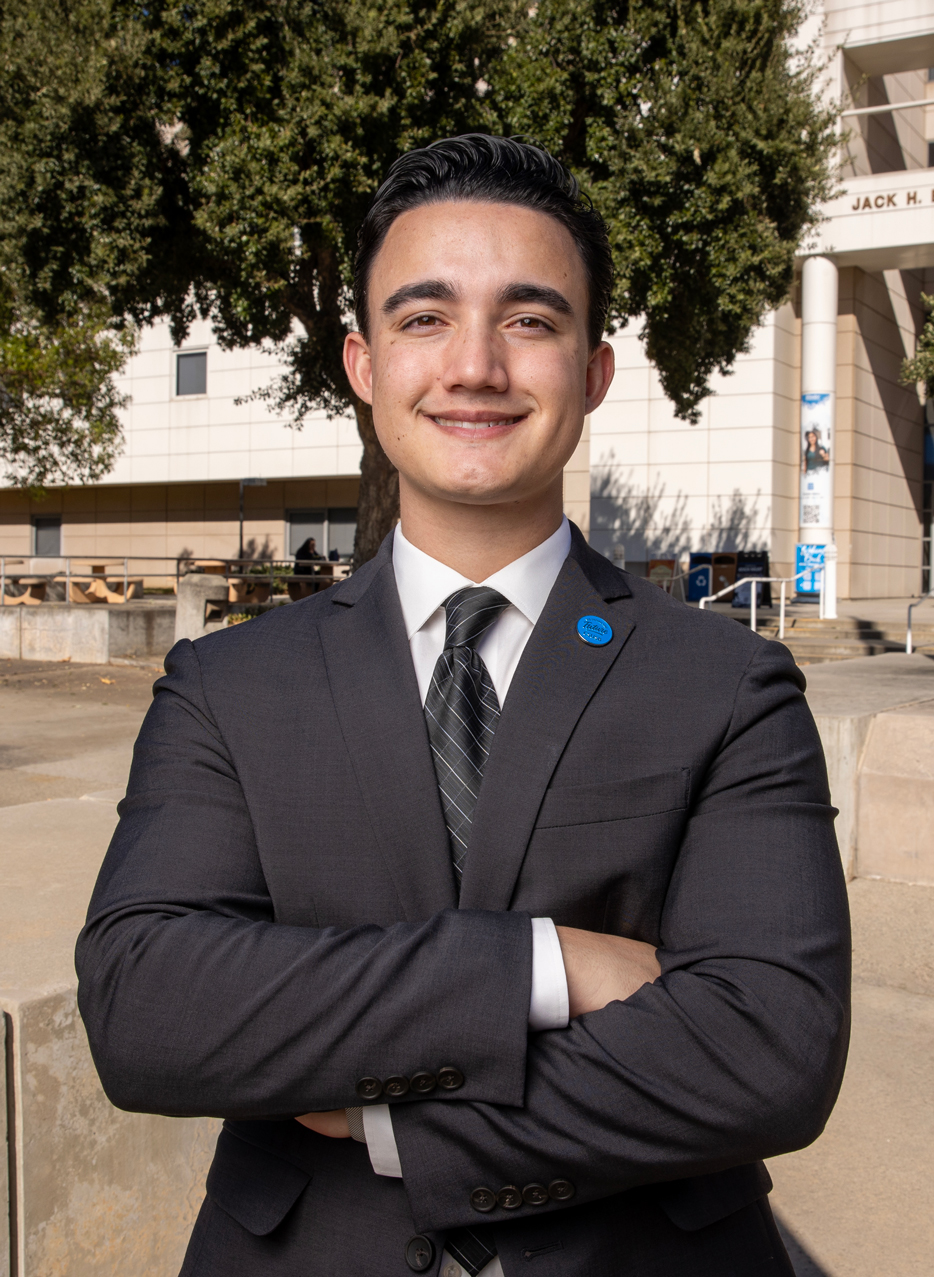
His advice struck a chord with Carson Fajardo, a current CSUSB Master of Public Administration student who also serves as a student trustee on the California State University Board of Trustees.
“Using development over mentorship – looking for people to develop you is something that hits close to home to me,” Fajardo said.
He shared that someone in his professional life recognized his potential and gave him an opportunity to grow.
“They gave me a shot and gave me something they knew I could grow into. Finding people like that in your college career and after college is super important,” he said.
Recognizing the value of who you are
The discussion also challenged another common assumption about career success: that being outgoing is essential to getting ahead.
When Barnier and Yorck acknowledged being introverts, Coakley encouraged students to recognize the strengths that different personalities bring to the workplace.
“There's plenty of greatness in being an introvert. Embrace that and leverage it,” he said.
He pointed out that introverts often bring valuable strengths to the workplace, including the ability to observe, analyze and offer thoughtful insights.
It was another reminder that professional success doesn't require everyone to have the same personality, background or career path.
Creating opportunities for students to grow
For Fajardo, the forum also raised a larger question about how universities can help students build the relationships that lead to meaningful career opportunities.
Speaking from his perspective as a CSU student trustee, he reflected on the value of bringing employers and students together in settings where professional connections can develop naturally.
“How do we facilitate more events like this where students can organically be put in situations where people can see something in them that they didn't see in themselves, just like someone did for me,” he said.
His reflections captured one of the forum's most meaningful messages: Career development isn't just about knowing what you want to do. It's also about finding people who recognize your potential and are willing to help you realize it.
And for students still figuring out their next steps, sometimes all it takes is one person who sees what they could become.