Alan Llavore | Office of Marketing and Communications | (909) 537-5007 | allavore@csusb.edu
As artificial intelligence reshapes industries and changes the skills employers value, what will it take to build a successful career, achieve financial independence and become an effective leader?
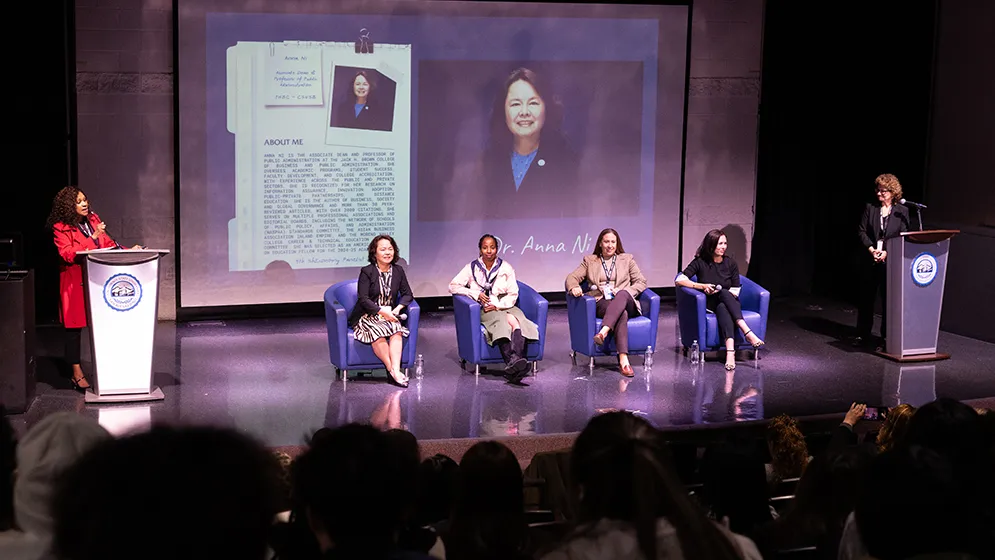
At Cal State San Bernardino’s ninth annual ShEconomy event on Oct. 22, four accomplished women shared their perspectives on navigating a changing workplace, emphasizing that adaptability, communication skills and human connection will remain essential to professional success.
Hosted by the Jack H. Brown College of Business and Public Administration (JHBC) Office of Academic Equity, the hybrid event drew nearly 350 attendees, who participated in person at the Santos Manuel Student Union South Theater and virtually via Zoom.
This year’s theme, “The Future of Work: Building Careers, Wealth, and Leadership,” explored how women can navigate an evolving economy, overcome barriers and create opportunities for themselves and others.
Francisca Beer, professor, associate dean and director of the JHBC Office of Academic Equity, opened the program by examining women's participation in the global economy, including persistent disparities in earnings, wealth accumulation and leadership opportunities.
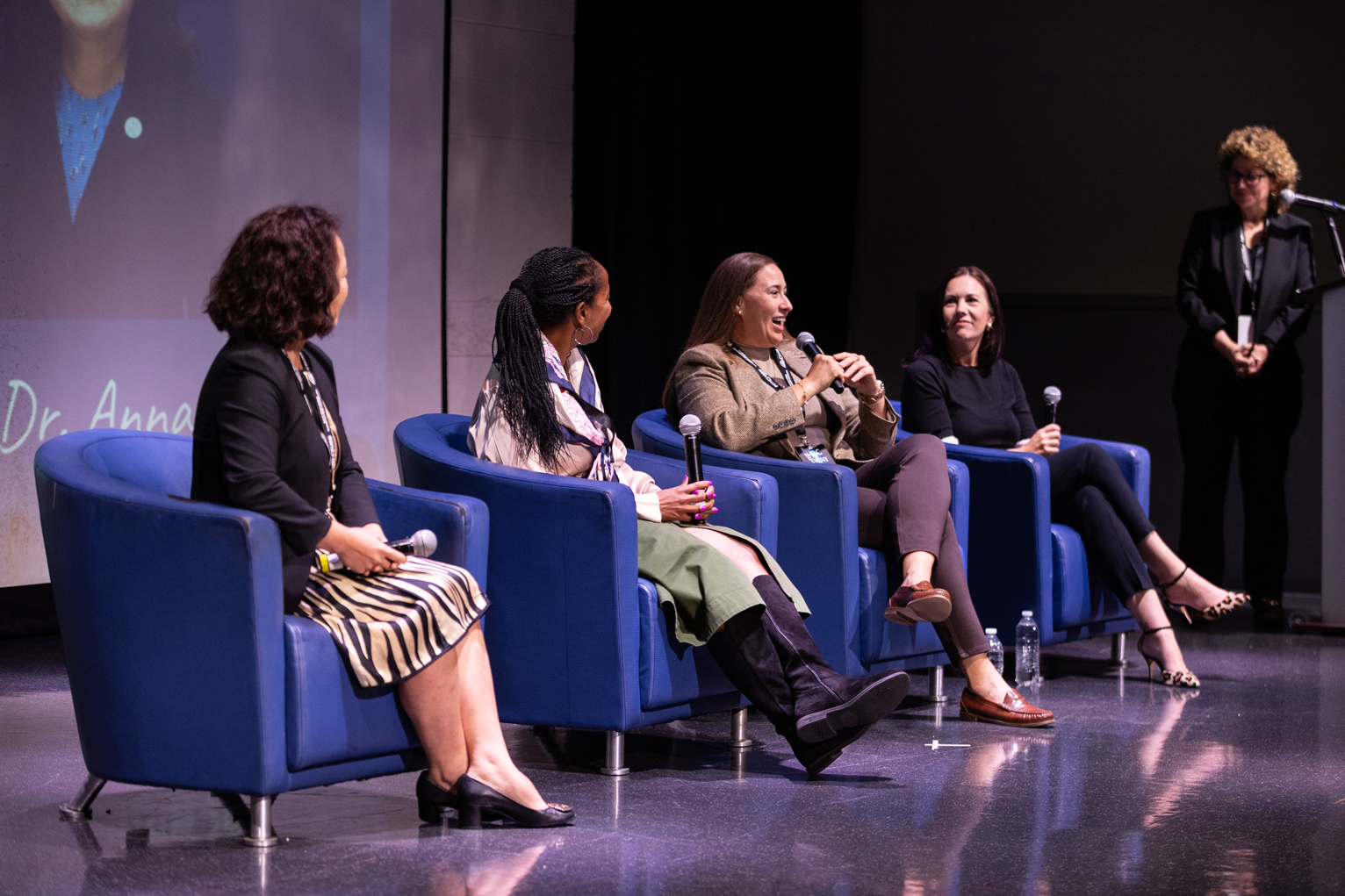
The discussion featured four panelists representing entertainment, banking and higher education: Miranda Lee, a CSUSB alumna and leadership and culture programs lead at Prime Video & Amazon Studios; Kara Dutton, a CSUSB alumna and vice president and business banking relationship manager II at PNC Bank; Nefertiti Long, chief operating officer of Alta Loma Enterprises; and Anna Ni, associate dean of the Jack H. Brown College of Business and Public Administration and professor of public administration.
Drawing from their professional experiences, the panelists discussed the importance of embracing change, developing transferable skills and building meaningful professional relationships.
Dutton, who has navigated nearly two decades of changes in the banking industry, encouraged students to remain adaptable as technology continues to transform the workplace.
“Don't get comfortable because it's changing quickly,” she said.
Lee recalled entering CSUSB's Master of Science in Entrepreneurship and Innovation program intending to complete her degree as quickly as possible. But she soon discovered that some of the most valuable learning opportunities extended beyond the classroom. Rather than rushing through the program, she slowed down to participate in activities that challenged her to pitch ideas, speak publicly and develop confidence.
“I started raising my hand for these opportunities,” she recalled.
Those experiences, she said, helped her build skills she continues to use in her career, particularly the ability to communicate ideas, tell stories and navigate uncertainty.
Long echoed the importance of communication skills, sharing how she initially avoided public speaking and group presentations as a college student, only to discover how essential those abilities would become in her career in finance and business leadership.
“Group dynamics, being able to be influential in a group and to present is what moves businesses forward,” she said.
The panelists also addressed financial empowerment, salary negotiations, mentorship and the importance of advocating for oneself.
During the audience question-and-answer session, the conversation turned to burnout, mental health and maintaining authenticity in the workplace. Panelists shared personal experiences and encouraged attendees to prioritize well-being alongside professional achievement.
As the discussion drew toward its conclusion, Beer asked each panelist to complete a sentence: “The future of work belongs to people who ...”
Their answers captured the evening's central themes:
- For Ni, the future belongs to people motivated to make a difference.
- For Long, it belongs to those who are adaptable to change.
- For Dutton, it belongs to people with drive and determination.
- And for Lee, it belongs to those willing to experiment.
Together, their perspectives offered students a reminder that preparing for the future does not mean having every step of their careers mapped out. It means developing the confidence, curiosity and relationships to navigate whatever comes next.
Reflecting on the evening’s discussion, Tomás Gomez-Arias, JHBC dean, highlighted a common thread running through the panelists’ experiences: the enduring value of human qualities in an evolving workplace.
“I think what really stuck with me was the emphasis you have all put on humanity in the workplace, the importance of being ourselves, working with others, being able to use our judgment,” he said. “Because ultimately that’s what creates value and how we add to the organizations we are working with.”