Alan Llavore | Office of Marketing and Communications | (909) 537-5007 | allavore@csusb.edu
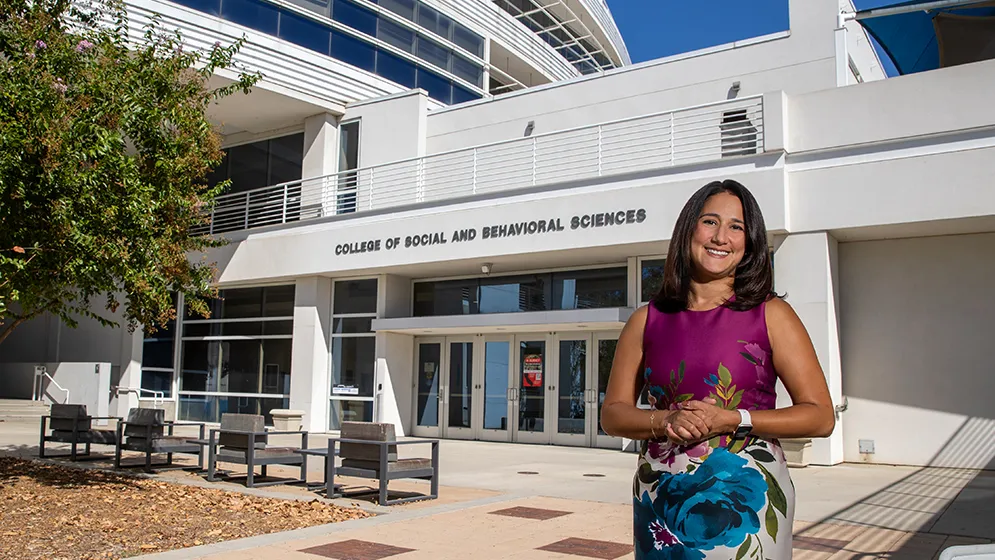

Christina Hassija’s path from community college student to dean of Cal State San Bernardino’s College of Social and Behavioral Sciences has been shaped in large part by her mother, who came to the United States from Cuba as a young teenager.
“My mother, who I think has been most influential in my life, has been incredibly formative to my career and my orientation as an educator, and is a big part of why I ultimately decided to embark on a leadership path,” said Hassija.
Her mother arrived in 1962, when she was 14, as part of Operation Peter Pan, a covert program that airlifted more than 14,000 children out of Cuba after Fidel Castro came to power. Sent with her sister to Nashville, Tennessee, the two were separated, and Hassija’s mother spent time in orphanages and with multiple foster families.
“She didn’t speak any English,” Hassija said. “Ultimately, she had to overcome a lot of barriers, and that was always instilled in me.”
The daughter of two immigrants, Hassija grew up with stories of the barriers her parents faced. Her father came from India to pursue higher education and met her mother at Cal State LA. Both experienced discrimination after arriving in the United States.
Her mother’s journey, however, became an especially powerful influence. After her grandparents were allowed to immigrate and settled in Southern California, her mother joined them. But some of her coursework from Tennessee was not accepted, and at age 19, she was still in high school.
“She met with the counselor and really had to advocate for herself and say, ‘I want to graduate, and I want to be done,’” Hassija said. “She’s just always been a fierce advocate for herself, and I saw that as an important quality.”
She eventually attended community college and transferred to Cal State LA, earning a bachelor’s degree in nursing and later a master’s in nursing at UCLA.
Her mother became a faculty member at Pasadena City College, practiced as a nurse, taught, and often held several jobs while raising her daughters.
“I was always aware of the sacrifices that you need to make in order to be successful in this country,” Hassija said.
Those experiences also shaped Hassija’s academic interests and her decision to pursue a doctorate in clinical psychology.
“I really wanted to understand what differentiates people who are able to adapt following really stressful or traumatic life experiences from those who have more difficulty and how we can foster resilience,” she said. “And I think that came from my mom’s upbringing and experiences that I had as a child.”
Hassija attended Pierce College before transferring to Cal State Northridge, where she realized that doing well academically was only part of preparing for graduate school.
“I never really talked to my professors because I thought that’s only something that you did if you needed help with a paper or you were struggling in a class,” she said. “I very quickly realized, ‘Oh, I need letters of recommendation. Oh, I need research experience.’”
She learned much of what she needed by speaking with other students and observing what they were doing. After earning a master’s degree at CSUN, she was accepted into the clinical psychology doctoral program at the University of Wyoming, where she studied trauma and PTSD.
Hassija went on to complete an internship at the Veterans Administration (VA) Puget Sound Health Care System in Seattle and postdoctoral training at the National Center for PTSD at the VA Palo Alto Health Care System and Stanford University. There, she encountered students whose academic backgrounds were very different from her own.
“A lot of the students that were on my internship and my postdoc had gone to R1s in undergrad, and they had worked with big principal investigators their whole educational careers,” she said. “I always felt a couple steps behind and suffered from imposter syndrome.”
Eventually, she recognized that she belonged in those settings. “I’ve just stayed in those spaces and persisted, and ultimately, I’ve found I’m just as strong or stronger than everybody else,” she said.
Her experience as a transfer student also shaped the kind of support she wanted to provide to students. “There’s those other pieces of information that you really only get from talking to your peers and from talking to your faculty, and those hands-on learning opportunities that really prepare you for those next steps,” she said.
When it came time to pursue an academic career, Hassija applied only to CSU campuses.
“I really wanted to come back to the CSU because I truly believe in our mission,” she said. “What the CSU represents, the students that we serve, and the access, opportunities and pathways we provide are critically important. It is what makes this work incredibly meaningful, empowering and deeply rewarding.”
During Hispanic Heritage Month, Hassija hopes students who see someone with a similar background in a leadership role understand that barriers do not have to determine where they end up.
“I hope that I inspire students like me, students like my mother, to really pursue their goals and to not let systemic barriers or even people that you encounter in your life make you feel like you’re not good enough, question your abilities or question whether you belong,” she said. “Don’t let that noise interfere with your outcomes, because I really think the biggest key to anybody’s success is persistence.”
And she knows that feeling of not belonging does not necessarily disappear with success.
“There will be spaces where you feel like you don’t belong. Even once you’ve succeeded,” Hassija said. “Even once you get to a Ph.D. program. Even once you get a certain kind of job.”
Her advice: “Believe in yourself and just persist anyway.”