Alan Llavore | Office of Marketing and Communications | (909) 537-5007 | allavore@csusb.edu
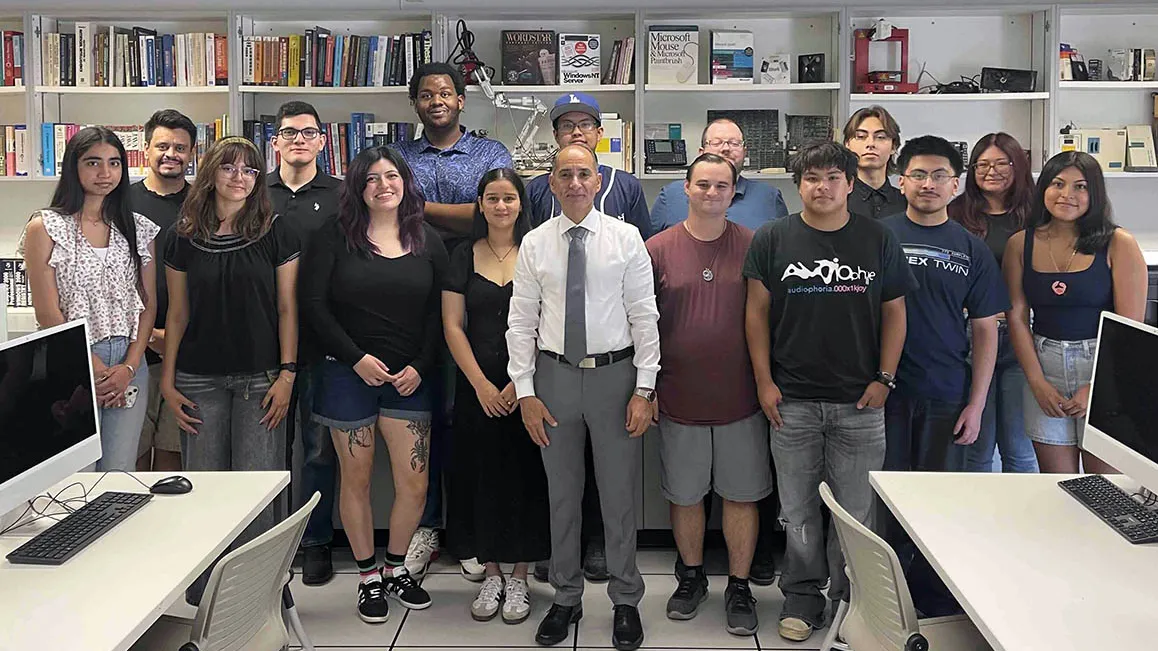
Six Cal State San Bernardino undergraduates are helping chart the future of cybersecurity – one in which artificial intelligence could assist analysts in detecting threats, managing vulnerabilities and responding to security incidents.
Working with faculty mentor Nabeel Alzahrani, adjunct professor in the CSUSB School of Computer Science and Engineering, the students examined how large language models, or LLMs, and autonomous AI agents can support security operations centers, which monitor and protect organizations from cyberthreats.
Their peer-reviewed study, “AI-Augmented SOC: A Survey of LLMs and Agents for Security Automation,” was published in the Journal of Cybersecurity and Privacy in November 2025. Within nine months, it had received more than 23,500 views and several Google Scholar citations as of Aug. 31, making it one of CSUSB’s most accessed and cited research publications within its first nine months.
The undergraduate co-authors are Siddhant Srinivas, Brandon Kirk, Julissa Zendejas, Michael Espino, Matthew Boskovich and Abdul Bari. They conducted the research under Alzahrani’s mentorship through the School of Computer Science and Engineering’s Artificial Intelligence, Quantum Computing, Fusion Energy, and Semiconductors Research and Training Lab, known as the AQFS Lab.
The study synthesizes findings from more than 600 sources published between 2022 and 2025. It explores the use of AI in alert triage, threat intelligence, incident response, report generation, asset discovery and vulnerability management.
The researchers also introduced a capability-maturity model outlining how security operations could progress from primarily manual work to increasingly autonomous, AI-assisted systems.
“Our survey provides a structured roadmap for understanding how LLMs and AI agents can support the evolution of security operations,” Alzahrani said. “Just as importantly, this project demonstrates what undergraduate students can accomplish when given the opportunity to participate directly in rigorous, publication-quality research.”
The six co-authors are part of a broader group of more than 50 undergraduate and graduate students who have participated in research and training through the AQFS Lab. Faculty mentors provide students with hands-on experience in artificial intelligence, cybersecurity, high-performance computing, quantum computing, fusion energy and semiconductor systems.
Sastry G. Pantula, dean of CSUSB’s College of Natural Sciences, described faculty-mentored undergraduate research as a key high-impact practice within the college.
“By engaging students directly in valuable research in artificial intelligence and cybersecurity, we are preparing them to contribute to rapidly advancing fields while strengthening CSUSB’s growing research enterprise,” Pantula said.
Khalil Dajani, director of the School of Computer Science and Engineering, said the project gave students an opportunity to apply theoretical knowledge while developing their technical and analytical skills. Such experiences can prepare students for graduate study, research careers and professional opportunities in AI, cybersecurity and related disciplines, he said.
“This research demonstrates our commitment to advancing CSE undergraduate research by providing students with meaningful opportunities to collaborate closely with faculty on complex, real-world challenges at the forefront of artificial intelligence and cybersecurity,” Dajani said.
For Siddhant Srinivas, from a student's perspective, the project offered an opportunity to move beyond classroom learning.
“Working on this survey was an incredible opportunity to engage with cutting-edge research at the intersection of AI and cybersecurity,” he said. “It allowed us to apply our classroom knowledge to a real-world, publishable study.”
Gerard Au, CSUSB’s chief information officer, said the work supports the university’s efforts to prepare students for a changing technology workforce, particularly in high-demand fields such as AI and cybersecurity. “These opportunities,” he said, “help students build the knowledge, skills, and experience needed for emerging careers while advancing student success and directly supporting CSU Forward initiatives.”
Through faculty mentorship, the AQFS Lab and a growing community of student researchers, CSUSB’s School of Computer Science and Engineering is connecting AI research with cybersecurity and other critical and emerging technologies.