Alan Llavore | Office of Marketing and Communications | (909) 537-5007 | allavore@csusb.edu
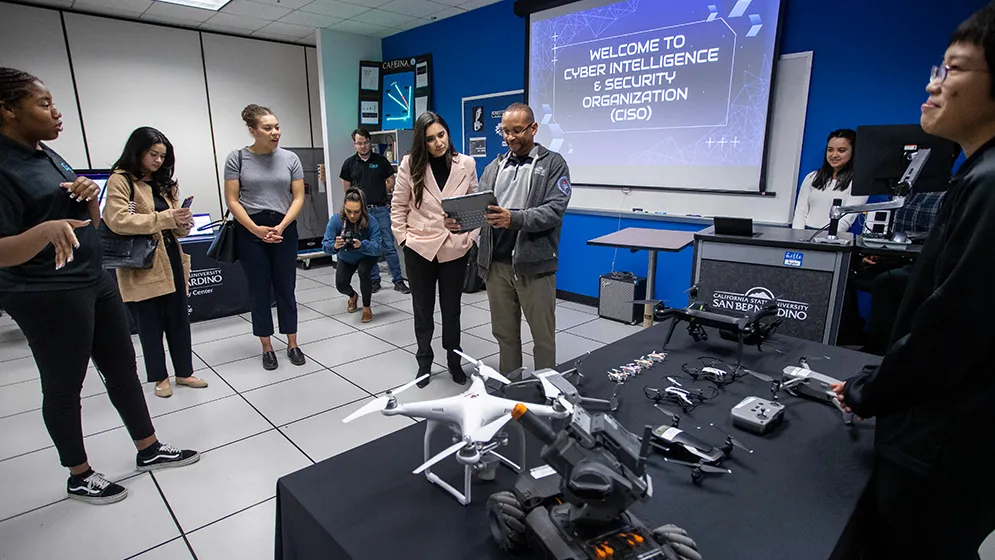
Cal State San Bernardino has been selected as one of just 14 universities nationwide to receive an inaugural award from the U.S. National Science Foundation’s CyberAICorps Scholarship for Service program, advancing the university’s work to prepare the next generation of professionals at the rapidly evolving intersection of artificial intelligence and cybersecurity.
The award will support CSUSB’s project, “CyberAI SFS: Building a Federal Workforce Pipeline of AI-Enabled Cybersecurity Professionals,” through the university’s Center for Cyber and AI.
The new CyberAICorps Scholarship for Service program expands NSF’s longstanding cybersecurity Scholarship for Service initiative to address the growing convergence of AI and cybersecurity. The program is designed to prepare students to use AI to strengthen areas such as threat detection, incident response and digital forensics, while also developing the expertise needed to make AI systems more secure and resilient against emerging cyber threats.
“As part of its advanced AI and cyber security education initiatives, the Center for Cyber and AI includes an operational Security Operations Center, national AI projects including the AI Horizon and AI4ward projects, and coming soon, a new AI and VR Retraining Center,” said Tony Coulson, executive director of CSUSB’s Center for Cyber and AI. “This CyberAICorps award further helps our students and community, while demonstrating the cutting-edge technology education at CSUSB.”

CSUSB was selected alongside institutions including Arizona State University, Texas A&M University, Vanderbilt University and the University of Central Florida following NSF’s competitive merit review process.
“Through the CyberAICorps Scholarship for Service program, NSF is investing in the talent needed to secure today's digital infrastructure and AI-enabled technologies and advance the nation’s capacity to meet evolving cybersecurity threats,” said Brian Stone, performing the duties of the NSF director.
For CSUSB, the award builds on more than 15 years of participation in NSF’s Scholarship for Service program. The university’s program began in 2009 and has helped more than 130 students prepare for careers serving the nation through federal, state, local and tribal government agencies.
Through the Scholarship for Service model, eligible CSUSB students receive financial support for their education while gaining specialized preparation for careers in government. The university’s current program provides support for tuition and books, along with a monthly stipend, with scholarships valued at up to $57,000 for undergraduate students and up to $85,000 for graduate students. In exchange, graduates complete a government service commitment.
The new CyberAI focus reflects a workforce in which cybersecurity professionals increasingly need to understand not only how AI can be used as a tool for cyber defense, but also how to protect AI-enabled systems themselves.
Across the inaugural CyberAICorps projects, students will have opportunities to develop those skills through integrated coursework and hands-on experiences such as faculty-mentored research, virtual cyber training, security laboratories, internships, capstone projects and work addressing real-world government and critical infrastructure challenges.
The award also reinforces CSUSB’s longstanding national leadership in cybersecurity education and workforce development.
CSUSB’s Center for Cyber and AI is nationally recognized for developing innovative, applied approaches to cybersecurity education. Since 2010, the center has attracted tens of millions of dollars in grants and sponsored programs from agencies and organizations including NSF and the National Security Agency, creating opportunities for students to earn scholarships, conduct research, participate in national conferences and gain hands-on experience with emerging cybersecurity challenges.
CSUSB was first designated a National Center of Academic Excellence in Information Assurance in 2008 and was redesignated as a National Center of Academic Excellence in Cyber Defense through 2028. The university also serves as the National Center for the Centers of Academic Excellence in Cybersecurity Community, helping support and connect hundreds of CAE-designated colleges and universities across the country.
The Center for Cyber and AI’s work has increasingly expanded into artificial intelligence as the technology reshapes both the cybersecurity workforce and the threats it must confront. Its initiatives include AI Horizon, which provides resources to help students, educators and professionals understand how AI is changing jobs and skills, with particular attention to the intersection of AI and cybersecurity.