Alan Llavore | Office of Marketing and Communications | (909) 537-5007 | allavore@csusb.edu
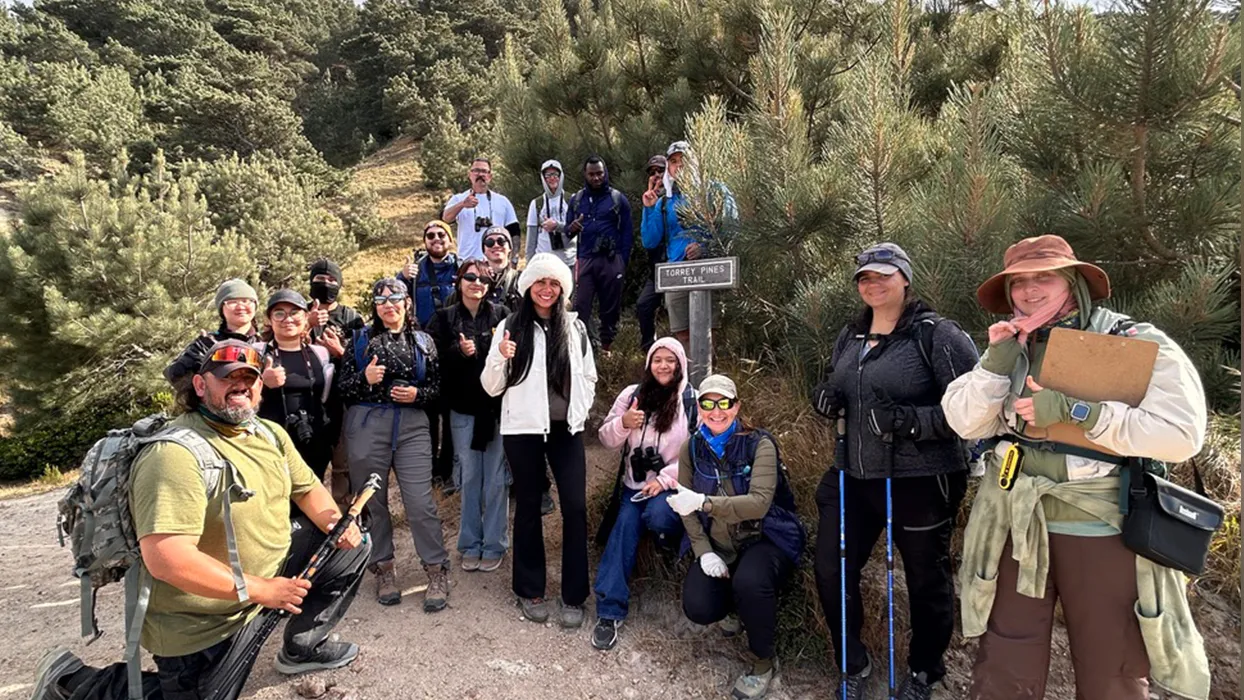
In May, less than two weeks after CSUSB students hiked amidst the rare Torrey Pine grove on Santa Rosa Island — one of only two places on Earth where the critically endangered species grows — a wildfire scorched nearly one-third of the island. Their photographs may now be among the last scientific records of what was there.
The students, 20 in all, were part of Professor Yolonda Youngs’s National Parks and Public Lands class (GEOG 5240) on a research and field trip to Channel Islands National Park and UNESCO Biosphere Reserve in May. The 16-week course is capped by a three-day backcountry expedition. Youngs is a professor of environmental studies and interim director of the Honors College.
An internationally recognized scholar and expert on U.S. National Parks and UNESCO sites, Youngs said that during the trip, the students gain access to hands-on field research. "Many of my students have never even been to the beach, never camped, never hiked more than a mile,” she said. “And this class provides the opportunity to learn field research on a remote island."
The Channel Islands are known as “The Galapagos of North America,” reached by a boat trip about four hours from the central coast of California.
And Youngs is the only CSUSB faculty member doing research there. A seasoned expeditioner, she plans every aspect of the trip and has been instrumental in securing grants for students to defray costs. She also coordinates field lectures, including one by National Park Service Superintendent Russell Galipeau, the former superintendent of Channel Islands National Park.
For the past three years, Youngs has taken a spring trip with students to the island, training them in repeat photography and long-term environmental monitoring. Students return to the same GPS-tagged site each year to photograph and document landscape change, precisely the skills California environmental agencies look for when hiring.
“My students know how to not just take a good picture, but how to take a scientifically accurate, photograph that can be used by researchers and for documentation,” she said. “Those skills transfer directly to the jobs they get after graduation.”
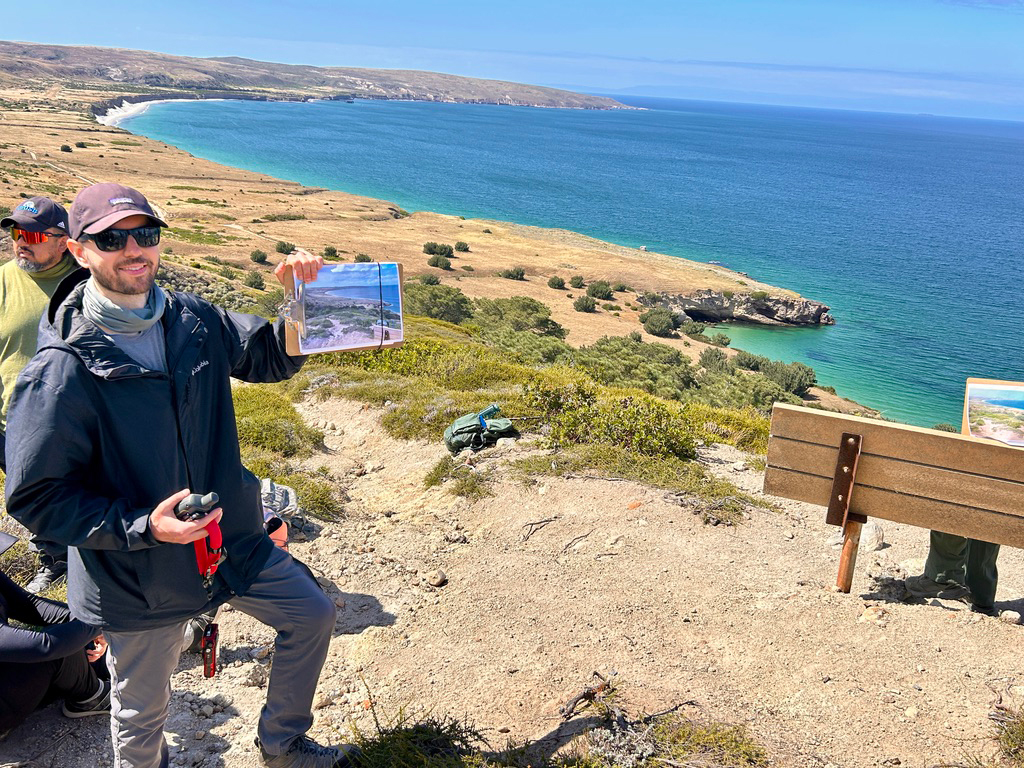
Four of the students in the class were awarded CSU COAST grants, while two received CSUSB’s Office of Student Research and Innovation eTIPS Research Experience grants.
Matthew Scully, 39, is a U.S. Army veteran pursuing a second bachelor's degree at CSUSB. He enrolled in the course during his first semester in 2025 — and returned this spring as an eTIPS-funded head field research assistant.
“On the first day of class, [Youngs] told us about this trip, and I was just amazed. It didn't seem possible — to go somewhere for multiple days, overnight, at a remote location on an island,” he said. “And then I thought, 'Oh, I think I'm in the right place.'"
After graduating in December, Scully hopes to pursue a master’s in environmental management. "I have this experience on my resume — experience and skills with repeat photography and environmental monitoring. It shows that I can be in remote locations and work with small teams to do this type of research,” Scully said.
While the Torrey Pine grove was spared extensive damage from the wildfire, the scientific documentation conducted by Cal State San Bernardino students on Santa Rosa Island will provide valuable data for scientists and researchers far into the future.