Alan Llavore | Office of Marketing and Communications | (909) 537-5007 | allavore@csusb.edu
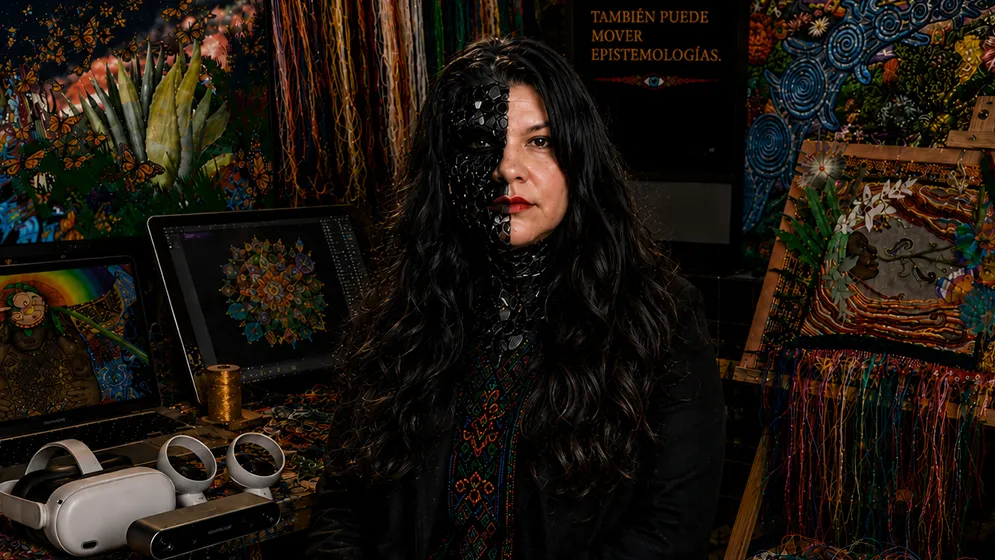
For Liliana Conlisk Gallegos, art doesn’t have to stay on a wall – or within the boundaries of a single culture, medium or technology.
This August, the Cal State San Bernardino professor of communication and media will take that idea to Mexico City, where her internationally recognized new media artwork will be featured in an exhibition at the Centro Nacional de las Artes (CENART), one of Mexico’s leading centers for arts education, research and creative practice.
Conlisk Gallegos’s project, “NepantlX: No-Muralismo transfronterizo y entremundos (NepantlX: Transborder No-Muralism and In-Between Worlds),” will be exhibited Aug. 27-Sept. 15 at the Laboratorio de Imágenes en Movimiento (Moving Images Laboratory) at CENART's Centro Multimedia. The exhibition is part of “DECLIVE: programa de estudios sobre animación e interdisciplina,” a program exploring animation and interdisciplinary practices.
She will also give an invited artist talk, “Expanded Animation and Transborder Tactics: Epistemic Displacements in Technologies of Representation,” exploring how animation, technology and creative practices can move across borders – geographic, cultural and technological – and create something new in the spaces between them.
That idea of creating “in between” worlds runs throughout Conlisk Gallegos’s work.
Central to her artistic practice is No-Muralismo, or non-muralism, a framework she developed that takes the tradition of muralism beyond the wall and reimagines it through immersive and expanded media. Drawing on transborder perspectives, rasquache and artisanal practices, and a mix of digital and physical technologies, her work explores identity, memory, colonialism and the experience of living between cultures.
The CENART exhibition is the latest stop in an international journey for that work.
The exhibition includes “The Coyolxauhqui Imperative 2020” and “Before the Sixth Sun: A Codex for Our Children,” which have appeared at major museums, festivals and events around the world, including Ars Electronica in Austria, ISEA in Australia, museums in China, the MexiCali Biennial and UCR ARTS as part of Getty PST ART: Art & Science Collide.
In 2023, “The Coyolxauhqui Imperative 2020” earned a particularly notable place in the history of digital art and technology when it was selected for the ACM SIGGRAPH 50th Anniversary Autodesk Time Tunnel in Los Angeles. The installation traced 50 years of advances in computer graphics and interactive technologies, placing Conlisk Gallegos’s work on a timeline alongside landmark projects associated with Industrial Light & Magic, Pixar and Wētā FX.
Her ideas have traveled just as widely as her artwork. Conlisk Gallegos has delivered keynote and invited presentations internationally on experimental and expanded animation, decolonial new media art and transborder approaches to technology. Her research has appeared in scholarly publications, and her writing and curatorial work have reached audiences across languages, with translations into Spanish, Korean and Chinese.
Now, bringing the work to Mexico City gives Conlisk Gallegos another opportunity to explore the very idea at the heart of her practice: what can happen when art, technology, cultures and ways of thinking meet.
“It is especially meaningful for me to share this work at CENART, in dialogue with practices of animation, interdisciplinarity, memory, technology and transborder thought,” she said.
Part of the work included in the exhibition was made possible through the support of Mihaela Popescu, professor of communication studies, and a grant from the CSUSB xREAL Lab.