Alan Llavore | Office of Marketing and Communications | (909) 537-5007 | allavore@csusb.edu
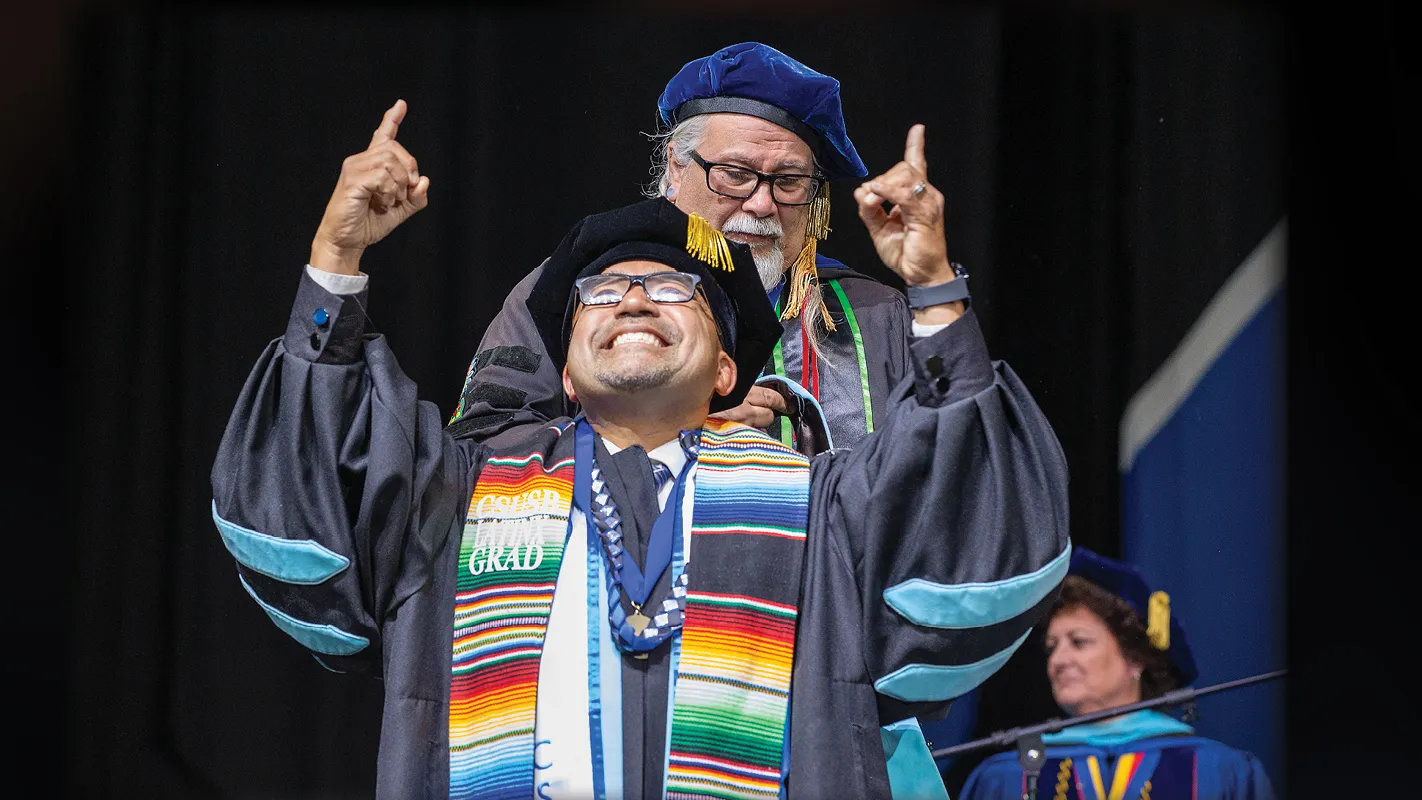
California State University, San Bernardino reported a 333% increase in on-time completion in its Doctorate in Educational Leadership program, marking what campus officials called the strongest improvement in the program’s history.
New data compare two consecutive cohorts – 15 and 16 – following a multi-year redesign aimed at improving equity, academic support and student progression in the three-year doctoral program, housed in the James R. Watson and Judy Rodriguez Watson College of Education.
Cohort 16, which entered in fall 2022, recorded a 62% on-time completion rate, with 13 of 21 students finishing their degrees within the eight-semester structure. One student finished after three years, four remain in progress, and three were dismissed.
By contrast, Cohort 15, which began in fall 2021, had a 14% on-time completion rate. Only three of 22 students finished on schedule, while seven completed after three years, three remain in progress, three were dismissed and six never enrolled. CSUSB officials said the increase represents 10 more students completing on time than the previous year.
Watson College of Education (WCOE) leaders attributed the gains to a series of intentional program changes, including a structural redesign, expanded academic and advising support, curriculum updates and broadened faculty engagement. Key initiatives included restoring the Ed.D. program’s standalone status, transitioning from quarters to semesters, creating a weekend executive modality for working professionals and introducing mission-aligned admissions criteria.
Recruitment efforts also expanded, with annual applications increasing from about 40 to more than 100, raising the program’s visibility and allowing admissions to grow to 25 students per cohort. A new full-time program specialist was credited as a decisive factor in improving student progress monitoring and individualized support.
Faculty involvement increased sharply as the program grew its roster from 20 to 125 faculty and fellows, and added retreats, governance updates and expanded dissertation support. New curriculum features, such as Laboratories of Practice, qualifying exam seminars and dissertation workshops, were introduced to align coursework with real-world problems of practice.
The program also launched community partnerships, including a Community Advisory Board and the Rancho Academy, and expanded equity-focused efforts such as the Holmes Scholar Program. Additional financial and professional development resources were created through a Financial Aid Resource Guide, wellness workshops and mentoring pathways.
CSUSB leaders said the program’s improvements contributed to broader institutional milestones, including the university’s rating of “Exemplary” in the Ed.D. program’s most recent five-year self-study. The university reported that its ranking among the top 20% of U.S. doctoral education programs was directly influenced by the program’s redesign and outcomes.