Alan Llavore | Office of Marketing and Communications | (909) 537-5007 | allavore@csusb.edu
White supremacy does not exist only in public rallies or extremist propaganda. It also takes shape in private homes, music festivals, online communities and other spaces where hate can be cultivated beyond public view.
That hidden world is the focus of an upcoming conversation with Pete Simi, a Chapman University sociology professor who has studied extremist groups and violence for more than 25 years. Simi will discuss “American Swastika: Inside the White Power Movement’s Hidden Spaces of Hate,” the book he co-authored with Robert Futrell, at the next Conversations on Race and Policing, scheduled for noon on Nov. 4.
The event will be held on Zoom and is free and open to the public.
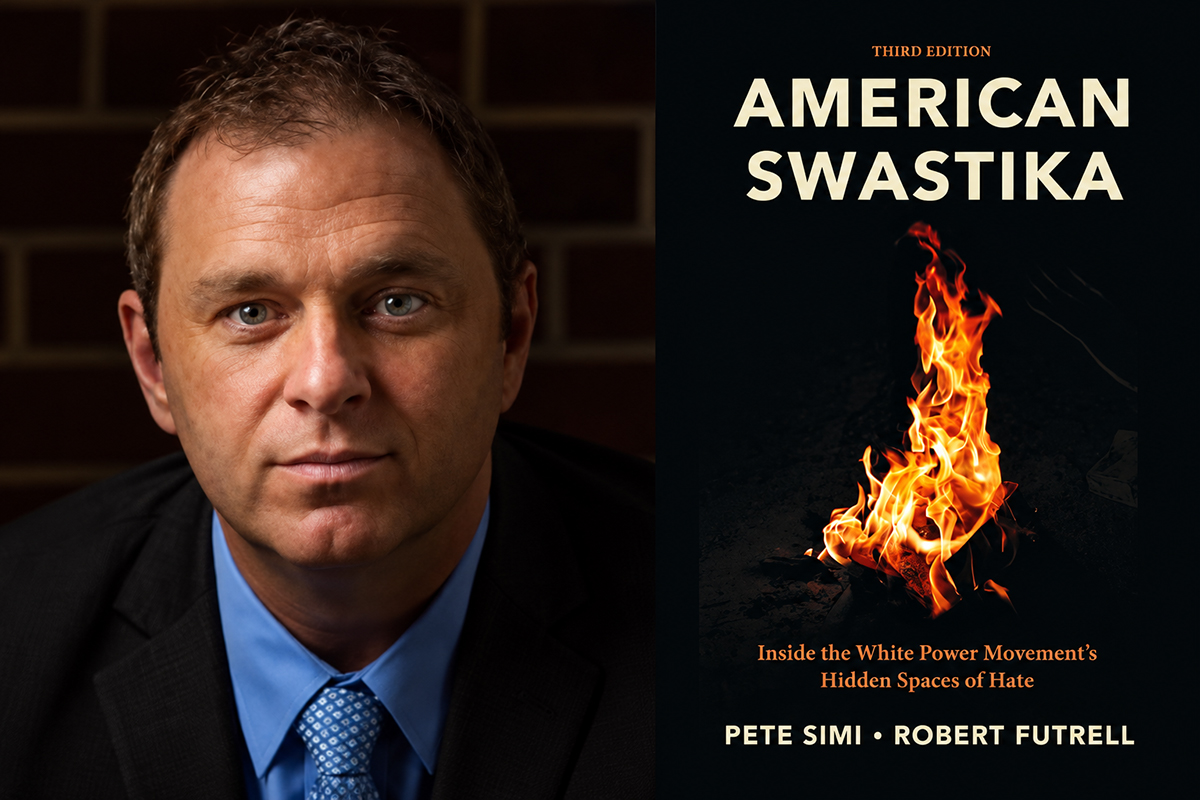
The book’s third edition, published in 2024 by Rowman & Littlefield, examines how white supremacist activism developed through homes, parties, rituals, music festivals and digital media. Through case studies, interviews and first-person accounts, it connects the movement’s past circumstances with present conditions.
The updated edition discusses new participants in the white power movement, emerging hate music genres and changes in the white power music festival scene. It also examines mainstream and fringe networking platforms, retail sites and video gaming sites as places where white supremacists connect and cultivate their culture.
Simi and Futrell also address the movement’s increased visibility in American political life, challenging the idea that its recent prominence is entirely new. The book examines the Biden administration’s attention to domestic terrorism while identifying the challenges involved in confronting white supremacy.
Simi is a member of the National Counterterrorism Innovation, Technology, and Education Center at the University of Nebraska Omaha, a Department of Homeland Security-funded research center focused on terrorism. He also frequently serves as an expert legal consultant in criminal and civil cases involving political extremism.
The Conversations on Race and Policing program began following the May 25, 2020, murder of George Floyd and its aftermath. Floyd, a Black man, was killed by a white Minneapolis police officer, triggering widespread protests, demands for systemic policing reforms and profound discussions about race and racism. The events also led to the creation of Cal State San Bernardino’s Conversations on Race and Policing, abbreviated as CoRP.
In subsequent court cases, three other former Minneapolis police officers implicated in Floyd’s death received prison sentences.
The series has featured scholars, journalists, law enforcement officers, lawyers, activists, artists, educators, administrators and others from throughout the nation who have shared their experience and expertise on issues related to race and policing.
Since June 2020, more than 140 forums have taken place, and video recordings of the sessions have been posted in the Conversations on Race and Policing Lecture Series Archive.
Programs take place every Wednesday beginning at noon unless otherwise noted. Upcoming speakers include:
- Nov. 18 – Clay Risen, “Red Scare: Blacklists, McCarthyism, and the Making of Modern America.”
- Thursday, Nov. 19 – Elizabeth Stordeur Pryor, “Something We Said: Richard Pryor, a Notorious Word, and Me.
- Dec. 2 – Janet Reitman, “The Inheritance: An American Tragedy in Five Acts.”
The organizing team for Conversations on Race and Policing includes Michael German, Stan Futch, Amber Broaden, Robie Madrigal, Jeremy Murray, Matt Patino and Mary Texeira, representing CSUSB and collaborating community and educational organizations.
For more information, contact Madrigal at rmadriga@csusb.edu or Murray at jmurray@csusb.edu.
Also visit the Conversations on Race and Policing webpage.