Alan Llavore | Office of Marketing and Communications | (909) 537-5007 | allavore@csusb.edu
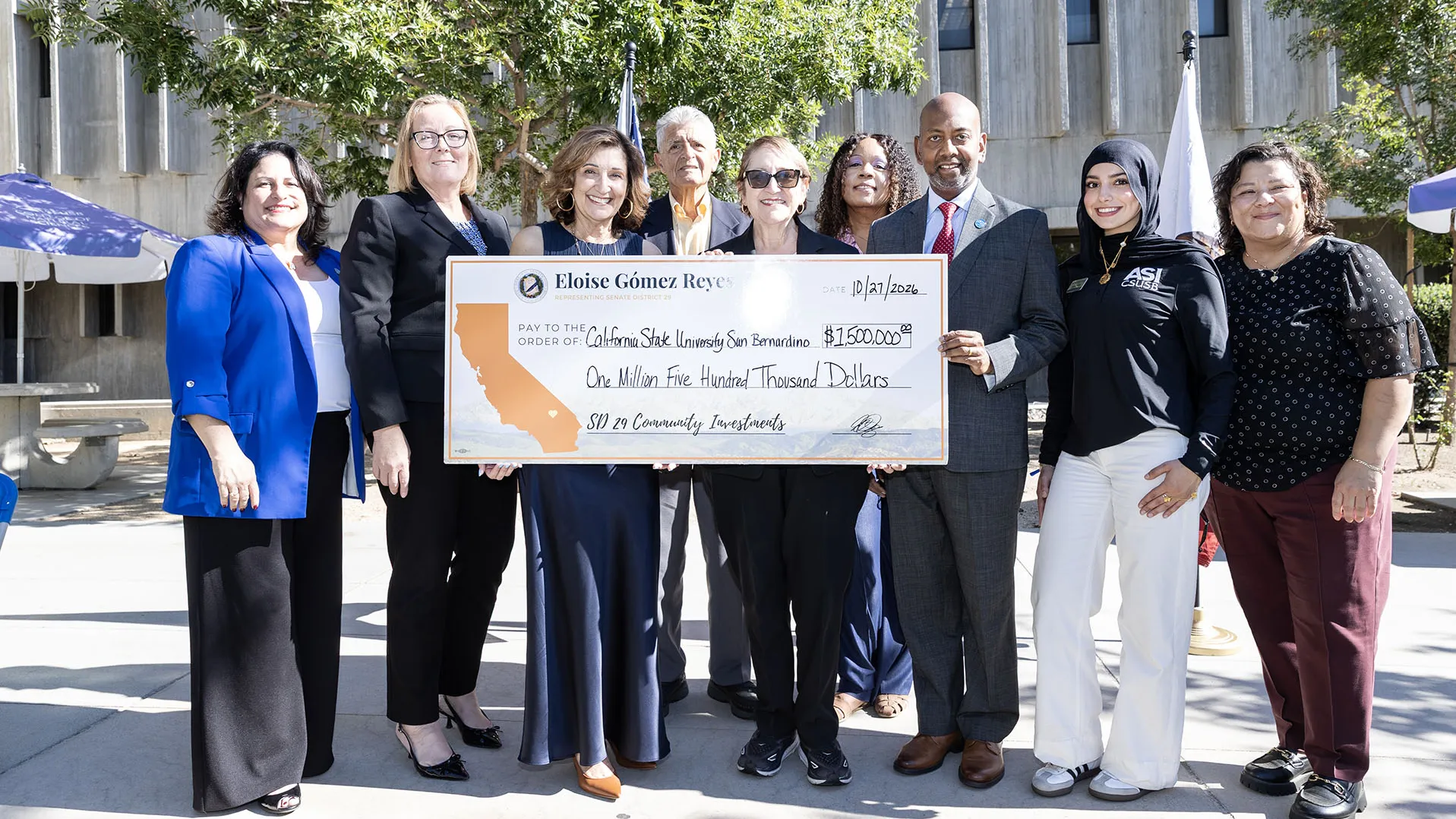
For more than 50 years, the Biological Sciences Building has supported instruction, research and discovery at Cal State San Bernardino. Now, a $1.5 million state investment will help prepare the aging facility for the next generation of students.
State Sen. Eloise Gómez Reyes presented the ceremonial funding check to CSUSB President Terri Gómez and university officials Tuesday outside the building, which opened in 1968 – three years after the university first opened its doors to students. The funding will replace outdated heating, ventilation and air conditioning controls in the facility’s classrooms and laboratories.
“When we invest in Cal State San Bernardino, we invest in the talent, the ambitions, and the future of our region,” Gómez Reyes said. “We want students from our communities to have every opportunity to pursue careers in science, contribute new discoveries, and bring their skills back to serve this region.”
At CSUSB, the funding will address deferred maintenance while improving energy efficiency, temperature regulation and ventilation reliability throughout the Biological Sciences Building.
“This $1.5 million investment will help us address critical deferred maintenance in our Biological Sciences Building – an investment in our students, our faculty and our staff,” Gómez said. “When we talk about student success, we often focus on academic programs, student support services, scholarships and opportunities for engagement. All of these are essential, but student success is also supported by something we don't always mention – the physical environment in which our students learn.”
Jennifer Sorenson, CSUSB’s chief administrative officer for Finance, Technology and Operations, said the project will replace the building’s older HVAC controls with modern digital controls.
“The Biological Sciences Building opened in 1968,” Sorenson said. “For more than five decades, it has supported instruction, research and discovery.” The upgraded system will provide centralized, real-time monitoring and automated controls, allowing facilities staff to optimize temperatures and ventilation, identify system faults remotely and respond more quickly to problems.
The project builds upon $6.4 million in prior state investments that funded energy-efficiency and HVAC modernization projects in University Hall and the John M. Pfau Library, as well as preliminary engineering and design work for additional campus renovations.
“Deferred maintenance funding is not simply about repairing old equipment,” Sorenson said. “It's about protecting the future of public higher education and ensuring our campus remains safe, functional, sustainable, and ready to serve our students.”