Alan Llavore | Office of Marketing and Communications | (909) 537-5007 | allavore@csusb.edu
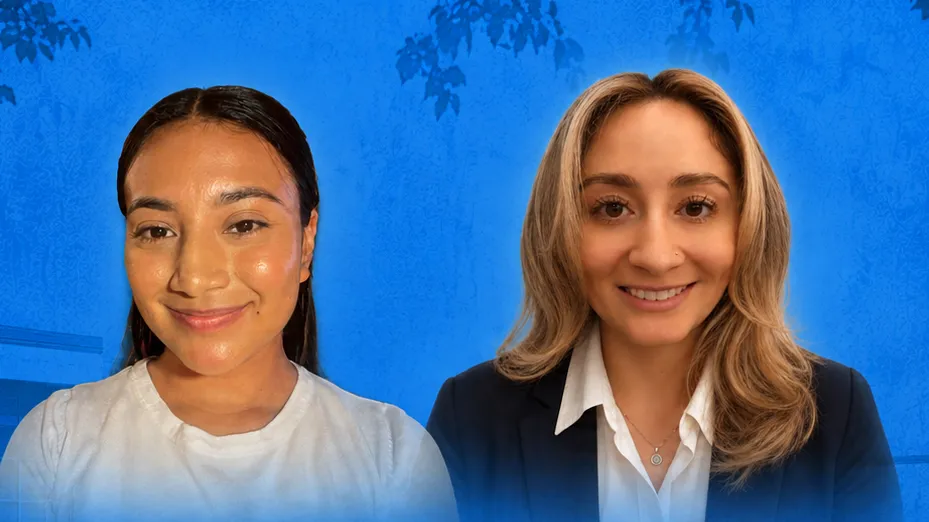
Two Cal State San Bernardino alumni pursuing doctoral degrees have been named fellows in the California State University Chancellor’s Doctoral Incentive Program, which supports aspiring college professors.
Veronica Morales of Highland and Stepfanie Alfonso of Wrightwood were selected for the program, known as CDIP. The program provides CSU faculty mentorship, professional development and access to financial assistance for doctoral students interested in faculty careers in the CSU or at other institutions focused on student success.
Morales, a second-year doctoral student in English literature at the University of Southern California, earned her bachelor’s degree in English literature and master’s degree in English literature, composition and rhetoric from Cal State San Bernardino. She remains a resident of the Inland Empire.
Her interdisciplinary research examines ethnic American literature, coloniality, carcerality and state power, drawing from ethnic studies, abolitionist theory and decolonial studies. Her current work explores policing and community writing through the genre of police reports, as well as prisons and jails, environmental justice, memory and resistance in local communities.
Before beginning her doctoral studies, Morales worked with the Justice Education Center at Pitzer College, supporting initiatives to expand access to higher education and build community-centered learning spaces inside and outside prisons.
Alfonso is a second-year doctoral student in mass communications at Penn State’s Donald P. Bellisario College of Communications. She earned both her bachelor’s and master’s degrees in communication studies from CSUSB.
Her research examines how digital platforms and emerging technologies shape power, labor, participation and inequality. Her work focuses in part on economically valuable labor that can be obscured by digital activities involving play, intimacy, creativity and community.
Her current research examines platform governance and hidden forms of labor in immersive and digitally mediated environments, including children’s “playbour” (a hybrid of play and labour) in platform economies and labor involving connected technologies.
Alfonso also studies surveillance and data extraction, digital infrastructure, information and telecommunications policy, and the social and economic effects of emerging technologies. After earning her doctorate, she plans to pursue an academic career and hopes to become a professor in the CSU system, combining research with teaching, mentorship and educational equity.
As CDIP fellows, Morales and Alfonso will work with CSU faculty mentors and have access to professional development designed to prepare them for academic careers.
The program also offers competitive financial support, including doctoral education grants of up to $2,500 annually, conference travel awards of up to $1,500 twice a year and a one-time dissertation award of up to $5,000. Awards are subject to budget considerations. Fellows also have access to an optional loan that can be forgiven if they obtain an instructional faculty position in the CSU system.