Alan Llavore | Office of Marketing and Communications | (909) 537-5007 | allavore@csusb.edu
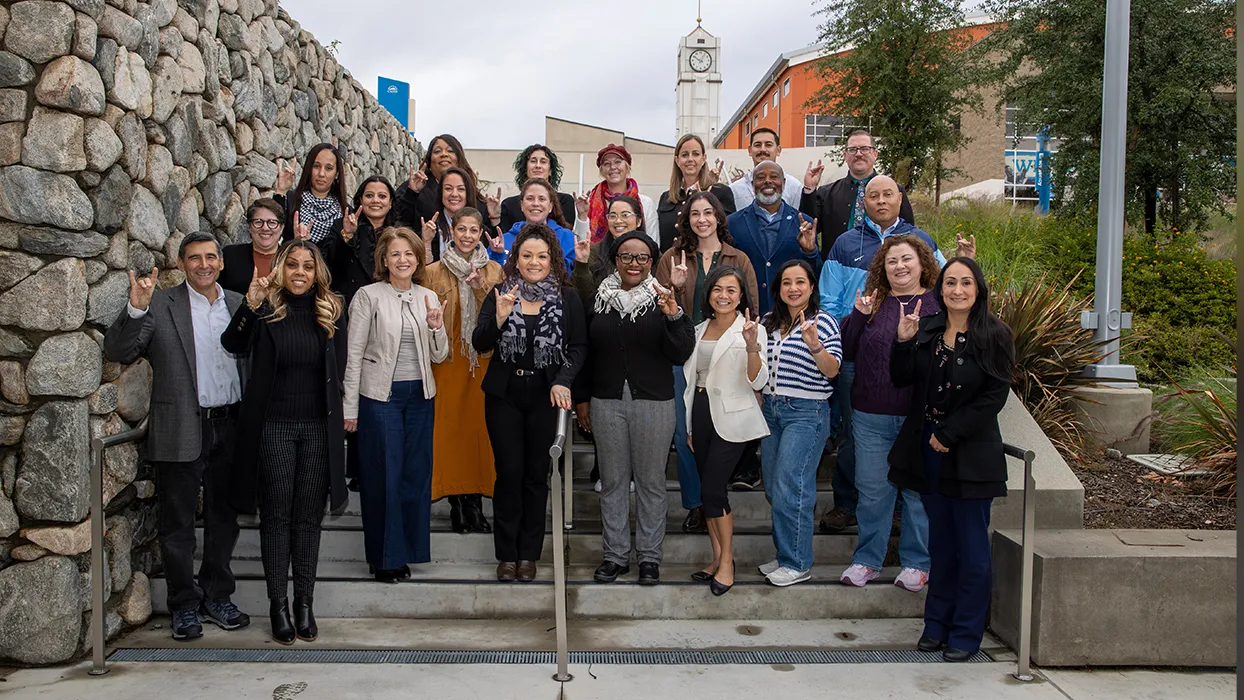
Last year, when a team of university faculty and administrators first imagined creating a leadership academy for Cal State San Bernardino faculty and staff, they weren’t thinking about job titles. They were thinking about potential.
Since stepping into her role as vice provost in 2022, Kelly Campbell, who also serves as senior diversity officer, said creating such a program to empower staff and faculty members to lead effectively from their current positions and to strengthen the university’s talent pipeline was one of her goals.
A relationship scientist by training, Campbell referred to a concept known as the Michelangelo phenomenon — the idea that people are shaped and refined through supportive relationships that help them become their best, or “ideal” selves. The concept offered a compelling framework: What if CSUSB intentionally created space for faculty and staff to grow into the leaders they already had the capacity to be?
That idea became the foundation for the CSUSB Leadership Academy, launched in fall 2025. It’s part of the university’s Strategic Plan for Faculty and Staff Success after Higher Education Research Institute survey findings indicated there was a desire for expanded career development opportunities.
After securing strategic plan funding, a six-member leadership development team was assembled. It included Campell, Rowena Casis-Woidyla, who at the time oversaw staff professional development, Nicole Dabbs, faculty senator and chair of the department chairs, Jordan Fullam, faculty senate chair, Robin Phillips, vice president of human resources and senior diversity officer, and Ted Young, associate provost for faculty affairs and development.
Together, they completed a specialized training and then designed the in-house leadership program tailored specifically to CSUSB, with all sessions facilitated by internal experts familiar with CSUSB’s culture, structure and challenges.
The academy was intentionally designed as a mixed cohort of faculty, staff and a small number of administrators, an approach Robin Phillips believes is central to its impact. “Combining faculty and staff into a single cohort will foster relationships and trust across the institution,” she said. “With successive cohorts participating, it can help impact the university’s culture positively.”
Each fall cohort includes approximately 12 faculty members and 12 staff members, along with several management personnel plan participants. Participants meet for six in-person sessions throughout the fall semester, with additional pre-work and reflection modules completed outside of class time. Sessions focus on leadership values and styles, communication and conflict management, strategic thinking and the development of an individual leadership philosophy.
For staff participant Michelle Bell, executive assistant to the associate vice president and administrator in charge at the Palm Desert Campus, the academy offered far more than she expected.
“It’s a great opportunity to reflect, to step back and just grow,” Bell said. “The sense of community and the shared purpose was amazing. You’re not just learning about leadership in theory. You’re actively growing through discussions, self-reflection and real-world applications.”
Bell admitted she initially questioned whether she belonged in a leadership academy at all.
“I didn’t know if I was going to be the right fit for this,” she said. “I’m not an MPP or a lead, and I kept thinking, ‘Why did Michelle get picked?’ But I learned that it doesn’t matter what your role is. You can be a leader, and you can have influence.”
One of the most meaningful aspects of the academy, she said, was the emphasis on values-based leadership and the creation of a personal leadership philosophy. “We spent a lot of time reflecting on our values and how that shows up in our leadership style and decision-making,” she said. “I’ve always known my core values, but I’d never had the opportunity to really put into words how I want to show up as a leader.”
Bell described the academy as a highly supportive environment. “Right off the bat, it was made clear that this was a safe space,” she said. “You could let your guard down. It didn’t matter if you were staff, faculty or administration. We were all there to grow together, and the academy really met us where we were.”
Learning alongside colleagues from across the university was particularly impactful. “Our paths never would have crossed,” Bell said. “Getting to hear faculty perspectives and talk openly about challenges gave me a whole new level of respect. Building those relationships was priceless.”
Faculty participant Diana Camilo, associate professor in the College of Education’s counseling program, said the academy offered an opportunity for reflection and connection. Having spent much of her career in K-12 education before transitioning to higher education, Camilo applied to the Leadership Academy to better understand leadership within the CSU system and her role in institutional change.
“What stood out most for me was taking the time to look at core values and how those shape your leadership style,” Camilo said. “In organizations, it’s easy to feel like you have to adopt a certain role or personality. The academy allowed me to lean into who I am.”
She also said learning alongside faculty and staff from across divisions helped break down silos. “Once we got into conversations, we realized there was so much commonality in our experiences and in why we do this work,” she said. “Those barriers really started to melt away.”
Phillips noted that those outcomes reflect the academy’s broader goals. Research consistently shows that in-house leadership programs increase employee satisfaction and engagement, she said. At CSUSB, the academy is also about succession planning, relationship-building and strengthening campus culture.
“I believe that happy faculty and staff make for happy students,” Campbell said. “This program is trying to impact students in that way, while also helping people feel confident to apply for that next career step and be successful once they secure it.”
The next Leadership Academy cohort begins in September 2026, with sessions scheduled September 4 and 18, October 2 and 16, and November 6 and 20. Topics will include CSU orientation, leadership paths, inclusive excellence, communication and conflict management, strategic problem-solving and developing individual leadership philosophies and action plans. Applications are due April 3, with notifications of acceptance sent in mid-May.
Both Phillips and Campbell encourage faculty and staff at all stages of their careers to consider applying. “You don’t have to want to be a university president,” Campbell said. “You can have a goal of leading in your current role. If you’re interested in learning how the university works, making positive contributions and making your workplace more productive, friendly and fun, this program is for you.”
For Bell, the impact of the academy has continued well beyond its final session. “The CSUSB Leadership Academy gave me the space, the tools and the perspective to grow as a more intentional and confident leader,” she said. “It reminded me that my work matters — not just my role, but that my voice has value.”