Alan Llavore | Office of Marketing and Communications | (909) 537-5007 | allavore@csusb.edu
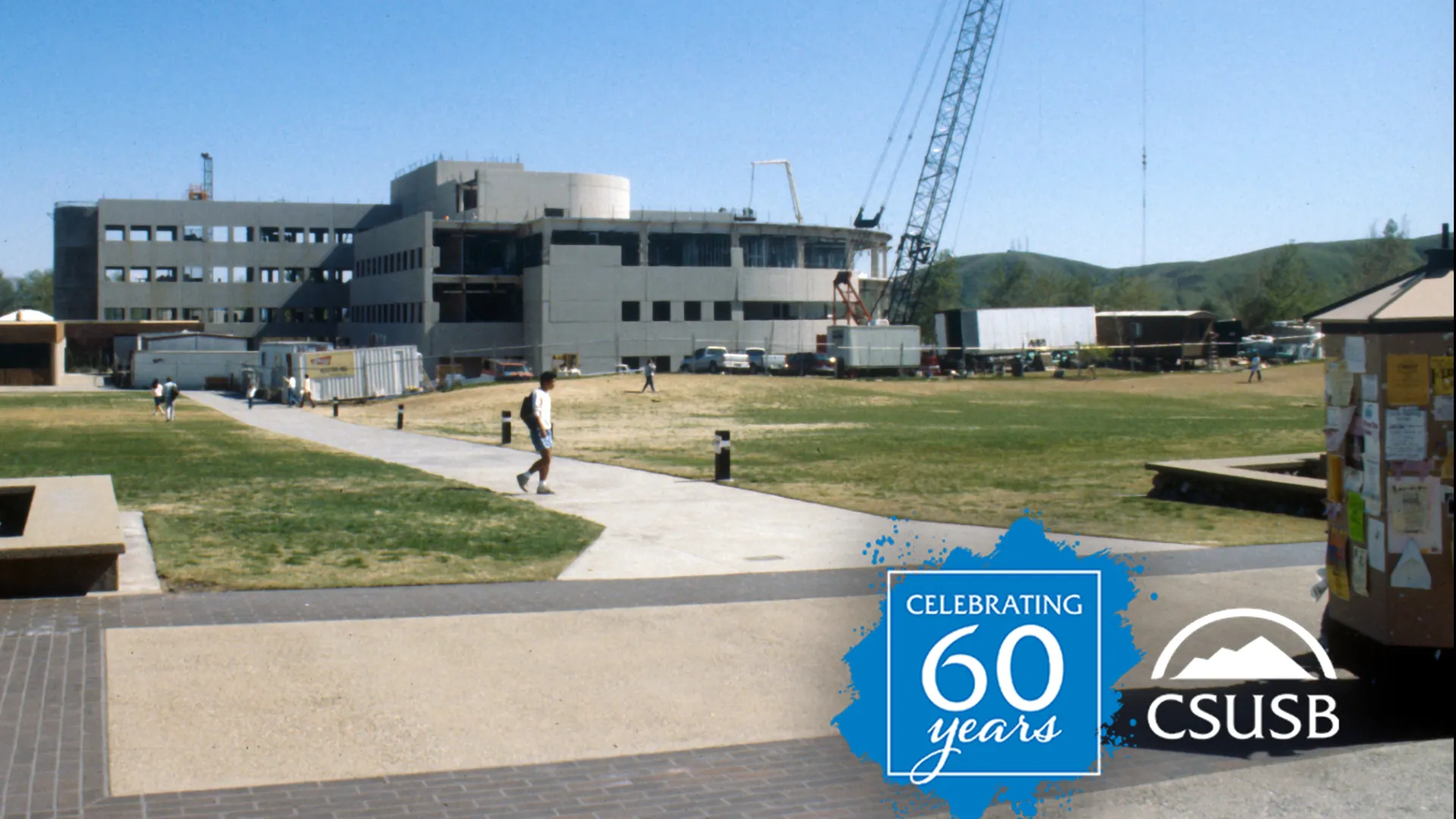
Academic year 2025-26 marks the 60th anniversary of the first classes held on the campus that would come to be known as California State University, San Bernardino. Those 60 years have seen tremendous changes, not only to the campus itself (which has expanded from San Bernardino to an additional, separate campus in Palm Desert) but also to the number of colleges, programs, degrees and students. As the world outside the campus has changed, CSUSB has continued to pursue the heart of its mission: serving the people of the Inland Empire and growing the success of individuals, families and communities through access to an outstanding institution of higher education.
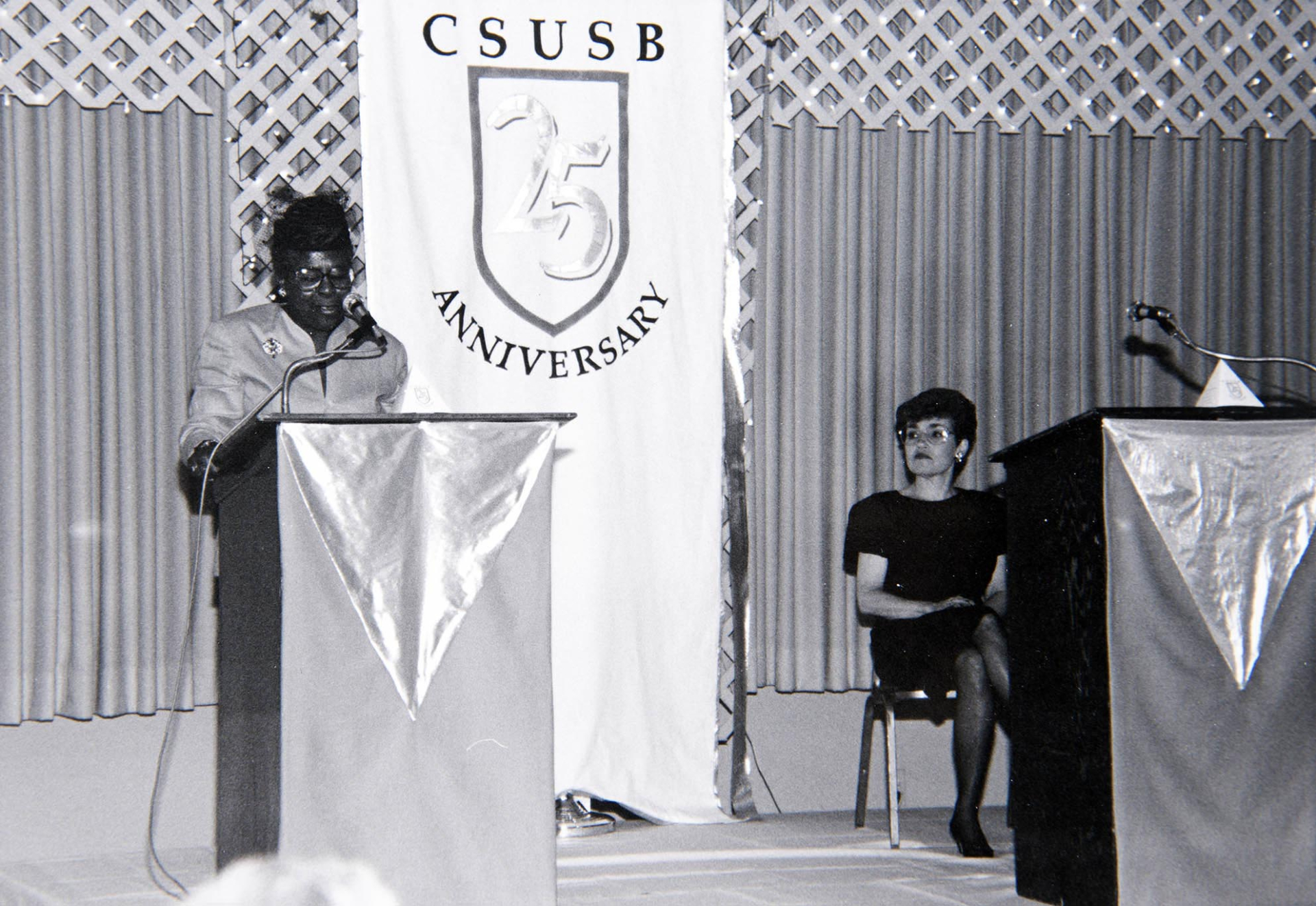
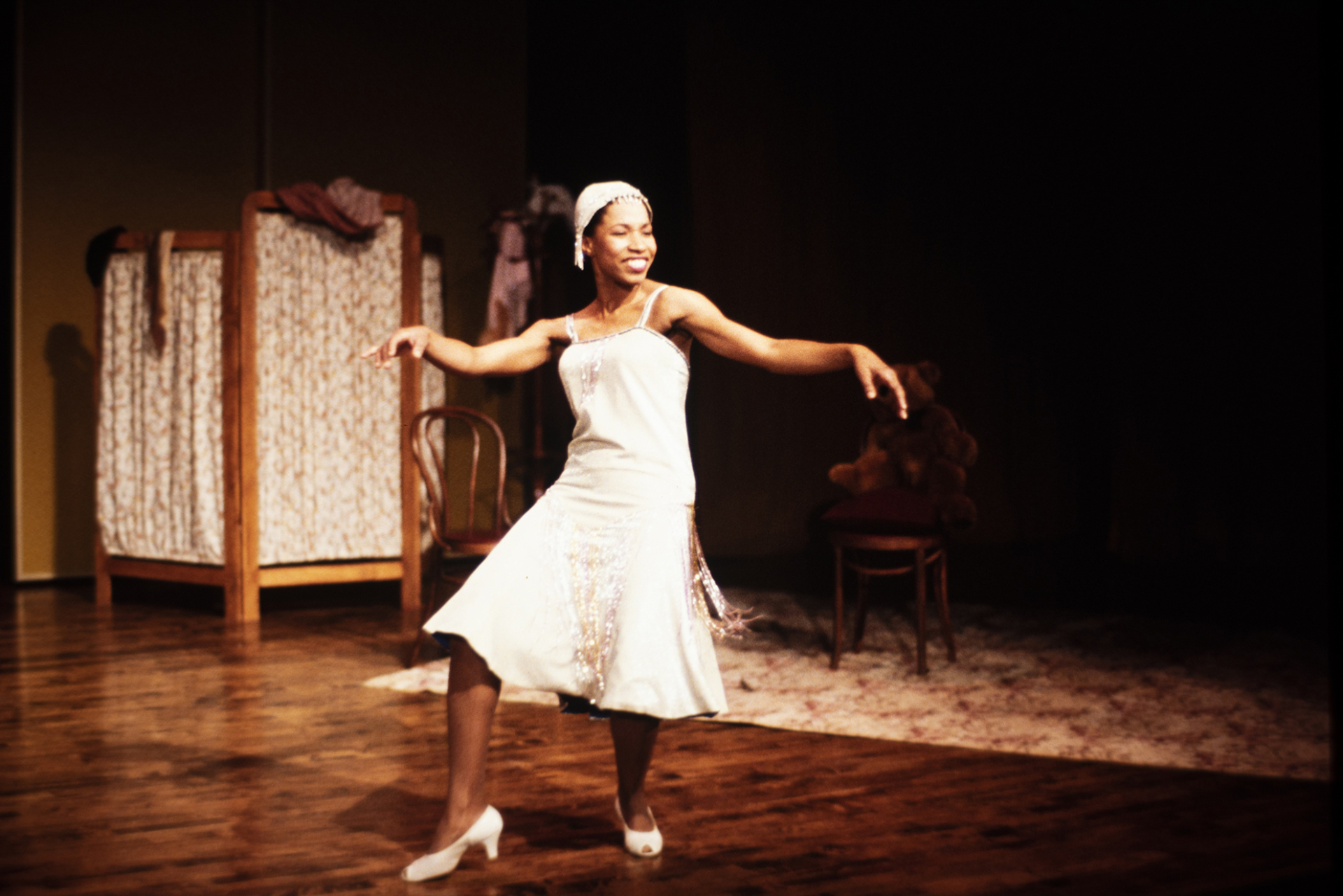
CSUSB celebrated its 25th anniversary in 1990 with a new alma mater and fight song. The John M. Pfau Library acquired its 500,000th volume, and Maya Angelou spoke in the campus gymnasium to celebrate. The California State University Board of Trustees approved plans for the future Jack H. Brown Hall. Construction began on University Hall. The Woman’s Resource Center opened and a CSUSB Honors Program began. Athletics continued to grow with the announcement that the university would move from NCAA Division III to Division II, effective fall 1991, and also affiliate with the California Collegiate Athletic Association. Theatre continued its vibrant presence on campus with “Ethel,” a hit musical based on the life of the blues singer Ethel Waters, starring student Val Limar.
The Foundation building officially opened in 1991, while the CSU Trustees approved the construction of the Health and Physical Education Center and the Visual Arts Center. The campus received a $62,645 matching grant from the National Science Foundation to buy an electron microscope. Men’s basketball repeated as Western Regional champions and finished sixth in the NCAA championship tournament.
University Hall was completed in 1992, which also saw ground broken for the Student Union building addition, and a topping off ceremony for the Business and Information Science building. Smoking was banned in all campus buildings. The CSU Trustees approved naming the Health and Physical Education Complex and Arena after the parents of Nicholas J. Coussoulis. The social work graduate program received national accreditation, and the American Association of State Colleges and Universities presented CSUSB with the Christa McAuliffe Award for its mentorship role with Hillside-University Demonstration School. The University Art Gallery held the official unveiling of 300 Egyptian antiquities from the Harer Family Trust. And “A Warring Absence,” an original play written by theatre arts alumna Jody Duncan and professor emeritus Bill Slout, was performed at the Kennedy Center for the Performing Arts as part of a national theater award for the work. Men’s soccer provided CSUSB with its first championship and hosted the West Regionals.
Jack H. Brown Hall officially opened in 1993, named after the CEO, president and chairman of Stater Bros. Markets. The Coyote Bookstore expanded. A Japanese university provided CSUSB with a $1 million grant to construct the Yasuda Extended Education Building. The CSUSB Model United Nations team won a second “Outstanding Delegation” award at the National Model United Nations conference in New York, representing Iran. The Model UN team would continue to win this award at future national conferences, establishing a tradition of excellence with this program. And the CSUSB Symphonic Band released the first CD ever recorded by the university’s students.
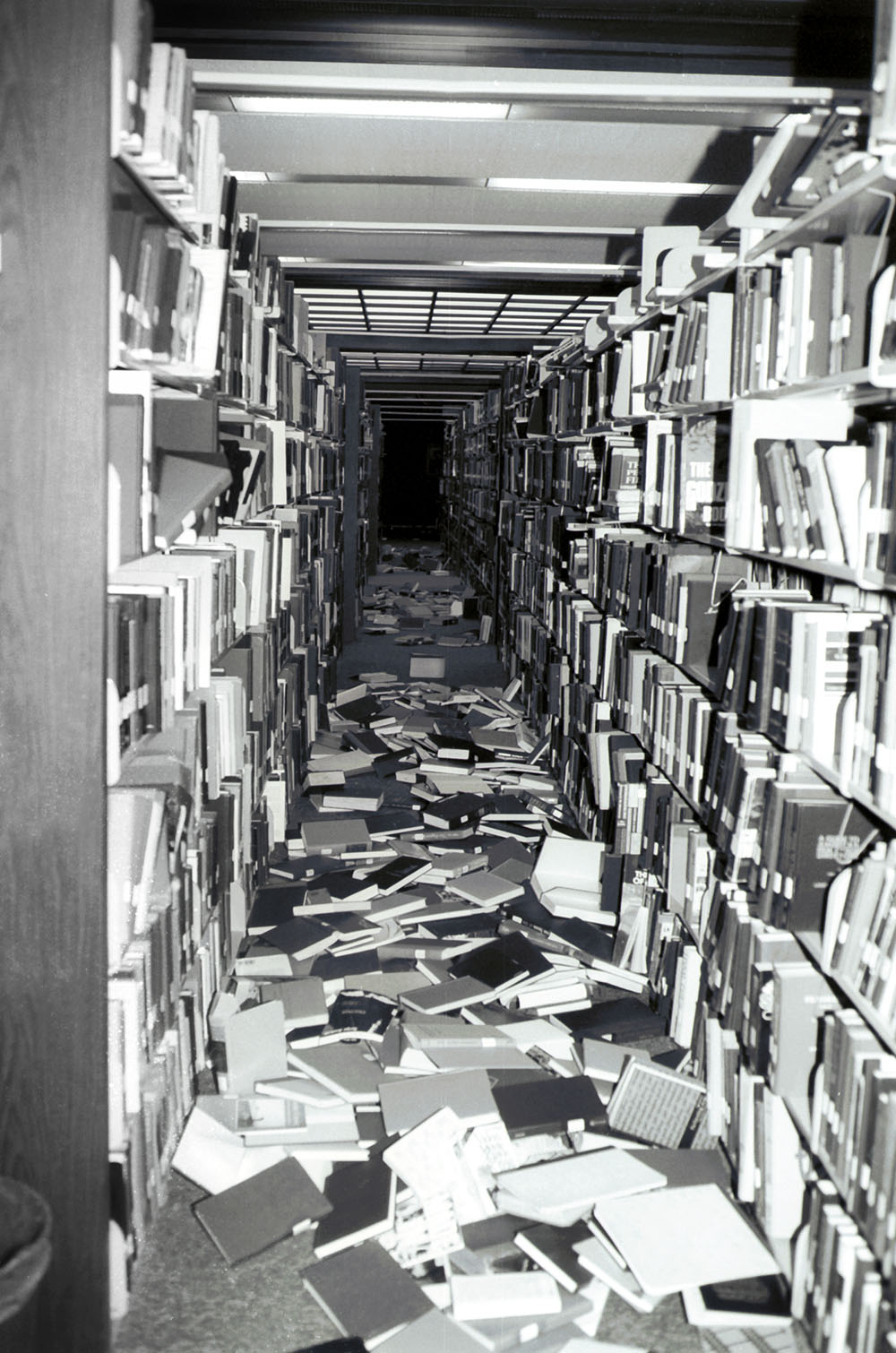
In 1994, the university received reaccreditation by WASC for the maximum 10 years. The graduate and undergraduate programs in the College of Business and Public Administration became the only ones in the Inland Empire to be accredited by the American Assembly of Collegiate Schools of Business. And a society of international scholars, the Gamma Lambda Chapter of Phi Beta Delta, launched for the campus’ international programs. The new Student Union addition officially opened, as did the Pfau Library addition. Thousands of volumes fell off the shelves on the library’s top floor during the Northridge Earthquake; subsequently, the library topped a list of 101 earthquake-vulnerable CSU buildings, per the Los Angeles Times. The Coyote women’s basketball team won the NCAA Division II Western Regional Championship and proceeded to the Elite Eight finals but did not win. And the campus’ radio station, KSSB, officially became known as Coyote Radio.
Coussoulis Arena opened in 1995, with seating for more than 4,100 people, becoming the Inland Empire’s largest indoor arena. It hosted its first intercollegiate athletic event in September, with the women’s volleyball team beating UC Davis. The Yasuda Center for Extended Learning received naming approval from the CSU trustees and opened. A public-private fundraising drive began to raise construction funds to build a permanent satellite campus in Palm Desert, near the intesection of Cook Street and Frank Sinatra Drive. The Annual Student Research Conference celebrated its ninth year. A wildfire in November forced the evacuation of all students and staff in San Bernardino.
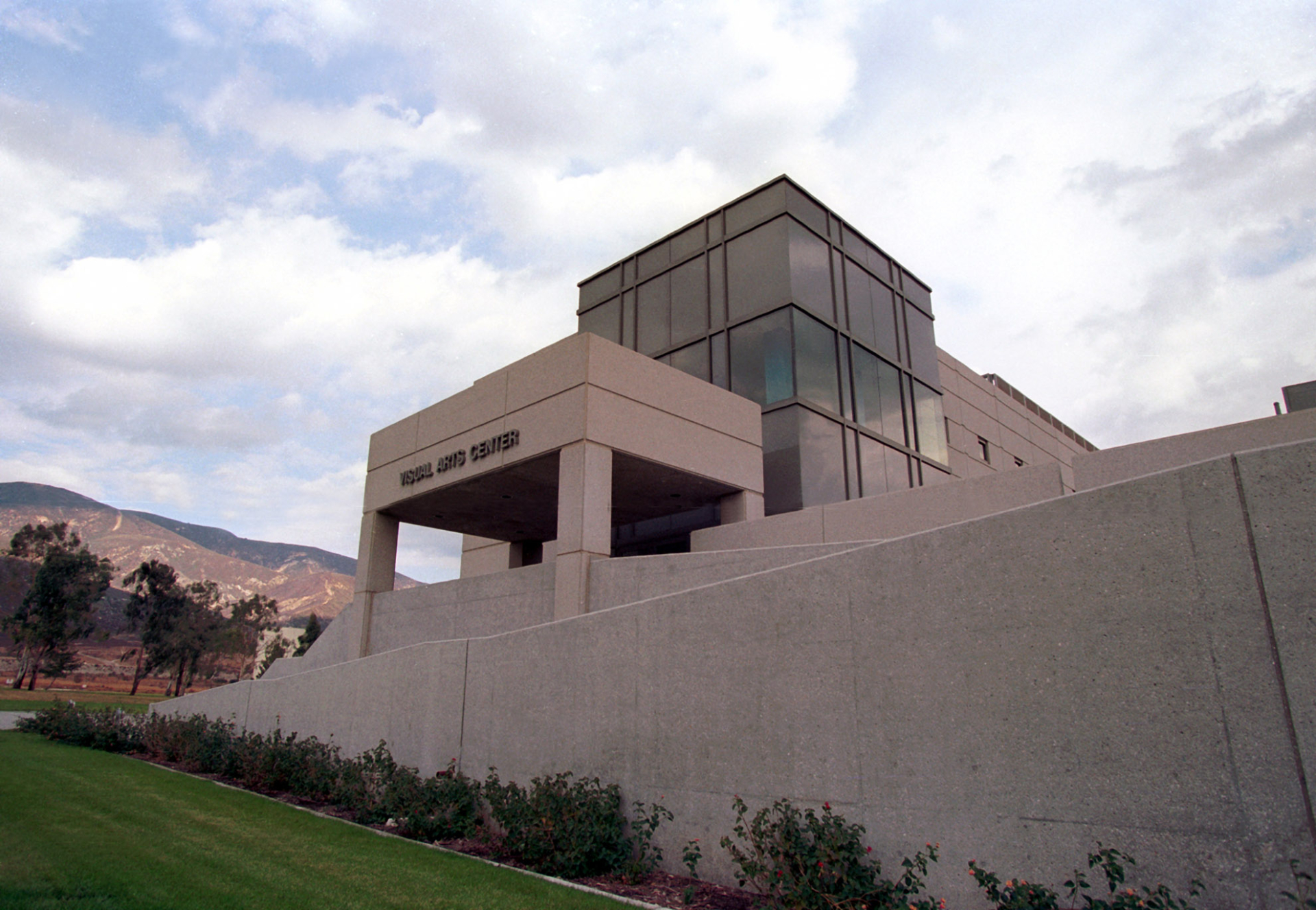
Openings on campus in 1996 included the Visual Arts Center and the Robert and Frances Fullerton Museum of Art. The Art Museum comprised a 4,000-square-foot facility, which included the goal to home priceless Egyptian, Etruscan and Asian antiquities. The official school colors changed from blue and brown to Columbia blue and black. The 30th Commencement was held in the Coussoulis Arena for the first time. The University Seal was updated to make the Pfau Library the central part of the emblem. President Anthony H. Evans announced his impending retirement in mid-1997. Seismic retrofitting of the library began in December.
CSUSB saw the appointment of Albert K. Karnig as the university’s third president; he formally took office in August 1997. The university now offered more than 70 graduate and undergraduate programs, with 13,280 enrolled students. The Pfau Library unveiled its online catalog. The campus received a $3 million cash gift from the Mary Stuart Rogers Foundation to construct the first permanent building on what would become the Palm Desert Campus. In Athletics, Scott Householder, a member of the golf team, became the university’s first national champion, capturing medalist honors in the NCAA Division II championships; the team itself finished third in the tournament.
President Karnig’s presidential installation took place in April 1998. Biology professor Stuart Sumida brought Cal State San Bernardino students to Chicago’s Field Museum to assist in the restoration of “Sue,” the largest T-rex fossil ever unearthed. Athletics continued its wins, with women’s basketball advancing to the NCAA West Region semifinals and the golf team placing third in the NCAA national championship. The CSUSB coyote mascot finally received its name: “Cody.” “The Yeti,” the first CSUSB student-created feature film, premiered on campus; directed and co-written by biology student Ezequiel Martínez, it was shot in the San Bernardino Mountains. The library’s seismic retrofitting project was completed. A groundbreaking was held for the 50,000-square-foot Corporation Yard. The five academic schools, along with Extended Education, became designated as colleges in November.
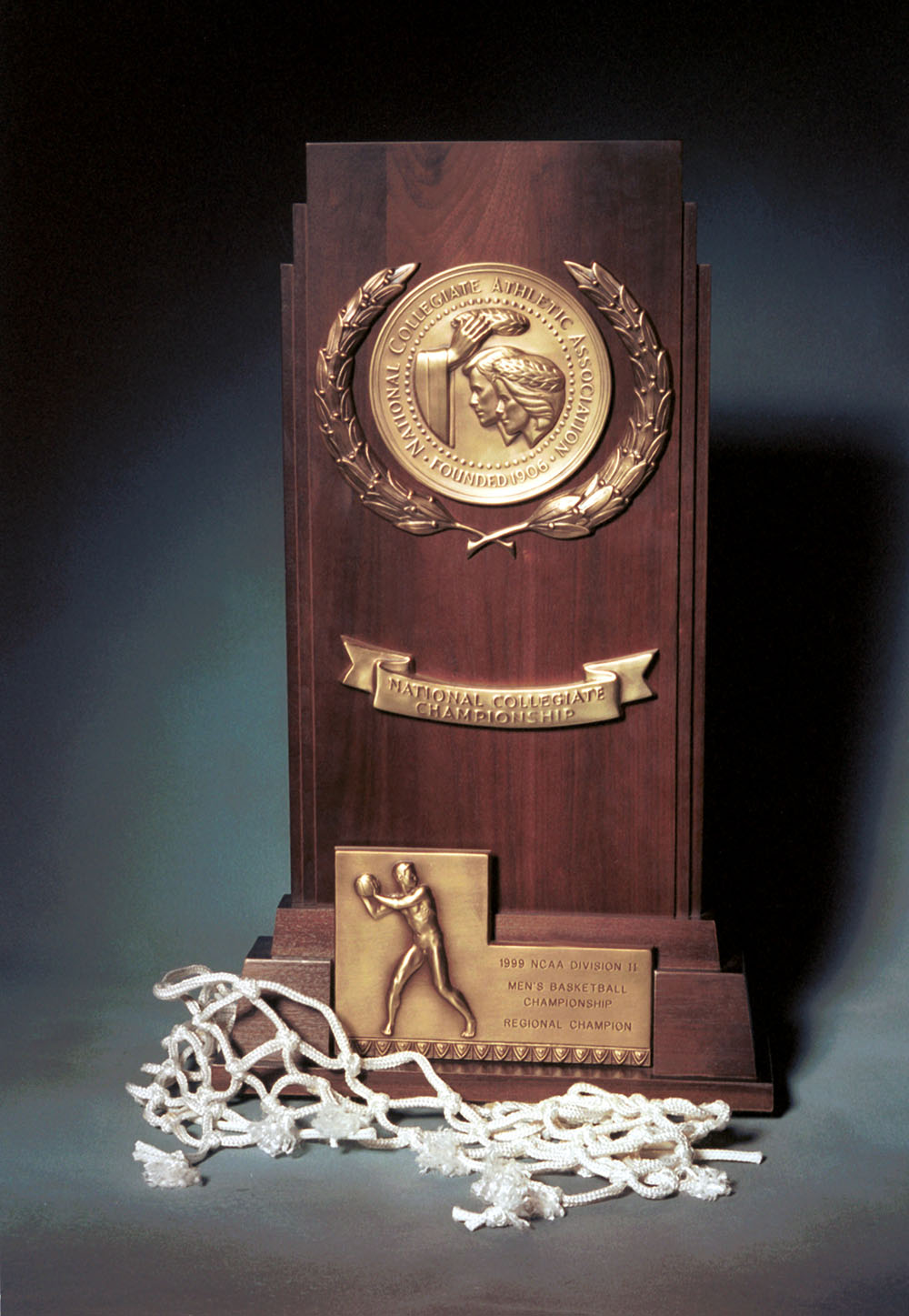
In 1999, the CSU Board of Trustees approved a 10-year master plan for CSUSB, including enrollment goals and capital projects. The Pfau Library was designated as a United States Government Documents depository and the university was named a Hispanic-Serving Institution by the U.S. Department of Education. This HSI designation facilitated the university’s receipt of a $2 million grant, which also spurred the first major campus-wide scholarship fund drive. Diane F. Halpern was the first CSUSB faculty member to win the prestigious $20,000 Wang Family Excellence Award from the CSU. Athletics established the women’s water polo program, giving CSUSB 11 NCAA-sponsored sports teams. Men’s basketball won the NCAA West Regional and advanced to the NCAA Elite Eight quarterfinals. CSUSB received the final gifts to reach the $9 million needed to begin construction of the first building at the permanent site of what would become the Palm Desert Campus.