CSUSB Welcomes Dr. Axelle Brémont as the W. Benson Harer Egyptology Scholar in Residence for Spring 2026!
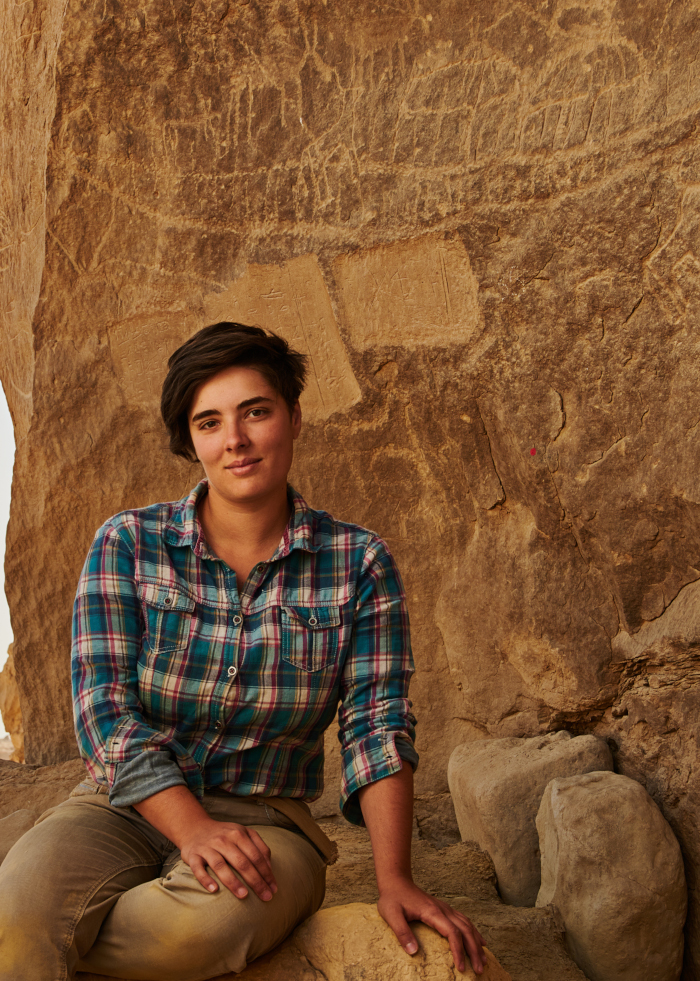
CSUSB is thrilled to welcome Dr. Axelle Brémont as the W. Benson Harer Egyptology Scholar in Residence for Spring 2026!
Find the related campus news item with more images at this link.
Dr. Brémont earned her Ph.D. in Egyptology from the renowned Sorbonne University and brings a wealth of international research and teaching experience to our campus. For the past four years, she has served as a scientific research member at the prestigious Institut Français d’Archéologie Orientale (IFAO) in Cairo—a coveted role among Egyptologists worldwide.
Her groundbreaking research explores the origins of ancient Egyptian art in the Predynastic period, focusing on the powerful intersection of animal imagery and early expressions of royal authority, before the invention of writing. And her research extends into the deserts of Egypt as a member of Yale’s archaeological team studying ancient rock art. In addition to her academic accomplishments, Dr. Brémont has taught at both the University of Toulouse and IFAO, where she is known for her engaging and insightful approach to teaching. Outside of her scholarly work, you might find her in the kitchen, experimenting with new recipes for her fusion Middle Eastern - European cookbook.
Welcome, Dr. Brémont! We’re excited to have you on campus.
***
Additionally, Dr. Brémont will be giving a lecture at RAFFMA on March 10 at 5pm. Find details on the RAFFMA page here, and below.
March 10, talk title: Did a Watched Pot Ever Boil? Detail Analysis & Possible Uses of Decorated Pots in the Predynastic Period
Abstract: This lecture will explore how the Predynastic (ca. 3800-3000 BCE) style of painted pottery known as "Decorated Ware" evolved over the nearly two centuries of its existence. Although these vessels look strikingly uniform at first glance, close study reveals rich detail variation in motif shape and placement, which can be attributed both to regional and chronological factors, and help build a finer chronology of these painted vessels. The lecture will then turn to the people behind the pots. Using style and detail analysis, we identify distinct workshops and explore how painters planned their designs, organized space, and avoided overcrowding or repetition. Finally, we will ask why these vessels were made: how they circulated, whether they had ritual or funerary roles, and what their use marks tells us about everyday life in Predynastic Egypt.